
Discover the honest truth about American Ginseng—the classical cooling and grounding adaptogen prized by the Asian tradition for centuries. Whether you are looking to support a balanced stress response, maintain steady daily energy without the crash, or sharpen your cognitive focus, the secret lies in the maturity of the six-year root. This guide strips away the marketing hype to teach you exactly what American ginseng is, what it does, and how to properly use it for grounded, systemic vitality.


I recorded these audios to directly answer the questions I've received most over the last 26 years. The text below contains the actual transcripts.
Jason J. DukeOwner / Artisan
Reference Directory

Commit to the Practice
Tonic herbalism rewards consistency. The deep, systemic building work happens quietly over a 30 to 90-day cycle of continuous saturation. Supply the raw materials your body needs with our premium 3-pack.
Shop the 3-Pack Formulation1. What is American Ginseng?
So, what is American ginseng, exactly? Is it just Asian ginseng with an American accent? No. Same plant family, same genus even, but a different species with the opposite personality, and that personality is the whole reason this bottle exists.
The botanical name is Panax quinquefolius, and quinquefolius means five-leaved. That's the field mark. Five leaflets fanning off a single stem. And notice where it grows, because location is character with this plant. This is a forest-floor root. It refuses open fields and full sun. It wants hardwood shade, filtered light, cool soil. A shade plant, all the way down. File that away, because that shade is this root's entire personality.
The genus name up top, Panax, is old Greek for all and heal, and both ginsengs wear it. The botanists hung that name on a Wisconsin root on purpose. They knew they were looking at material in the same class as the legendary Asian root. One family, two temperaments.
Classification before benefits, always. American ginseng is an adaptogenic herb, and its energetic is grounding, cooling and calming. Plain English: this is the steadying root. The one that supports a calm, level state instead of pushing output.
Now let me clear up the word everybody trips on. Calming does not mean sedating. This root will not put you to sleep. It maintains a calm, steady state while nourishing energy metabolism. Settled, not sedated. And that one distinction tells you who buys this root. People who run hot. People who lean wired. People who can't take aggressive stimulation without paying for it later. That's the market for this bottle, and it always has been.
Inside that root are the constituents the whole tradition runs on: ginsenosides, specifically the Rb and Re classifications, supplying the raw materials your body uses for energy metabolism and sustained energy. Steady output, no aggressive push. That's the signature of this material, the whole sentence of it.
Here's one more piece of biology, and it explains how ginseng gets graded. A growing root puts a fresh scar on its neck every year, the way a tree puts on a ring. Count the scars and you know the age. Six years, six marks, six seasons of slowly assembling constituents underground. That's the mature grade. Ours is six-year root, and we state it plainly.
But here's the twist. This Wisconsin-grown root is huge in Asia, and it has been for centuries. Most Americans have never once tried the root their own heartland is famous for. That story gets its own piece in this series, because it's one of the great untold trade stories out there.
This is the steady root. The practice is what makes it work.
Benefits accumulate over time.
2. Where Does It Come From?
Where does American ginseng come from? Short answer: Wisconsin. Real answer: a three-hundred-year story that starts with a hunt in the woods.
First, the facts, straight. This is one hundred percent American ginseng root, Panax quinquefolius, Wisconsin grown, six-year roots. Those three belong together for a reason. Wisconsin is the heartland of this crop, and especially one county, Marathon County, where families have been growing ginseng under shade canvas for generations. The great majority of America's ginseng comes out of that one county, and the great majority of it ships straight to Asia. Sit with that one a second, because we'll come back to it.
Now the root itself. Every year a growing root adds a scar to its neck, like a tree ring, so a six-year root carries six marks. Six seasons underground, slowly building its constituents. That's the mature grade, and that's what's in the bottle.
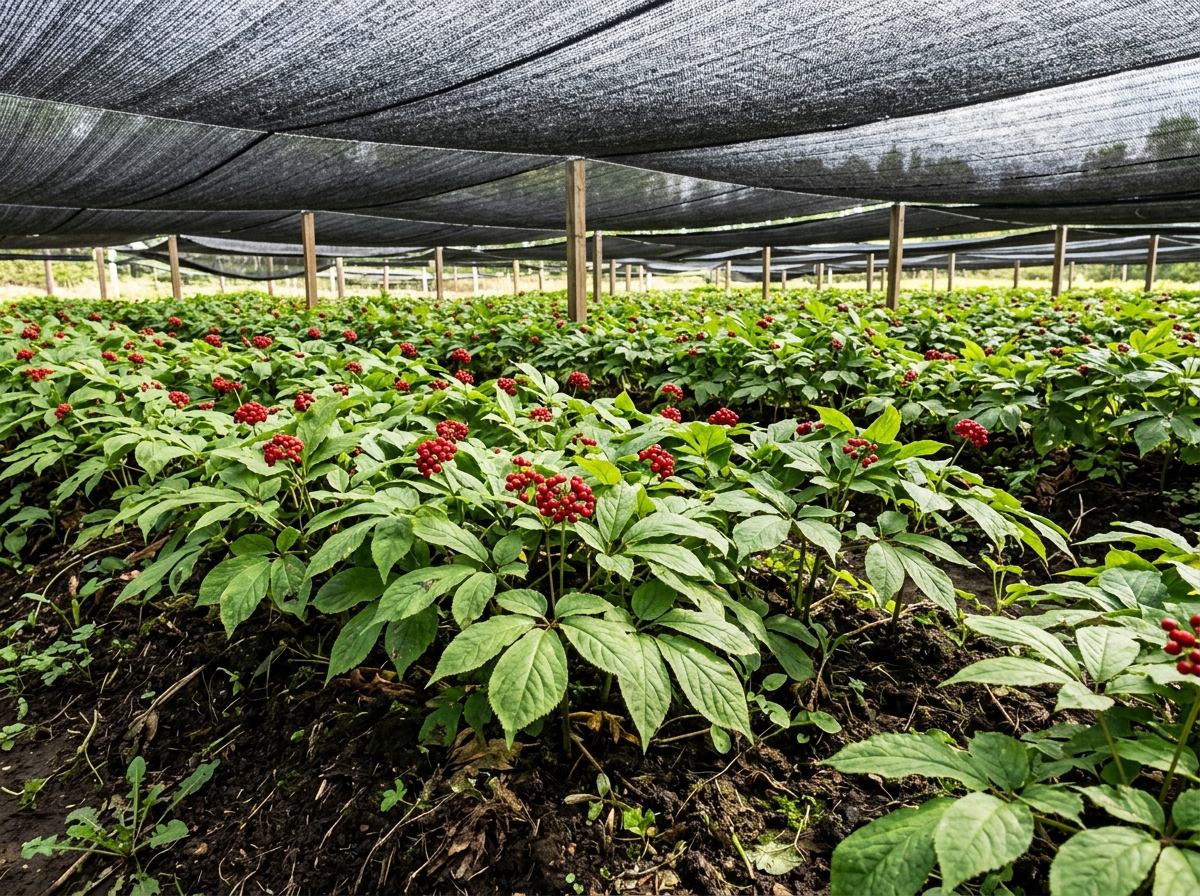
And remember, this is a shade plant. It will not grow in an open field, period. So Wisconsin growers build the forest. Long shade canopies stretched over the beds, recreating the understory, because the root refuses anything else. A ginseng farm is a hand-built forest floor. That's the level of craft behind every field of this crop.
Then the extraction, built to respect the material. Every batch is custom crafted, multi-step, and micro-batched. Structured distilled water and triple filtered USP grade organic alcohol at twenty-five percent by volume. The water pulls one class of constituents, the alcohol pulls the other, and the whole process stays cold, unheated, so the fragile constituents hold their shape in fluid suspension for maximum absorption.
The ratio is right on the label: one pound of root to one quart of liquid. That works out to about forty-five thousand milligrams of ginseng extracted into every two-ounce bottle. Nothing hidden, nothing dressed up.
And the taste tells on it. This extract comes out thick and strong, and thickness is the fingerprint of raw botanical material. The more you taste the stronger it is. A clear, thin tincture tastes like exactly what it is: mostly nothing.
Quick history note, because people ask. American ginseng turned up growing wild in North America in the early seventeen-hundreds, and within a generation it was on ships headed for China, one of the founding trades of the young republic. The full timeline gets its own piece in this series, and it's worth the listen.
Good root, honestly grown, carefully pulled. That's where it comes from.
Taken consistently over time.
3. What Does It Actually Do?
What does American ginseng actually do in your body? Let me skip the list and give you one picture, because the picture is the mechanism.
A thermostat. It doesn't blast hot, doesn't blast cold. It holds a set point. That's this root in one image, and the rule underneath never moves: the root supplies the raw materials. Your body maintains the set point.
Start with energy, since that's the first thing everybody wants, and here's the honest version. The ginsenosides, specifically the Rb and Re classifications, supply the raw materials required for energy metabolism and sustained energy, supporting efficient cellular function. Your body holds its own steady metabolic output instead of riding a spike and then paying for the crash. What that looks like in real life: energy that carries you through the afternoon without borrowing from your evening.
Next, the mind. Your nervous system runs on communication between nerve cells, and specific ginsenosides help maintain that communication, supplying what's required for focus, memory, and mental clarity. This is the quiet kind of sharp. Processing information effectively, decision after decision, without the engine running loud.
Then the immune system, and this is the part almost nobody talks about. The complex polysaccharides and peptides in the root nourish your white blood cells, giving them the nutritive support your body uses to identify foreign material, contain it, remove it, and keep tissue clean. A balanced, adaptive immune response, fed from the inside.
Now the anchor, because this is the heart of the root. As a grounding, cooling and calming adaptogen, the broad spectrum of ginsenosides steadies the neuroendocrine system, the network of glands. That interaction provides the building blocks required to maintain hormonal balance, helping your body adapt to whatever the day throws and buffer everyday wear and tear. Think keel, not engine. It keeps you upright in choppy water without slowing the boat.
Two quieter mechanisms finish the picture. Specific ginsenoside profiles support healthy glucose utilization, promoting steady blood sugar levels for cellular homeostasis. And the bitter constituents of the root support the production and activity of digestive enzymes, so your body can actually pull the nutrients out of complete balanced meals. The root feeds the machinery that turns food into fuel.
And one thing it flat out does not do. It does not create energy out of thin air. It assists your body in efficiently using the food you eat. So the meals aren't optional furniture here. They're the fuel.
Supply, and maintain. Feed the set point, and the body holds it.
Benefits accumulate over time.
4. Who Is It For?
Who is American ginseng actually for? Let me tell you who buys it, because it's not who the marketing usually points at. This is the desk-and-backpack bottle. The root for people who run hot.
The office worker, first, because that's the most common buyer. Sitting all day, staring at screens, and somewhere around two in the afternoon the day starts fading, and the third coffee is sitting there staring back. That third coffee is a loan against your evening. American ginseng supports healthy blood flow to the brain and steady energy metabolism, nourishing the communication between nerve cells for focus and mental clarity. The bottle sits next to the keyboard, and the afternoon stops being a cliff.
The student. Late nights over textbooks, assignments stacking up, a brain asked to hold focus long past its natural hours. This root gives the nervous system the nourishment it needs to stay mentally sharp and keep processing information without cranking the engine. The bottle rides in the backpack.
The worker on their feet. Standing through a whole shift, steady output all day. American ginseng supplies the raw materials to maintain that output and delay fatigue during physical activity. The bottle lands in the lunch pack.
The high-stress buyer, and this one's the flagship. Chaotic days, dealing with people all day long, trying not to get annoyed. The grounding, cooling properties help maintain a balanced stress response, steadying the neuroendocrine system so the day can keep coming without you riding every wave. The even keel holds.
And the traveler. Long transit, jet lag, environments that don't cooperate. The grounding properties help your body adapt and hold systemic balance when the schedule's sideways and the time zone is wrong. This one gets zipped in the carry-on.
Now the athlete angle, stated honestly, because the page serves it. Waking up stiff, trying to keep pace with a training schedule: this root drives steady metabolic output and adaptation to physical activity. Steady adaptation, not fire. The fire-and-drive job belongs to the warming root, and that's the honest redirect.
Right root, right constitution. If you run hot, lean wired, and want calm steady energy, this is your bottle. If you run cold and want drive and lift, the warming counterpart, Panax red ginseng, is the honest answer, and plenty of people keep both and take them at different times of day. That routing gets its own piece in this series.
One last aside, because it earns its spot. This root suits the summer months and the run-hot seasons. Cooling and grounding is the character, and the character works year round, but summer is where it shows up most obvious.
Taken consistently over time.
5. How Do You Take It?
Tonic Synergy & Timing: We remind you that with consistent use, benefits accumulate over time.
For rapid mucosal assimilation, we recommend taking it on an empty stomach (up to 30 mins before eating), followed by a complete balanced meal to provide the heavy building blocks (proteins/fats) your body requires to sculpt and refine itself.
This is American ginseng liquid extract, the general-use tonic in a two-ounce bottle with sixty dropper servings.
One dropper is one press of the rubber bulb, which fills the dropper tube to just above half-way. That's thirty drops, which is also one milliliter.
To find a functional dose, start with a minimum dose of ten drops to one dropper and work up. We suggest ten drops to one to three droppers, taken one to three times per day, which is two hundred fifty to two thousand two hundred fifty milligrams daily.
Now, the bottle has two jobs, and it's worth knowing both. For immediate impact, hold one to two droppers under the tongue, sublingually, for fifteen to thirty seconds. Longer isn't necessary. For tonic building, to continually saturate your system and build deep, long-term health, take one to two droppers with meals, or up to two to three droppers with your largest meal.
And here's a freedom worth knowing, because it's part of this root's character. American ginseng is cooling and calming, not warming and driving, so you can take it any time of day. Afternoon, evening, whenever the steady state is wanted. The warming roots want a morning cutoff. This one doesn't have one. But hear the other half of that rule just as plainly: any time of day does not mean instead of meals. The root doesn't demand to be taken with the meal, but it never promotes skipping meals either. The fuel comes from complete balanced meals, always.
Shake gently. Secure the lid and turn the bottle over back-and-forth three to five times to evenly distribute the liquid extract. Vigorous shaking oxidizes the volatile constituents, so don't do that.
By mouth: hold the liquid under the tongue for fifteen to thirty seconds before swallowing, or mix the drops into two to four ounces of lukewarm drinking water. Never boiling water. Boiling water alters the delicate volatile compounds.
Timing, plain and simple. For rapid mucosal assimilation, take it on an empty stomach, up to thirty minutes before eating, followed by a complete balanced meal to provide the heavy building blocks, the proteins and fats.
One practical note, because it catches people off guard. This extract comes out thick, and thickness is the fingerprint of the raw botanical material, the polysaccharides and the ginsenosides in suspension. That's normal, not a defect. Storage is easy: an opened bottle holds about thirty to forty-five days. Unopened, about two years from the batch date. Keep it dark and cool.
If it didn't sit right, try again at a lower dosage and with a complete meal.
Some effects are immediate within the first few days. Consistency at a functional dose is what builds the rest.
6. How Long Until You Notice Results?
How long until you notice something from American ginseng? Most-asked question about any tonic, so here's the straight answer, in three windows.
Some effects are immediate within the first few days, one to three days. That's the felt layer. The subtle lift in energy and concentration, the sense of staying level when the day gets loud. Subtle is the honest word for this root, and subtle is not the same as nothing.
Other effects and benefits are building, and become noticeable within one to two weeks. The steadier afternoon. The mood that stays level. Energy that shows up without the jitter. The deeper work doesn't announce itself. It stacks up underneath, quietly, while you go about your life.
Then the long game. The systemic shifts and the deeper hormonal benefits arrive as you continuously saturate your body over a thirty to ninety day cycle. That's how every tonic works. You're feeding a system that puts materials to use on its own schedule. The body doesn't take orders. It takes deliveries.
A good tonic cycle is thirty to ninety days. That's not a sales line; that's just how tonics work. A tonic is a practice, not an event.
And you gotta take enough to make it work. The more you take, the better it works. Not enough doesn't work. Someone can only take so much of anything at any one time, so enough is the target, and consistency is the vehicle that gets you there.
Nothing is a quick fix. Anyone selling a quick fix in a bottle is selling snake oil. Tonics reward time, not dosage.
And keep the foundation under all of it: complete balanced meals, every time. Skipping meals and eating incomplete meals will lead to ineffective results. The tonic rides on food; it doesn't replace it.
Benefits accumulate over time.
7. Safety and Quality
Is American ginseng safe, and how do you know you're getting a quality bottle? With this root, those are the same question, and the answer isn't a promise printed on a label. It's the age of the root, the honesty of the sourcing, and the craft.
Start with the markers that matter, stated straight. Species named: Panax quinquefolius, one hundred percent root, nothing else in the bottle. Source named: Wisconsin grown, the heartland of the American crop, generations of shade-canvas farming behind it. Age named: six-year root, the mature grade, six seasons of constituents assembled underground. Most commercial ginseng never tells you the age of its root. There's a reason they don't volunteer it.
Then the craft. Every batch is custom crafted, multi-step, and micro-batched, extracted with structured distilled water and triple filtered USP grade organic alcohol at twenty-five percent by volume, cold processed so the fragile constituents hold their integrity in fluid suspension. The ratio is honest and heavy: one pound of root to one quart of liquid, about forty-five thousand milligrams in every two-ounce bottle. Rapid, high bioavailability, and the full extraction and lab methods are published on our standards page, if you want to see exactly how the work gets done.
And your own tongue is the lab. A real extract of this root is thick and strong, and thickness is the fingerprint of raw botanical material. The more you taste the stronger it is. A clear, thin tincture is mostly what it tastes like: mostly nothing.
Now, honest use, plain and simple. This is a cooling, calming root, which means you can take it any time of day, and that flexibility is part of the character. But flexibility on the clock is not flexibility on the plate. The root never promotes skipping meals, and the steady state rides on complete balanced meals underneath. And generally, this formulation may be taken with other dietary supplements. As food added to the diet, it works synergistically with other formulations.
One piece of doctrine to keep the whole thing straight. Herbs are always more effective and more powerful in the long-term for supporting health, whereas drugs are always more effective and more powerful in the short-term for treating diseases, conditions, and any emergencies. Do not use an herb when one should use a drug, and do not use a drug when one should use an herb. Each has its own job, and this bottle's job is the long term.
And the price. You shouldn't pay a lot for ginseng mystique, because this is a farmed crop with a real commodity market behind it, not some rare treasure. Pay for the root and the craft, not for the story.
Be the Best and Buy the Best.
It is important to do your own research. Health is the most valuable asset of one's life and the most valuable investment.
8. Intimacy & Calm Deep Dive
Can American ginseng support intimacy? Fair question, and it deserves the honest version, because this is the cooling root, and the honest answer runs through calm, not heat.
Start with something worth noticing. People reach for ginseng for connection in every culture that has it, all over the world. Always been that way. But the marketing only ever sells the fire side of the story, the drive side, and that's only half the picture. Connection has a quiet half too, and the quiet half is where a lot of people actually live.
Think about who buys this root. People who run hot. People who lean wired. People whose engine idles high all day, so by the time evening comes around, the system is humming and the last thing the body wants is to settle in and connect. Being wound up is the enemy of presence. Everyone knows this from the inside.
So the mechanism, told plainly. Intimacy depends on two foundations: a settled nervous system and a well-fed endocrine system. American ginseng works on both. The grounding, cooling properties ease the wired state, helping your body hold a balanced stress response instead of riding every wave of the day. And the broad spectrum of ginsenosides steadies the neuroendocrine system, the network of glands, supplying the building blocks required to maintain hormonal balance. Calm enough to be present, fed enough to have the energy for it. Both halves.
And the teaching that makes sense of the hormone half: hormones are built, not summoned. Did you know that testosterone and estrogen are over ninety-five percent cholesterol by weight? The glands are factories, the material is the delivery, and the factories build what the body calls for, nothing more. Which means the plate matters. Taking a hormone tonic without saturated fat and cholesterol will negate the effects. Eggs with soft yolks, so as not to denature the cholesterol. Salt your eggs for stomach acid to absorb the protein, vitamins, fat, and cholesterol. Skipping meals and eating incomplete meals will lead to ineffective results. An empty loading dock builds nothing.
And here's the timing bonus, because it's part of this root's character. The warming ginsengs want a morning cutoff. This one doesn't have one. Cooling and calming means evening-friendly, so the bottle that supports the calm half of connection doesn't have to fight the clock to do it.
Now the honest redirect. If what you're after is fire and drive, the ignition root, that's the warming counterpart, Panax red ginseng, and that's a real job for a real bottle. Some couples keep both and split the day. But for the run-hot constitution, the wired-evening crowd, the people whose problem isn't the spark. It's the idle. This is the steady side of that picture.
The foundation builds over the cycle, thirty to ninety days of continuous saturation, with complete balanced meals underneath. Not overnight. Underneath.
Taken consistently over time.

9. The Eating Protocol
What should you eat while taking American ginseng? Let me put the headline up front, because it decides everything else: this is the steady-fuel root, and steady fuel comes from steady meals.
Here's the core of it. Specific ginsenoside profiles in this root facilitate healthy glucose utilization, promoting steady blood sugar levels. Plain English: the root helps your body use the fuel you eat without riding the spikes and the crashes. Now notice what that means for the plate. The root works on the level. If you feed the day sugar spikes and skipped meals, you're asking a thermostat to hold a set point while somebody keeps slamming the windows open and shut. It can't hold what the inputs keep breaking.
So the meals, stated straight. Complete and balanced, every time: protein, fat, and carbohydrate together. The body requires macronutrients, protein, complex carbohydrates, and healthy fats, to recover and rebuild. And this root makes the meals matter more, not less. The bitter constituents support the production and activity of your digestive enzymes, so your body can actually pull the nutrients out of what you eat. The root feeds the machinery that turns food into fuel.
Protein gets the rhythm. The body can't bank protein the way it banks fat, so the target is protein every four to six hours: at breakfast, through the day, complete meals carrying it. The most important nutrient for the body is protein, which must be consumed consistently at every meal.
Breakfast sets the tone, and eggs are the flagship. Two to six eggs, and the rule scales with the body: the more you weigh, the more eggs. Keep the yolks soft, so as not to denature the cholesterol. Salt your eggs for stomach acid to absorb the protein, vitamins, fat, and cholesterol. Coffee alongside is fine. No ritual crisis required.
And here's the part that surprises people. The steadier the fuel, the better this root shows. People who buy it and eat right report the difference inside a week or two: the afternoon that doesn't cave, the mood that stays level. Same root, same dose, different plate, different experience. That's not magic. That's the set point finally getting steady inputs.
Because the honesty underneath never moves: it does not create energy out of thin air. It assists your body in efficiently using the food you eat. The meals are the fuel. The root is the hand on the thermostat.
Skipping meals and eating incomplete meals will lead to ineffective results.
Food and supplements work together. They meet in the middle.
Food heals.
10. The Six-Year Root
Six years. That's the number almost nobody prints in this market, and it's the whole grade of the material. Let me tell you what those six years actually are, and how you can check them yourself.
A growing ginseng root adds a scar to its neck every year, the way a tree adds a ring. Count the scars, and you know the age, no lab required. Six scars, six seasons, six years of the plant slowly assembling its constituents underground. Age isn't marketing here. It's botany. You can read it off the root the way you'd read rings off a stump.
And this plant doesn't rush anything, anywhere in its life. Here's a piece of biology most people never hear. A ginseng seed doesn't sprout the spring after it drops. It sits through roughly two winters first, a dormant stretch the growers call stratification, before it's ready to wake up. The plant takes its time before it even starts. Then it spends years in the shade building toward the mature grade. Patience is the whole species' personality, from seed to harvest.
So why six? Because that's how long the plant takes to build the complete range. At six years, the root carries its full holistic constituent matrix, everything the seasons assembled. A younger root is a thinner version of what it becomes. And the difference isn't cosmetic. The mature root carries constituents the young root simply hasn't made yet.
Now here's the lowdown on the market. Most commercial ginseng never tells you the age of the root. Big labels, heritage branding, impressive packaging, and nowhere does it say how old the root actually was at harvest. There's a reason they don't volunteer it.
Ours is stated plainly: six-year root, Wisconsin grown, the mature grade. And the craft honors it. One pound of root to one quart of liquid, cold processed, so the six years of work arrive in the bottle intact. About forty-five thousand milligrams in every two-ounce bottle.
The taste backs the story up. The more you taste the stronger it is. A six-year root extracted properly comes out thick and strong, the kind you can still taste minutes later. Age shows.
So when you're shopping this category, ask the one question the labels are hoping never comes up: how old is the root? Six scars or silence. The label answers it one way or the other.
Be the Best and Buy the Best.
11. Red vs. White vs. American
Red, white, American. Three bottles on the shelf, and half the explanations online make it sound like three different plants. It's simpler than that, and more interesting. Let me line them up from the American side, since that's the bottle we're standing on.
This one, American ginseng, is its own species: Panax quinquefolius, the forest-floor root of the eastern woodlands. Cooling, calming, grounding. The steady root. That's the personality, and the personality is the whole point of the species.
Red and white are the same plant as each other: Panax ginseng, the classical Asian root. The difference between those two is fire. White ginseng is the root harvested and simply air-dried, carrying its original constituents. Red ginseng is that same root, steamed and dried, and the heat rearranges the ginsenosides into new secondary forms. The red color is the visible mark of the change. Same root, two personalities: white leans gentle, red leans invigorating.
So really, the shelf holds two plants and three personalities. And the tradition sorts them the practical way, by constitution. If you run cold and want drive, lift, mornings, fire: red is the honest answer. If you run hot, lean wired, want calm steady energy and something you can take in the evening: this bottle, the American root. Same family, opposite temperaments. Some people keep both and take them for different jobs at different hours. That's not indecision. That's knowing the tools.
Now the history, because it's a good one, and it belongs to this root more than people know. American ginseng turned up growing wild here in the early seventeen-hundreds, and the trade to China built itself almost overnight. After the Revolution, one of the first American ships to reach China, the Empress of China, sailed out of New York in seventeen eighty-four carrying ginseng among her cargo, and the trade never really stopped. Even Daniel Boone ran ginseng expeditions, digging it out of the Appalachian woods, and once lost a whole boatload of it in a river accident on the way to market. Two and a half centuries of this root crossing the Pacific, and most Americans have no idea their own woodlands were famous in Asia for it.
That's the standing joke of the whole category. The East has prized the American root for centuries. The West mostly forgot it had one.
Right root, right constitution, right hour of the day.
12. Ginseng and Coffee
Can I take American ginseng with my coffee? That question comes from almost everyone who buys this root, because the office crowd is exactly who this bottle is for, and the office crowd runs on coffee. So here's the honest answer, and then the interesting one.
The short answer: yes, they get along fine. The coffee does what coffee does, and the root does what the root does, and neither one cancels the other. No timing conflict either. This is a cooling, calming root, so there's no morning cutoff, no don't-stack-the-stimulants rule. You can take them in the same hour if you want.
The interesting answer is what happens when you notice the difference between the two, because most people have never actually felt a non-caffeine energy source before.
Here's the distinction that matters. Coffee borrows energy. It pulls output forward and charges you for it later, and the interest rate is the three o'clock slump and the four o'clock third cup. That third cup is a loan against the evening. Everyone in an office knows the shape of this cycle.
American ginseng doesn't touch the account. The ginsenosides, the Rb and Re classifications, supply the raw materials your body uses for energy metabolism, so your body holds its own steady output instead of borrowing. The coffee makes the spike. The root holds the level. Two completely different jobs.
So what do people report, over the cycle? The coffee stops being the plan. Mornings keep their cup because they like the cup, and the afternoon stops needing one at all, because there's no slump left to fight. The root didn't do anything to the coffee. It just turned the coffee back into what it was supposed to be: a thing you enjoy, not a thing you owe. And some people find themselves naturally drinking less, without ever deciding to. That's not willpower. That's a set point that finally holds.
Two practical notes. First, don't skip the meals under either one. Coffee on an empty stomach is a spike with no floor under it, and this root works with glucose utilization and steady fuel, which means the complete meals, protein, fat, and carbohydrate together, are what the whole stack rides on. Second, if you're sensitive to caffeine, you already know your own cutoff for coffee. This root won't fight it either way.
Enjoy the cup. Feed the meals. Let the root hold the level.
13. Will It Keep Me Up At Night?
Will American ginseng keep me up at night? Straight answer: almost certainly not, and that's not a side note. That's one of the biggest differences between this root and its famous warming cousin, and it flips the whole timing question on its head.
Here's why. Red Panax ginseng is invigorating and warming, so it wants a morning slot and a midday cutoff, because the lift it gives holds for hours. American ginseng is the opposite temperament: grounding, cooling and calming. It steadies the system instead of pushing it. There's no morning cutoff on the label because there doesn't need to be one. Afternoon, evening, whatever your day asks for.
So flip the question, because for this root the flip is the good news. When is the evening dose actually useful? When the mind is still humming at nine at night. The wired constitution, the run-hot crowd, the people whose engine idles high and takes hours to wind down. The grounding properties help the body ease out of the day's tension and hold a balanced state. For that crowd, the evening is this root's home field, not a danger zone.
Now the honest caveat, because unique constitution is real. A small number of people notice any support of energy metabolism as a touch of alertness, same as they'd notice it from a strong meal or a good night of sleep. If that's you, you'll find your line inside the first few days. Start low, pay attention, and dose where it serves you. That's the whole discovery process for any tonic.
But for most people who buy this root, the pattern runs the other direction entirely. The day ran level, the nervous system never got cranked up, so the evening winds down the way evenings are supposed to: on its own. A system that ran steady all day doesn't need to be powered down. It just settles.
And that's the trade this root offers the run-hot crowd. The warming root sells better mornings. This one sells better evenings. Same family, different hours.
Any time of day. That's not a loophole on the label. That's the character of the root.
Taken consistently over time.
14. The Asian Tradition (The Yin Root)
Why does Asia prize American ginseng? Why has the East bought the West's root by the ton, century after century, while most Americans have never tried it once? That's the question under this whole bottle, and the answer comes down to one word from the classical tradition: yin.
Yin, in plain English, is the cooling, moistening, nourishing, settling half of the balance. Yang is the warming, building, activating half. Neither one outranks the other. They're two sides of one scale, and the whole tradition is the art of knowing which side your body is asking for.
The Chinese call this root xi yang shen, western ocean root, because that's where it came from: over the ocean, from the West. The name is the entire trade story in three words.
Here's how the story ran. In the early seventeen-hundreds, missionaries noticed a woodland plant growing in North America that looked remarkably like their own ren shen, the classical Asian root. Samples crossed the water, and the Chinese herbalists ran the new root through their system the way they graded everything: by temperament. And it tested cool-natured. Moistening. Settling. A yin root, and a ginseng at that.
That combination is what made it famous. The Asian tonic shelf already ran rich in yang materials: their own ginseng, deer antler, the warming, building tonics. What the tradition lacked was a first-class yin ginseng, a root with the same standing as the famous warming root but the opposite character. Then this root arrives from across the Pacific, tests as cooling, and it's ginseng. Same genus, same family of constituents, opposite temperament. That's a rare thing in the materia medica, and the market knew it. The trade built itself almost overnight.
And here's the part the West never hears. In Hong Kong, southern China, and Southeast Asia, the hot, humid belt of the tradition, American ginseng is the everyday ginseng. Not because anyone rejected the Asian root, but because climate and constitution run hot there, and the warming root in a hot constitution runs the engine too high. The cooling root is the right half of the scale for that crowd, and they've been saying so for three centuries.
And when modern chemistry finally read the root, it agreed. The Rb classification, the calming class of ginsenosides, dominates this species, where the Asian root leans toward the stimulating class. The old herbalists sorted these roots by temperament long before anyone could read a molecule, and when the molecules finally got read, they backed the tradition's verdict.
So why does the East use this instead of Panax red ginseng? Different job, different body, different season. Red is the winter root, the cold constitution, the drive. This is the summer root, the hot constitution, the settling. The tradition never saw them as rivals. It saw both halves of the scale, and this root is the half their own land couldn't grow.
Yin, cooling and calming. The settling root the East trusted before this country was even founded. Took us a while to notice what we had.
Taken consistently over time.
15. How It Works (The Science)
How does American ginseng actually work? Not what it does. How. That's the piece nobody explains, so let me walk it from the molecule up to the system, because once you see the shape of it, everything else about this root makes sense.
Start with what a ginsenoside actually is, because the name hides something worth knowing. Ginsenosides are saponins, and saponin means soap-molecule. Shake a real ginseng extract and it foams, and that foam is the fingerprint of the whole class. And here's the part I find genuinely great. The backbone of a ginsenoside is a four-ring skeleton, the same ring architecture your body uses to build its own hormones and its cell membranes. Same blueprint, different molecule. And that shape is why the body reads ginsenosides at all. They aren't strangers at the door. They arrive built like the body's own language.
Inside this root, two classifications carry the signature. The Rb class is the cooling, calming side of the root's chemistry. The Re class carries the steady-energy side, the metabolism and glucose side. Two temperaments inside one root. The tradition calls that yin and yang, and this is the rare case where the classical words and the chemistry line up on the same page.
Now the three doors where the work happens.
First door: the membrane. Your nervous system runs on signals crossing from one nerve cell to the next, and those signals move across membranes. The ginsenosides support that signaling, which is why the downstream reads as focus, memory, and mental clarity. The root isn't doing the thinking. It's feeding the wiring the thinking runs on.
Second door: the control tower. The neuroendocrine system, the hypothalamus and pituitary and adrenals, reads your stress and sets your response. This is the axis the whole adaptogen class is named for: works with the body to support a balanced stress response, helping you adapt rather than pushing you somewhere. The broad spectrum of ginsenosides steadies that tower, supplying the building blocks required to maintain hormonal balance. That's the anchor of everything this root does.
Third door: the fuel line. Specific ginsenoside profiles facilitate healthy glucose utilization, promoting steady blood sugar and a steady delivery of fuel to the cells. Energy that holds without the spike and the crash. Same mechanism, third location.
And riding alongside, the support crew. The complex polysaccharides and peptides nourish the white blood cells, the crew that identifies foreign material, contains it, removes it. And the bitter constituents support your digestive enzymes, the machinery that turns a meal into usable fuel. Building, defending, digesting. The whole crew gets fed.
Now hold the whole picture with one rule. The root supplies. Your body uses. Nothing here is a switch getting flipped. It's deliveries arriving at a site that was already working. Which is why the meals underneath matter: the heavy building blocks, the proteins and fats, come from complete balanced meals, and the root's work rides on them. It does not create energy out of thin air. It assists your body in efficiently using the food you eat.
That's the how. Molecule to membrane to control tower to fuel line, and a fed body doing the work.
Benefits accumulate over time.
Commit to the Practice
Tonic herbalism rewards consistency. The deep, systemic building work happens quietly over a 30 to 90-day cycle of continuous saturation. Supply the raw materials your body needs with our premium 3-pack.
Shop the 3-Pack Formulation