
Welcome to the complete guide. This page gathers everything we know about tinctures into one place — what they are, the four solvents that make them, the math on the label, how they're extracted step by step, how to take them, and how to store them. Every section includes a short audio explanation, so you can listen your way through the whole guide if you prefer. The thread running through all of it is simple: a tincture is a liquid extract. The herb gives its constituents to the liquid, and the liquid holds them — protected, concentrated, and ready for your body to use. Start at the beginning or jump to the section you need.
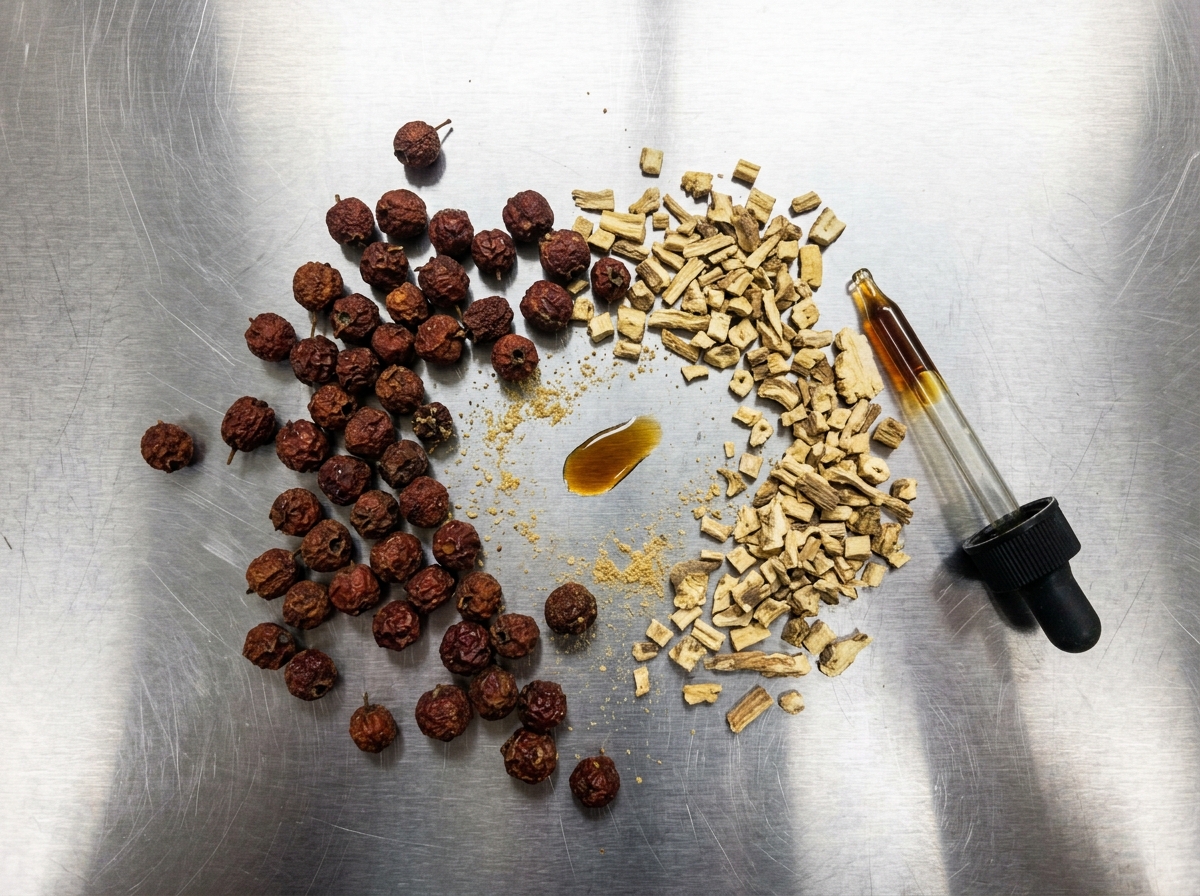

I recorded these audios to directly answer the extraction and formulation questions I've received most over the last 26 years. The text below serves as the complete reference manual.
Jason J. DukeOwner / Artisan
Part 1 — What Is a Tincture, Exactly?
Before anything else, let's define the thing. A tincture is a concentrated liquid extract — herb material steeped in a fluid that pulls the constituents out of the plant and holds them in suspension. In this section we cover the definition, the words of the craft, and the two completely different products that both get called "tinctures" on a shelf.
Listen to this section:
Read Audio Transcript
What is a tincture, exactly? Let's define the thing before anything else, because the word gets used loosely, and it shouldn't be.
A tincture is an easy-to-take, concentrated fluid supplement, made of any combination of vitamins, minerals, spices, herbs, botanicals, and superfoods, and it's taken in small serving sizes and fractional doses. That's the whole definition. Everything else on this page is detail.
Now, the word itself. Tincture comes from the Latin tingere, which means to soak, to steep. And here's the fun part. Tincture and tint share the same root, because dyers and apothecaries worked the same craft. One soaked cloth to pull out the color, and the other soaked plants to pull out the medicine. Same move, different material. That word has been doing this job for centuries.
And what counts as an herb? More than you'd think. In this craft, an herb is any edible, non-intoxicating plant or plant part. The leaves, the roots, the bark, the berries, the seeds, the fungi, even the seaweeds. The old definition included animal materials and minerals too. If it holds constituents and it isn't intoxicating, it's an herb.
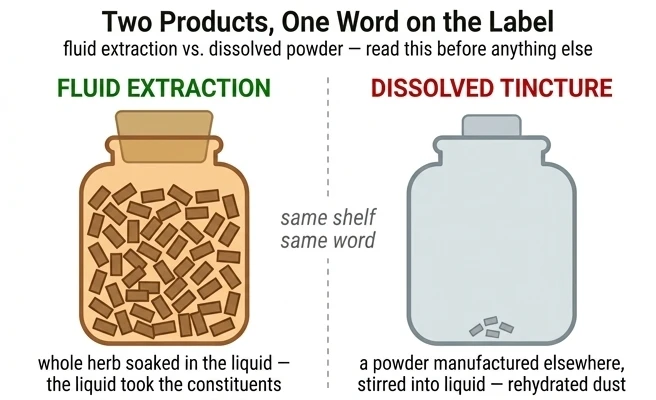
So how does a tincture actually get made? Two ways, and this distinction matters more than anything else on the page. The first is fluid extraction. Whole herb material, soaked directly in a liquid, and the liquid pulls the constituents out of the plant and holds them in suspension. The liquid does the work on the actual plant. The second is a dissolved tincture. A powder manufactured somewhere else, then stirred into a liquid. The liquid never touched the plant. It just carried a pre-made powder.
Both of those sit on shelves labeled tincture. They are not the same product, and we'll show you how to tell them apart when we get to the label.
The old formulators had a saying about the craft. An effective tincture has to be potent enough to work, but good-enough so that the bottle may be finished. That's the balance. Potency you can live with, taken day after day.
And what a tincture is not, is a medication. A medication forces a mechanism. A tincture is food, concentrated. Medicine in the oldest sense of the word, the nourishment kind, the first lesson every doctor learns at the beginning of the career. It supplies raw materials, and your body decides what to build with them.
To supplement means 'to add to' a complete meal.
That's the rule the whole craft runs on. Taken with meals, over time.
A tincture is an easy-to-take concentrated fluid supplement of any combination of vitamins, minerals, spices, herbs, botanicals, and superfoods, taken in small serving sizes and fractional doses. The word itself comes from the Latin tingere — to soak, to steep. Tincture and tint share the same root, because dyers and apothecaries worked the same craft: soak material in liquid, let the liquid carry away what the material holds.
What counts as an herb, in this craft, is broader than most people expect: any edible, non-intoxicating plant or plant part — including seaweeds, and by the old definition even animal materials and minerals.
The two methods — read this before anything else on the page:
| Method | What it is | What the liquid did |
|---|---|---|
| Fluid extraction tincture | Whole herb material, macerated and extracted directly into the liquid | Soaked the actual plant and took its constituents |
| Dissolved tincture | A powder extract manufactured elsewhere, dissolved into a liquid | Dissolved a pre-made powder |
Both sit on shelves labeled "tincture." They are not the same product. A fluid extraction carries the whole constituent matrix of the plant in the proportions the plant built. A dissolved tincture carries whatever survived the powder-manufacturing process — which is usually heat-damaged and stripped of its volatile fraction. The rest of this guide is about fluid extraction tinctures: how they're made, how to read them, and how to take them.
CALLOUT — Herbal Wisdom: "An effective tincture is made in a balanced way to be taken consistently; therefore it has to be potent enough to work, but good-enough so that the bottle may be finished."
Section FAQ
- What is a tincture? A concentrated liquid extract: herb material soaked in a fluid — alcohol and water, glycerin, vinegar, or oil — that pulls the plant's constituents out and holds them suspended. Taken in small servings and fractional doses, usually under the tongue or in a little water.
- Why is it called a tincture? From the Latin tingere, to soak or steep. Tincture and tint share the root — dyers and apothecaries used the same soaking craft, one to color cloth, the other to extract plants.
- What is an herb in herbalism? Any edible, non-intoxicating plant or plant part — leaves, roots, bark, berries, seeds, fungi, seaweeds — and by the traditional definition, even animal materials and minerals.
- Are all liquid supplements tinctures? No. A true tincture is a fluid extraction — the whole herb soaked in liquid. Some "liquid extracts" are just a powder manufactured elsewhere and dissolved into a base. The label math in Part 6 shows you how to tell them apart.
Part 2 — Why Liquid? The Case for the Tincture
The form is part of the function. A capsule and a liquid extract of the same plant can carry very different cargo, because of what happens between your mouth and your bloodstream — and what happens to a powder before it ever reaches the bottle. This is the physics of why we make liquids.
Listen to this section:
Read Audio Transcript
Why liquid? Why not just put the herb in a capsule and call it done? Because the form is part of the function, and the difference shows up in three places. Between the plant and the bottle, between your mouth and your blood, and on the calendar.
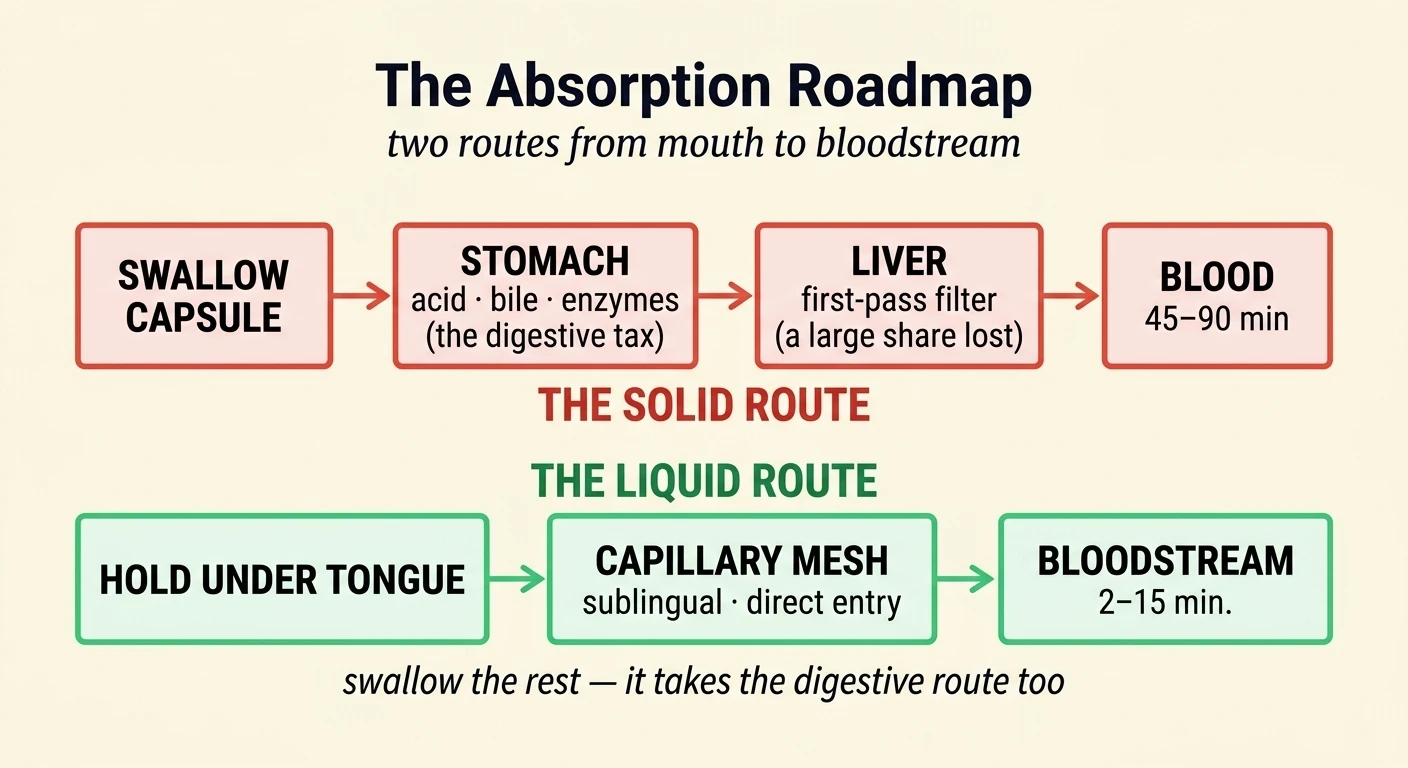
Start with the swallow. A capsule is processed as a solid object. Your body has to break it down mechanically, drown it in stomach acid, call for bile and enzymes, and all of that costs real energy. Then everything absorbed from the gut travels to the liver first, and the liver filters and metabolizes a big share of the active constituents before they ever reach general circulation. That's the price of the solid form. We call it the digestive tax.
A liquid takes a different road. The tissue under your tongue and inside your cheek is a rich mesh of capillaries, separated from the surface by a membrane only a few cells thick. Hold a tincture in your mouth, and part of it diffuses directly into the bloodstream. No stomach queue, no liver gatekeeper. Then you swallow the rest, and it takes the digestive route too. Both doors, one dose.
And taste. Taste is not an inconvenience. The moment bitter or aromatic compounds touch your tongue, the vagus nerve fires, and your body starts preparing the liver, the gallbladder, and the pancreas for what's coming. That's the handshake before the delivery. A coated capsule sneaks past the tongue, and the handshake never happens. Simply put, tasting your medicine is part of taking your medicine.
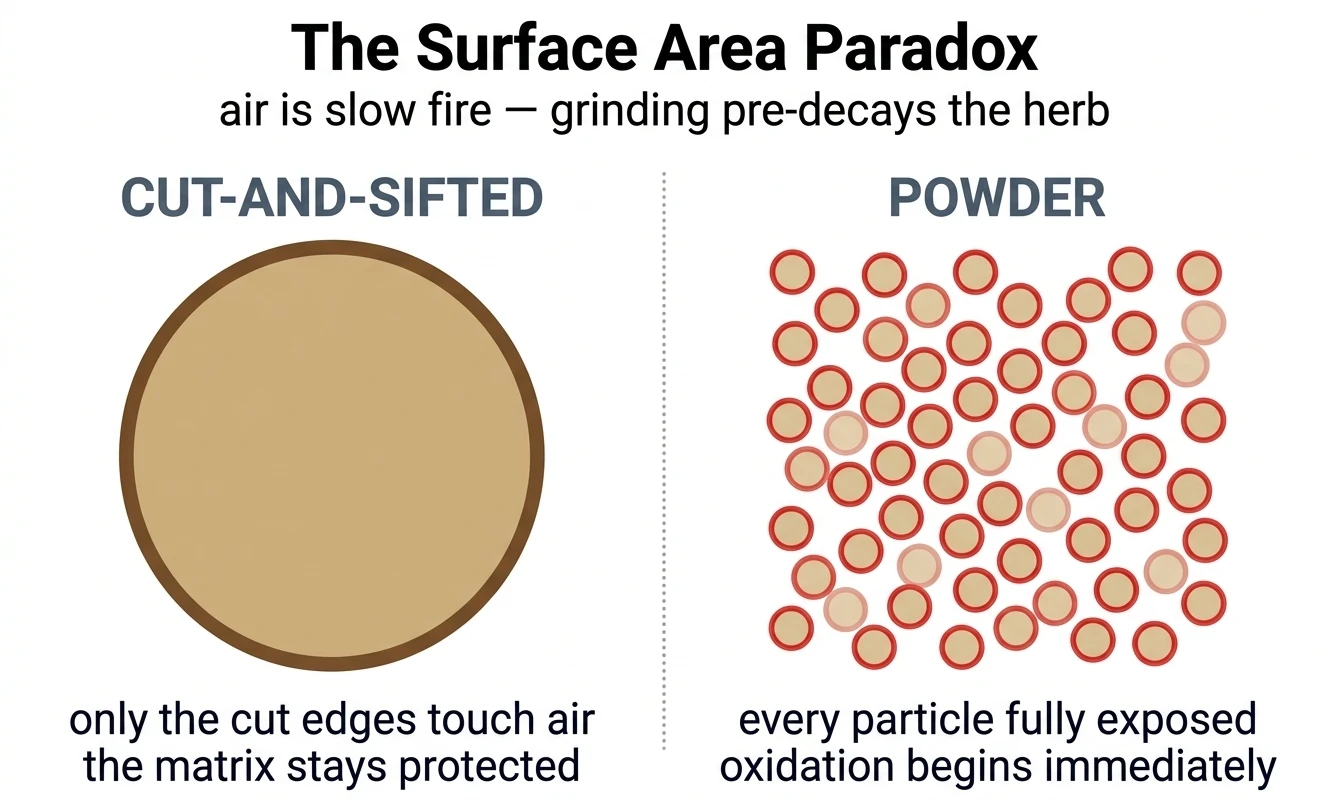
Now the shelf, and here's the surface area paradox. Slice an apple and watch it brown. That's oxidation, and air is slow fire. Grind a plant to powder, and you've exposed essentially its whole surface to air at once, so the delicate volatile constituents evaporate and degrade before the bottle is ever filled. Cut and sifted herb keeps its matrix intact, protected from air until the exact moment it meets the liquid.
But get this. The liquid keeps protecting after the extraction. Alcohol suspends the plant's chemistry in a sterile, air-free state. Sealed wine has come out of ancient Egyptian tombs still drinkable, while the bread beside it turned to dust centuries ago. Same physics, working for your tincture.
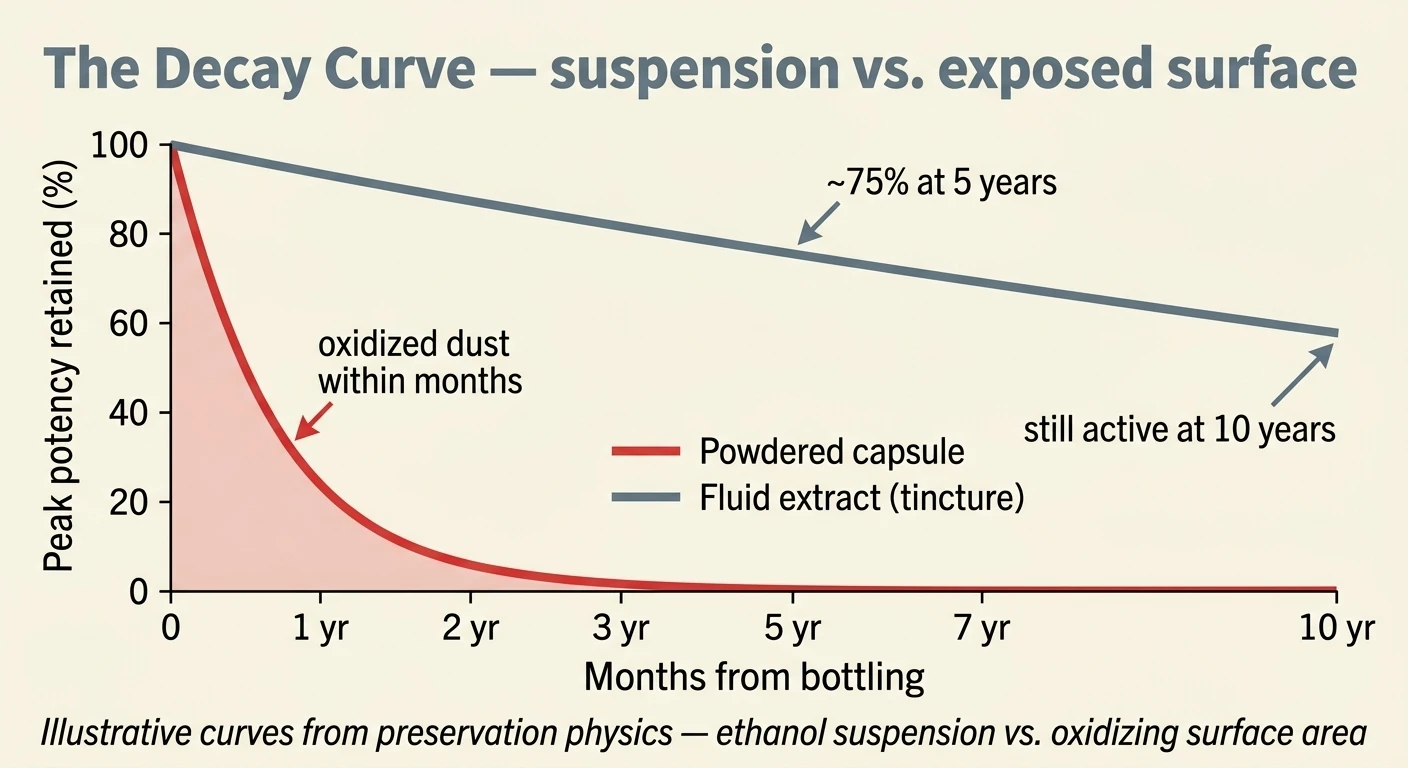
So the honest timeline looks like this. A well-made liquid holds most of its potency for years. A powder is well on its way to inert dust within months. That's not marketing. That's surface area and air.
Food is medicine, and a tincture is that kind of medicine. The liquid carries it, and your body puts it to work.
Taken with meals, over time.
The digestive tax. A swallowed capsule is processed as a solid object. It demands mechanical breakdown, stomach acid, bile, and enzymatic processing — real cellular energy spent on packaging. Then everything absorbed from the gut travels first to the liver, where a significant share of the active constituents is filtered and metabolized before reaching general circulation. That is the price of the solid form.
The sublingual shortcut. The tissue under the tongue and inside the cheek is a rich mesh of capillaries separated from the surface by a membrane only a few cells thick. A liquid held in the mouth diffuses directly into the bloodstream — no stomach queue, no liver gatekeeper. Held, then swallowed, a tincture uses both routes.
Taste is a signal, not an inconvenience. The moment bitter or aromatic compounds touch the tongue, the vagus nerve fires and the body prepares the liver, gallbladder, and pancreas for what's coming. This is the cephalic phase — the handshake before the delivery. A coated capsule sneaks past the tongue, and the handshake never happens.
| Metric | Solid State (Capsules/Powders) | Liquid State (Tinctures) |
|---|---|---|
| Absorption pathway | Digestive tract, subject to first-pass liver filtration | Mucosal and sublingual, direct to circulation |
| Energy cost | High — mechanical and enzymatic breakdown | Near zero — passive diffusion |
| Matrix status | Oxidized, static, moisture-attracting | Preserved, suspended, air-free |
| Sensory signal | None — bypasses the tongue | Full — triggers the cephalic phase |
The surface area paradox. Slice an apple and watch it brown — that's oxidation, and air is slow fire. Grinding a plant into powder exposes essentially its entire surface to air at once, and the delicate volatile constituents evaporate and oxidize before the bottle is ever filled. Cut-and-sifted herb keeps its matrix intact — protected from air until the moment it meets the liquid.
The ethanol lock. Alcohol suspends the plant's chemistry in a sterile, air-free state. Sealed wine has been recovered drinkable from ancient tombs; bread returns to dust in weeks. A tincture holds the majority of its potency for years; a powdered capsule is well on its way to inert dust within months.
Section FAQ
- What is first-pass metabolism? Everything absorbed from the digestive tract travels first to the liver, which filters and breaks down a share of the active constituents before they reach general circulation. Liquids held in the mouth absorb through the capillaries instead, bypassing that filter.
- Why do tinctures taste so strong? Because taste is function. Bitter and aromatic compounds trigger the vagus nerve, which signals the liver, gallbladder, and pancreas to prepare before the extract arrives. The strong taste is the mechanism announcing itself.
- Why is a liquid better than a capsule? A liquid absorbs through the mouth's capillaries directly into the bloodstream, carries its constituents in molecular dispersion, and triggers digestive preparation through taste. A capsule must survive acid, dissolve, and pass the liver before anything reaches circulation.
- Do tinctures stay potent longer than powders? Yes. Suspended in liquid with no air exposure, a tincture holds most of its potency for years. A powder's massive surface area oxidizes continuously — it degrades toward inert dust within months.
Part 3 — The Four Solvents
The carrier liquid is a choice, not a given. Four fluids make tinctures — alcohol and water, glycerin and water, apple cider vinegar, and oil — and each one pulls a different payload and serves a different purpose. Here is the full comparison.
Listen to this section:
Read Audio Transcript
Where does the liquid come from, and which liquid? There are four, and each one is a different tool for a different job.
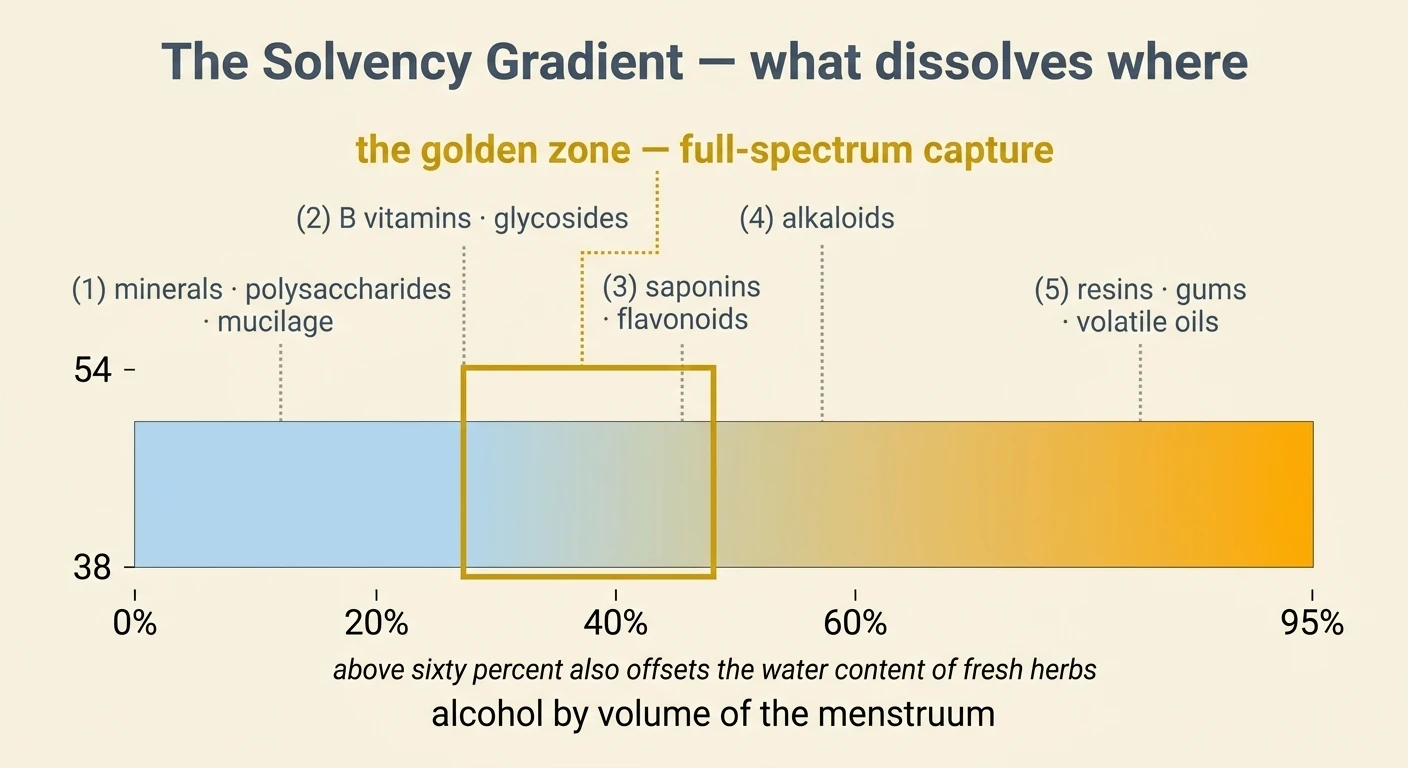
The rule underneath everything is simple. Like dissolves like. Plants build two broad chemistries. Some of it loves water, the minerals, the polysaccharides, the mucilage, the B vitamins. And some of it loves fat and alcohol, the resins, the volatile oils, the alkaloids. No single pure solvent takes from the whole herb. The craft is choosing the fluid that matches the payload.
The first, and the standard, is hydroalcohol. Edible alcohol and distilled water together in one liquid. The water pulls the plant's body, and the alcohol pulls its spirit, and together they take from the whole herb. That's why hydroalcohol is the superior form for tonics, superfoods, adaptogens, and medicinal herbs alike. And the best versions are made with a triple filtered, purified spirit. Cane alcohol from a specialty distiller tastes sweet, with less bite than store-bought vodka.
Second, glycerin and water. The glycerite. Genuinely useful, and we mean that. Sweet, gentle, easy for children and for anyone avoiding alcohol entirely. But we're honest about the chemistry. Glycerin cannot break resins, and it can't efficiently pull many alkaloids. Those stay behind in the spent herb. A glycerite trades potency for gentleness. And the rule of thumb is this. The more water in a glycerite, the stronger it's going to be, up to about half water.
Third, apple cider vinegar. Here's the trick. Acetic acid converts stubborn alkaloids into soluble salts, and it pulls minerals well. That's why the digestive bitters tradition runs on vinegar. Its lane is digestion and mineral roots.
And fourth, oil. Oil pulls the fat-soluble constituents, and it makes superb topical and culinary preparations for skin, scalp, and hair. One hard rule, and it's a safety rule. Dried herbs only. Water content in oil spoils. Always dried.
So the choosing is simple. Tonics and adaptogens, hydroalcohol. Children and the sensitive, glycerites. Digestion, vinegar. Skin and the fat-loving herbs, oil. The herb decides, and the liquid follows.
Each one is food carrying food. Medicine in the nourishment sense, never a medication forcing anything.
Taken with meals, over time.
The rule of solubility is absolute: like dissolves like. Plants build two broad chemistries — some that loves water, some that loves fat and alcohol. No single pure solvent takes from the whole herb. The craft is choosing the fluid that matches the payload.
| Solvent | Grade | What it pulls best | What it misses | Best use |
|---|---|---|---|---|
| Hydroalcohol (ethanol + distilled water) |
Superior | Nearly all constituents — both the water-loving and the resinous, including the volatile fraction | Nothing significant | Tonics, adaptogens, superfoods, medicinal herbs — the default |
| Glycerin + water | Satisfactory | Water-soluble constituents, sugars, mucilage, vitamins | Resins, many alkaloids, volatile oils | Children, the sensitive, abstainers, mild culinary herbs |
| Apple cider vinegar | Specific | Aromatic bitters; converts alkaloids into soluble salts; pulls minerals | Resins, gums, most tonic constituents | Digestive bitters, mineral roots, acetic tradition |
| Oil (extra-virgin olive) | Specific | Fat-soluble constituents, resins, essential oils | Everything water-soluble | Culinary and fat-loving herbs, topical and cosmetic use |
Hydroalcohol, explained. Water extracts the plant's body — minerals, polysaccharides, mucilage, B vitamins, glycosides. Alcohol extracts its spirit — resins, volatile oils, alkaloids, triterpenes. Together they take from the whole herb. The alcohol also preserves: it suspends the extracted chemistry in a sterile, air-free state, and acts as a carrier for quick absorption. Best made with triple-filtered, purified-grade ethanol — cane alcohol from a specialty distiller has a sweet taste with less bite than store vodka.
Glycerites, honestly. Glycerin is a gentle, sweet, syrupy medium — genuinely useful for children, sensitive systems, and anyone avoiding alcohol. But it is chemically incapable of breaking resins or efficiently extracting many alkaloids; those stay in the spent herb. A glycerite trades potency for gentleness.
CALLOUT — Rule of Thumb: "The more water used in making a glycerite, the stronger the potency. The most water usually used is fifty percent, which makes a moderate potency tincture; a zero-water glycerite makes a low potency tincture."
| Glycerite type | Glycerin / Water | Typical dose | Shelf life | Character |
|---|---|---|---|---|
| Fifty-fifty | 50% / 50% | 20–60 drops | 18 months | Moderate potency — the glycerite standard, all herb types |
| Two-thirds | 67% / 33% | 1–2 droppers | 24 months | Moderate-low, all herb types |
| Three-quarters | 75% / 25% | 1–3 droppers | 24 months | Low-moderate, for sensitive people |
| Full glycerite | 100% / 0% | 1–3+ droppers | 24 months | Low potency, most sensitive |
Vinegar's acid trick. Many medicinal alkaloids are nearly insoluble in water as they sit in the plant. Acetic acid converts them into acetate salts — soluble, absorbable — which is why the bitters tradition runs on vinegar. It also pulls minerals well.
Oil's one hard rule. Oil extracts the fat-soluble constituents and makes superb topical and culinary preparations — but never use fresh herbs in oil. Water content in oil spoils and molds. Dried herbs only.
Section FAQ
- Why is alcohol used in tinctures? For its solvent polarity and its preservation, not for intoxication. Alcohol dissolves the resins, volatile oils, and alkaloids that water cannot, then suspends the whole extracted matrix in a sterile, air-free state that keeps for years.
- Are glycerites as effective as alcohol tinctures? Not for most herbs. Glycerin holds water-soluble constituents well, but it cannot break resins or efficiently extract many alkaloids — those remain in the spent herb. Glycerites trade potency for gentleness and sweetness.
- What is apple cider vinegar best at extracting? Aromatics, minerals, and alkaloids. The acetic acid converts stubborn alkaloids into soluble salts, which is why the digestive bitters tradition is built on vinegar.
- Can I make a tincture with oil? Yes — an oil extract, for fat-soluble constituents and topical use. The hard rule: dried herbs only. Water content in oil spoils the preparation.
Part 4 — The Alcohol Spectrum
How strong the alcohol is — and why. Proof, the five tiers from low to high, the preservation zones, and the counterintuitive chemistry where less alcohol makes stronger immune medicine.
Listen to this section:
Read Audio Transcript
How strong is the alcohol in a tincture, and why does it vary so much? Because the herb decides. Proof is simply double the alcohol by volume. Eighty proof is forty percent alcohol and sixty percent distilled water. From there, the craft picks the strength to match the material and the purpose.
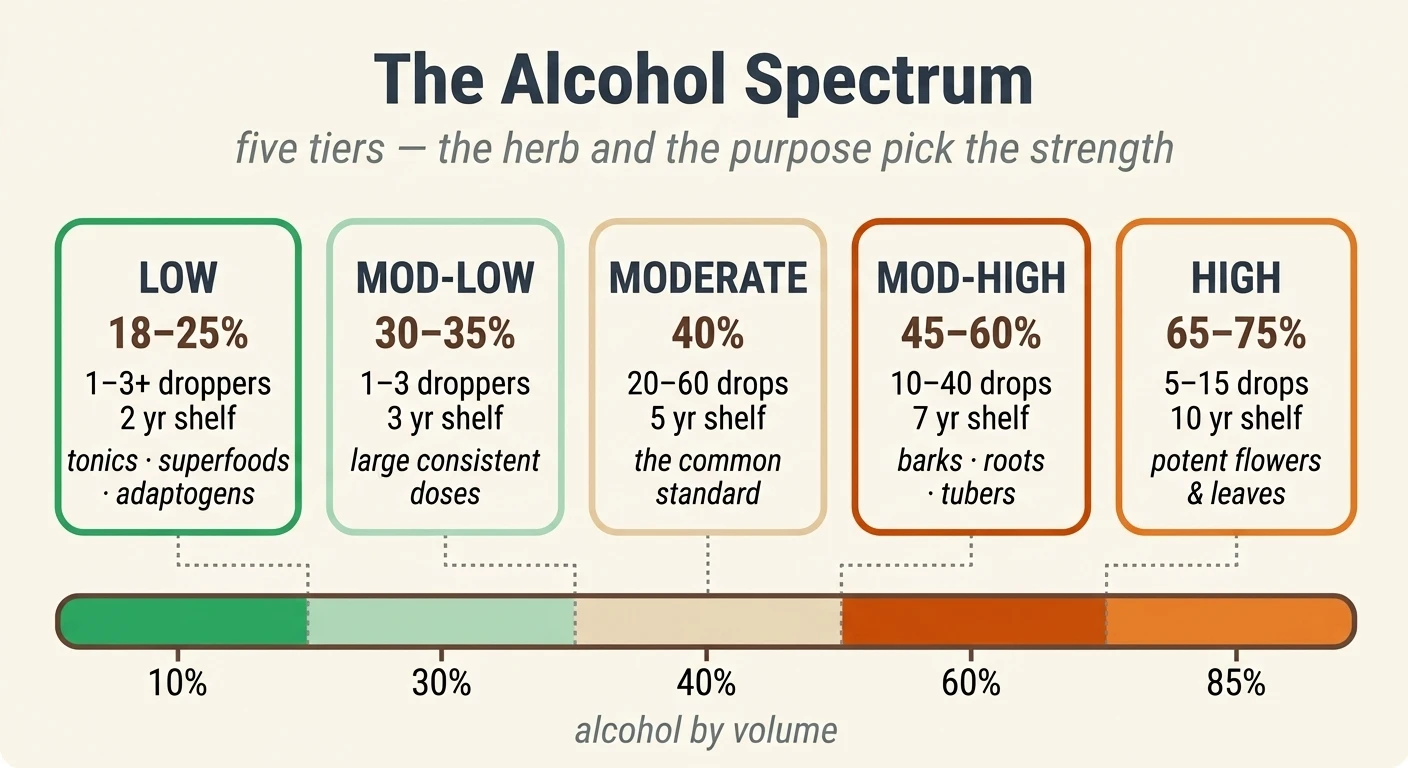
Low alcohol runs eighteen to twenty-five percent. That's the tonic band, built for superfoods, tonics, and adaptogens, taken in larger doses of one to three droppers, gentle enough for sensitive people, and it keeps about two years.
Moderate-low sits at thirty to thirty-five percent, for larger consistent doses with some of the medicinal character. Moderate, at forty percent, is the common standard. Well rounded, good for nearly any herb and any part, with about five years on the shelf. Moderate-high, forty-five to sixty percent, serves the barks, roots, and tubers, in smaller doses. And high alcohol, sixty-five to seventy-five percent, is drop-dose territory. Five to fifteen drops of potent flowers and leaves, and it keeps up to ten years.
Now, a quick note here, because this one surprises people. Less alcohol can literally make stronger medicine, for the immune tonics anyway. High alcohol crowds the heavy polysaccharides, the long-chain sugars in mushrooms and tonic roots, out of solution, where they settle as sludge at the bottom of the bottle. Stay low to moderate, and those constituents stay suspended in the liquid where you can drink them. For mushrooms, weaker alcohol yields stronger medicine.
And the water side matters as much as the alcohol side. Distilled water is the hungry solvent. Spring water arrives already carrying dissolved minerals, its hands full. Distilled water arrives empty, with full capacity to pull the plant's minerals and water-loving constituents into the liquid.
If you ever make your own, the math is friendly. High-proof spirit, distilled water, and simple subtraction gets you any target strength. One note. Mixing high-proof alcohol with water warms the jar. Real heat. Let it cool before the herbs go in.
The strength is a choice made for the herb, and the whole thing stays what it always was. Food, concentrated.
Taken with meals, over time.
Proof is simply double the alcohol by volume: eighty proof is forty percent alcohol, sixty percent distilled water. From there, the craft picks the strength to match the herb and the purpose.
| Tier | ABV | Typical dose | Shelf life | Purpose |
|---|---|---|---|---|
| Low alcohol | 18–25% | 1–3+ droppers | 2 years | Tonics, superfoods, adaptogens — maximum nutrient and constituent density, easiest for sensitive people |
| Moderate-low | 30–35% | 1–3 droppers | 3 years | Larger doses taken consistently, some medicinal benefit, still gentle |
| Moderate | 40% | 20–60 drops | 5 years | The common standard — well-rounded tinctures of any herb and part |
| Moderate-high | 45–60% | 10–40 drops | 7 years | Barks, roots, tubers — where immediate medicinal character is wanted over nutrient density |
| High alcohol | 65–75% | 5–15 drops, up to 30 | 10 years | Potent flowers, leaves, stems — small drop-doses of strong medicinal herbs |
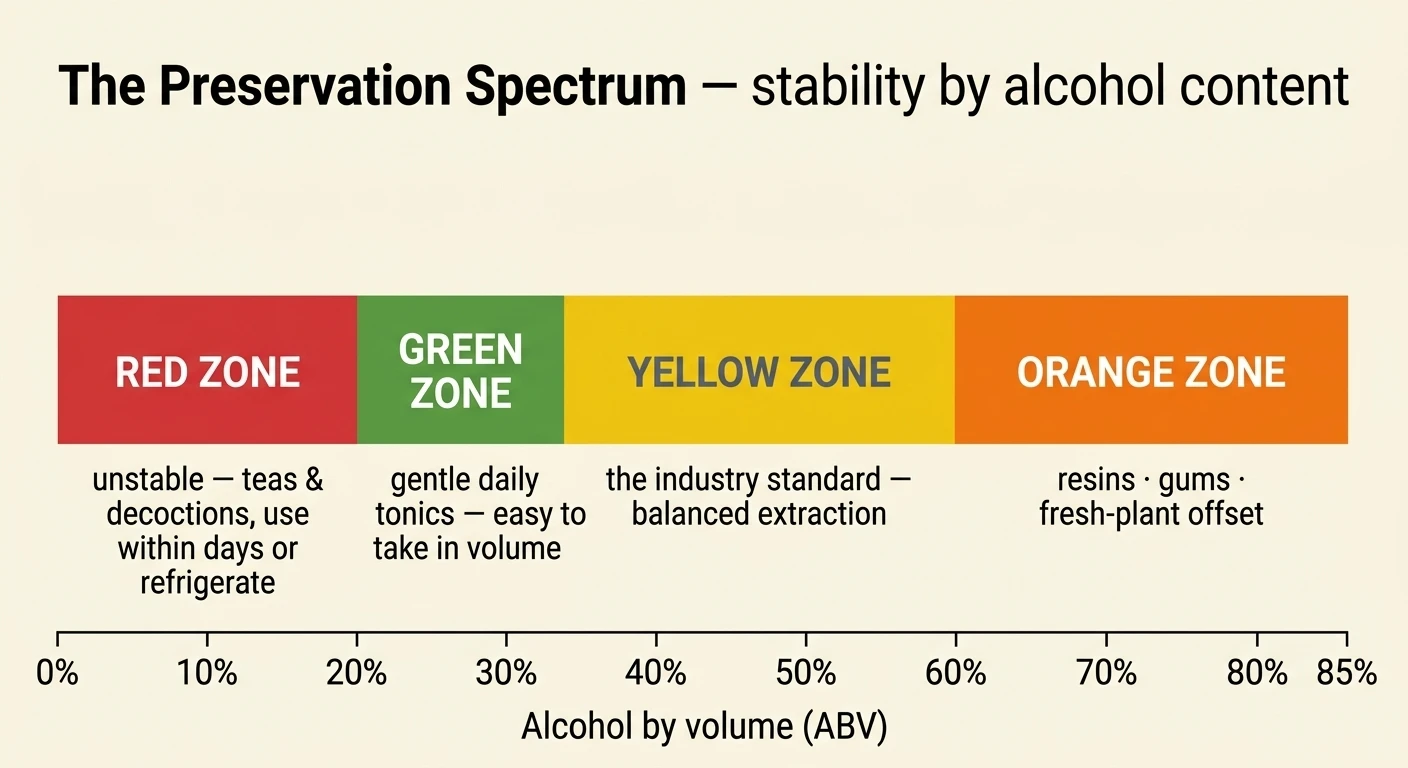
The preservation zones. Below twenty percent alcohol, a preparation is unstable — the red zone; think teas and decoctions, consumed within days. Twenty to thirty is the green zone: gentle, daily-tonic territory, and the easiest to take in volume. Thirty to sixty is the yellow zone, the industry standard, balancing water-soluble and alcohol-soluble extraction. Above sixty is the orange zone — for resins, gums, and offsetting the water content of fresh plants.
The counterintuitive chemistry. High alcohol crowds the heavy, water-loving polysaccharides — the long-chain sugars in mushrooms and tonic roots — out of solution, where they settle as sludge. Staying in the low-to-moderate range keeps them suspended where you can drink them. For immune tonics, weaker alcohol yields stronger medicine.
Distilled water — the hungry solvent. Spring and tap water arrive already carrying dissolved minerals; their binding capacity is partly occupied. Distilled water arrives empty, with full capacity to pull the plant's minerals and water-soluble constituents into the liquid.
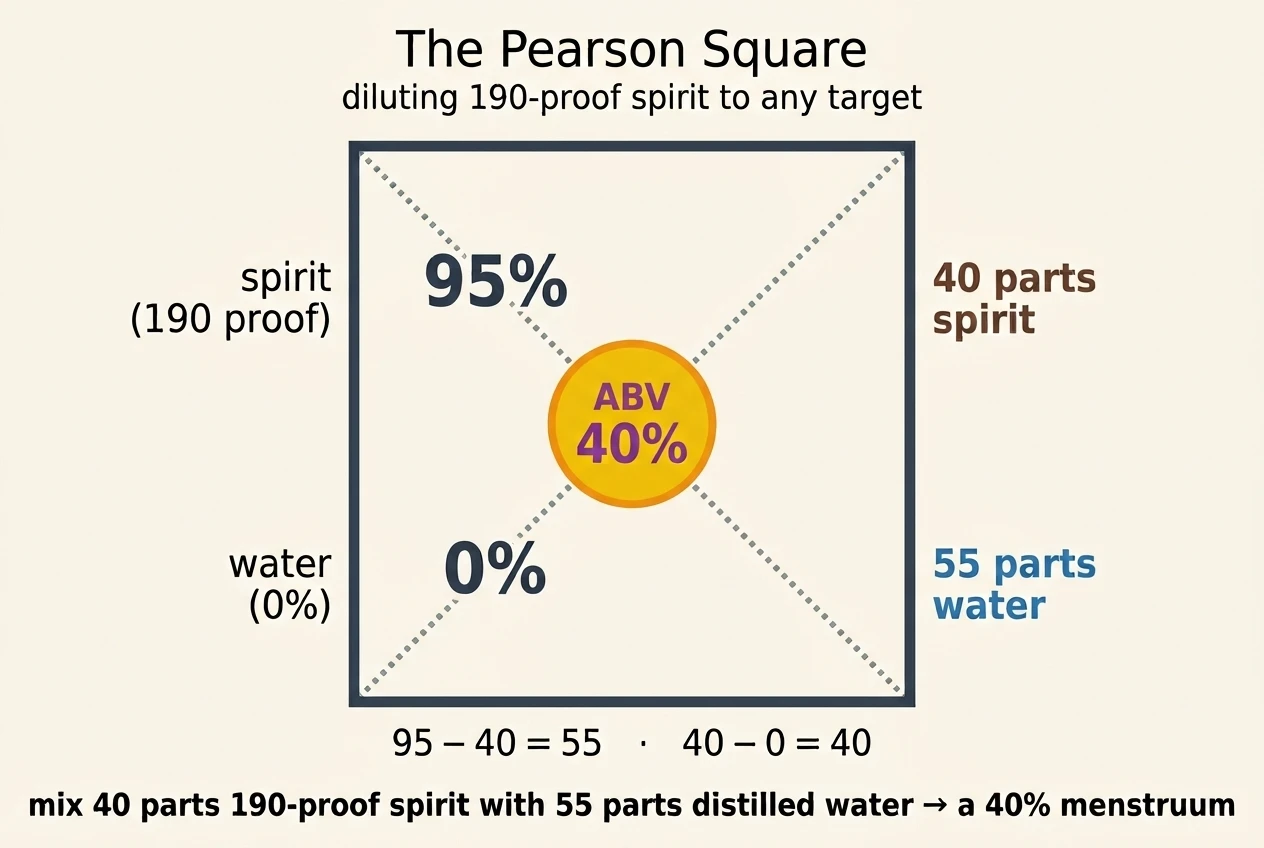
Dilution math (the Pearson square). To reach any target from high-proof spirit: write the spirit's percent top-left, water's zero bottom-left, the target in the center, subtract across. Ninety-five percent spirit to a forty percent target: mix forty parts spirit with fifty-five parts water. One note — mixing high-proof alcohol with water releases heat; let the blend cool before the herbs go in.
Section FAQ
- What does proof mean on a tincture? Proof is double the alcohol by volume. Eighty proof is forty percent alcohol and sixty percent water. A tincture's strength is chosen to match the herb and the purpose, not standardized across the board.
- Why do some tinctures have more alcohol than others? The herb decides. Dense roots and barks and potent medicinal flowers take higher alcohol in small doses; nutrient-dense tonics and adaptogens take low alcohol in larger, gentler doses.
- Is a low-alcohol tincture weaker? It is less concentrated, not weaker — you simply take more of it. For dropper-dose volume in tonics, low alcohol is the superior form, and it keeps the heavy immune polysaccharides suspended instead of settled.
- Why use distilled water instead of spring water? Distilled water is empty — no dissolved minerals occupying its binding capacity. It pulls the greatest concentration of constituents from the herb into the liquid.
Part 5 — Know the Herb
The material decides the method. Plant parts and where the power lives in each, the four grades of herb material, the physics of fresh versus dried — and the shapeshifters, herbs whose chemistry transforms in the drying.
Listen to this section:
Read Audio Transcript
Where does the power live in the plant? That's the question underneath every tincture, because the material decides the method.
A plant is not one uniform thing. The roots are the storage organ. Dense, heavy, the plant's concentrate. The bark carries its resins. The berries carry pigments and fruit acids. The seeds carry oils. The flowers and delicate tops carry the volatile constituents, the ones that evaporate easiest. And fungi hold their polysaccharides behind tough walls. Different parts, different cargo, different handling.
The material comes in four grades. Whole dried, small enough to extract as is. Sliced, for the long roots and fungi. Powdered, and we'll be plain with you, powder pays a toll, because grinding exposes everything to air at once and the fragile fraction degrades before the liquid ever arrives. Which leaves the standard. Cut and sifted. Cut to small pieces, with the powder sifted away. The matrix stays intact, protected from air, until the exact moment it meets the liquid.
Now, fresh or dried. That's real chemistry, not preference. A fresh plant is mostly water, so it takes a stronger alcohol, around sixty percent, to offset all that plant water. A dried plant is concentrated, and it takes a gentler liquid, twenty-five to forty percent, to rehydrate it and pull the deep constituents. Fresh gives you back all your liquid and more, because the plant donates its own juice. Dried drinks some of yours.
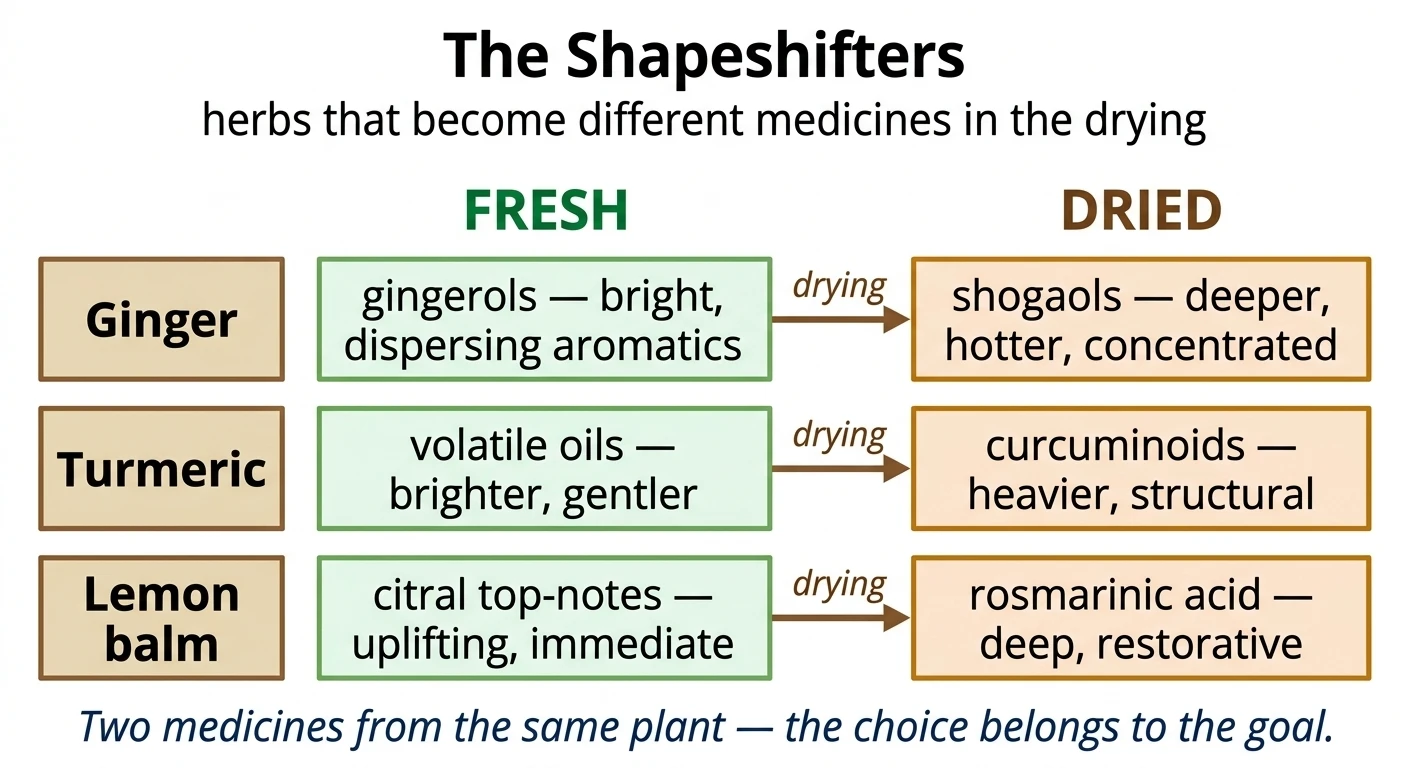
And some herbs shapeshift in the drying. Ginger fresh carries the bright, dispersing gingerols. Dried, those convert to shogaols, which run deeper and hotter. Turmeric fresh carries its volatile oils, while dried concentrates the curcuminoids. Lemon balm fresh gives you the bright, uplifting aromatics, and dried gives you the deep restorative acids. Two different medicines from the same plant, and the choice belongs to the goal.
Some herbs must be fresh. Milky oats only work in their one-week milky window, and dried, they're just straw. And some are better dried. Nettles and roots concentrate, so a jar holds four times the material.
Know the part. Know the grade. Know the state. The herb decides, and the craft follows.
Taken with meals, over time.
| Plant part | What it is | Where the power lives |
|---|---|---|
| Tops | Flowers and small leaves near the stem ends | Delicate volatile constituents — extract gently |
| Aerials | All above-ground parts: stems, leaves, flowers | Varies by plant; standard floral and leaf chemistry |
| Bark | Exterior surface of trunks or roots | Dense, resinous — long maceration |
| Roots | Below-ground parts, including rhizomes, tubers, bulbs | The plant's stored concentrate — dense and heavy |
| Seeds | Gathered whole and dry at harvest | Oils and concentrated constituents |
| Berries | Generally harvested ripe, may be dried | Pigments, sugars, fruit acids |
| Fungi | Fruiting bodies, harvested at the right time and dried | Polysaccharides behind tough chitin walls — need heat stages |
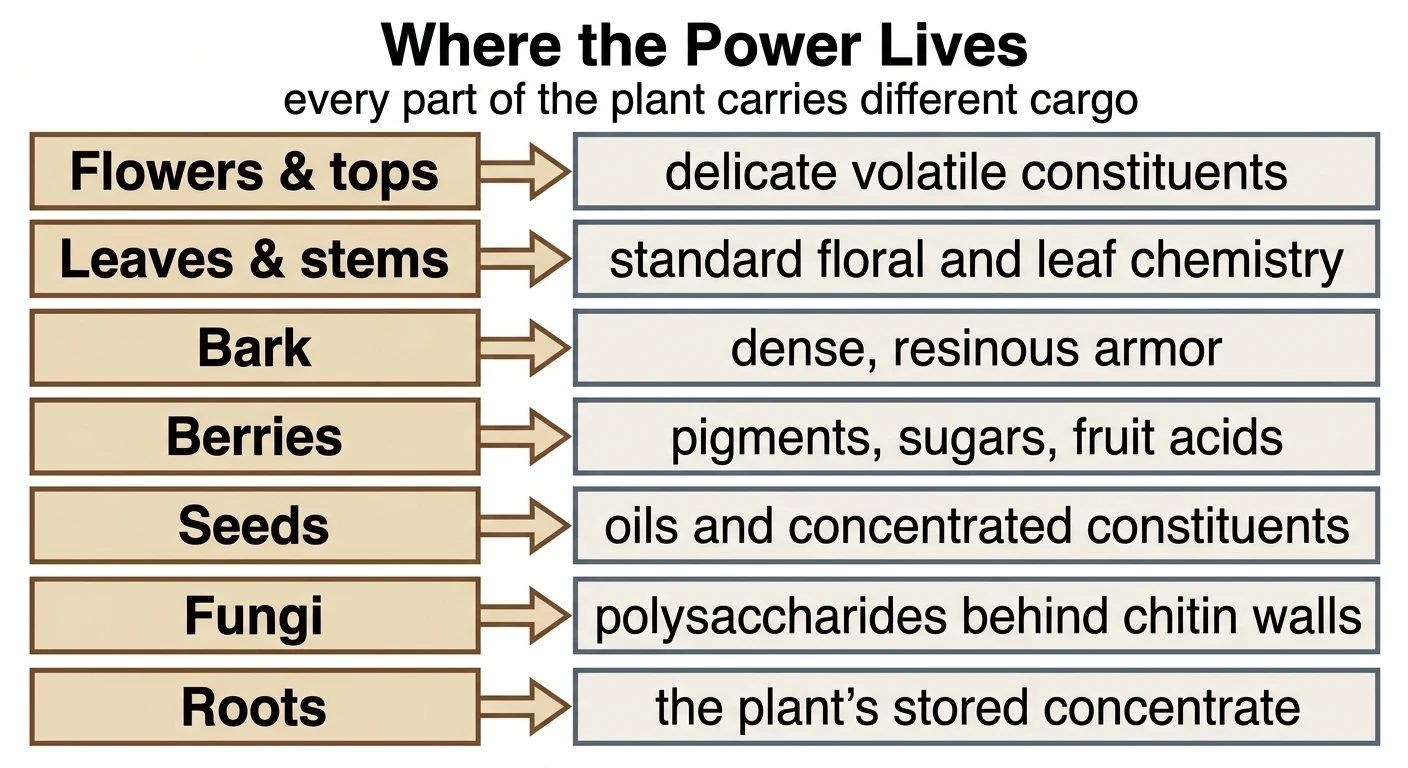
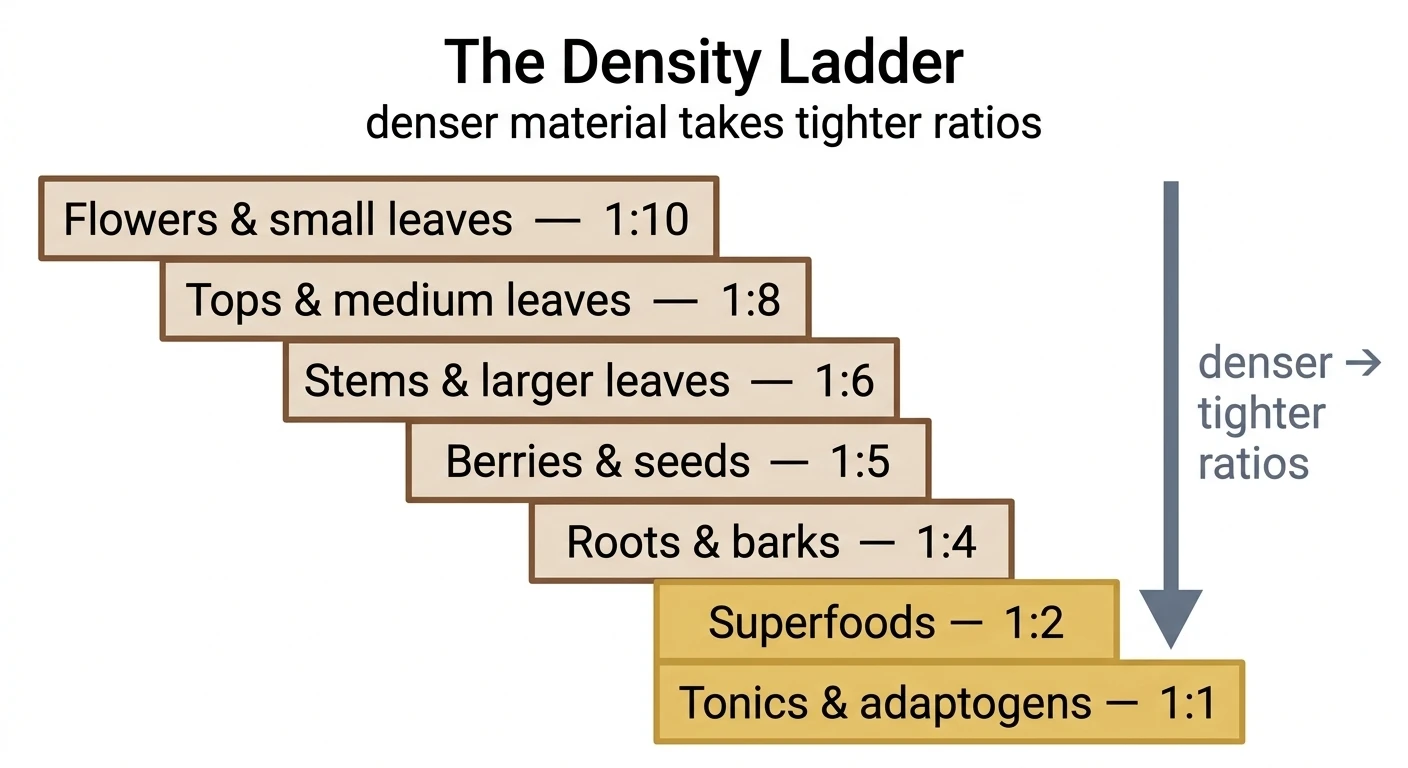
Density order, least to most: flowers and tops, leaves, fungi, berries, seeds, bark, roots. The denser the material, the tighter the extraction ratio it can take — this table is the foundation of the ratio math in Part 6.
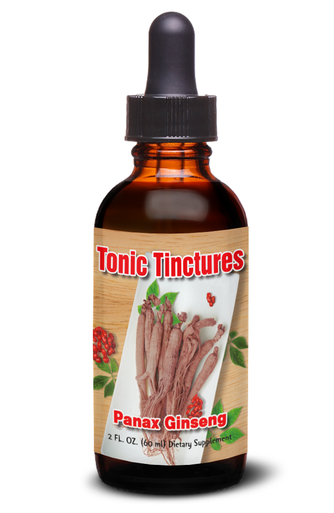
Botanical Profile: Panax Red Ginseng
The ultimate dense root. Panax Red Ginseng requires a tight extraction ratio and patient maceration to pull its heavy, active ginsenosides from the core of the six-year mature root.
View the Extract →The four grades: whole dried (small enough to extract as-is), cut-and-sifted (cut to small pieces, powder sifted away — the extraction standard, because the matrix stays protected from air until soaking), sliced (diagonal slices for maximum surface on long material), and powdered (for capsules and quick, lower-quality extractions — the volatile fraction pays the toll).
Fresh versus dried is real chemistry, not preference:
| Fresh herb | Dried herb | |
|---|---|---|
| Water content | 70–80% | 5–10% |
| Alcohol needed | ~60% ABV to offset plant water | 25–40% ABV to rehydrate and extract |
| Yield | 100% or more — the plant donates its own juice | 60–70% — the dry material drinks the menstruum |
| Carries | Volatile oils, latex, enzymes — the living spirit | Minerals, polysaccharides, concentrated reserves |
The shapeshifters — herbs that become different medicines in drying:
| Herb | Fresh extract carries | Dried extract carries |
|---|---|---|
| Ginger | Gingerols — bright, aromatic, dispersing | Shogaols — deeper, hotter, more concentrated heat |
| Turmeric | Volatile oils — brighter, gentler | Concentrated curcuminoids — heavier, structural |
| Lemon balm | Citral top-notes — uplifting, immediate | Rosmarinic acid and polyphenols — deep, restorative |

Dried Ginger Extract
Extracted from dried root to capture the deeper, hotter shogaol constituents rather than the lighter fresh gingerols.
View Extract →
Dried Turmeric Extract
Extracted for structure. We use dried turmeric root to focus the extraction on the heavy, structural curcuminoids.
View Extract →Strictly fresh: milky oats (the medicine is the milky latex of a one-week window; dried, it is straw), shepherd's purse, cleavers. Better dried: nettles and roots (concentrated, four times the material per jar) and mushrooms (drying and heat help crack the chitin).
Section FAQ
- Fresh or dried herbs — which makes a better tincture? Neither, universally. Fresh material carries volatile oils, latex, and enzymes; dried material concentrates minerals and polysaccharides and takes tighter ratios. Some herbs must be fresh, some are better dried, and some — ginger, turmeric, lemon balm — become genuinely different medicines.
- Why is cut-and-sifted better than powder for extraction? Powder exposes the whole plant to air at once, oxidizing the delicate volatile constituents before extraction even begins. Cut-and-sifted keeps the matrix intact and protected until the moment it meets the liquid.
- What part of the plant is used? Whichever part carries the constituents — roots for root herbs, berries for berry herbs, and so on. The label must state the part used; Part 6 shows why that line matters.
Part 6 — Reading the Label: The Math of Potency
The front of the bottle is the promise; the back panel is the confession. Ratios, herb equivalency, the physical limit of saturation, and the three red flags that reveal a dissolved powder dressed as an extraction.
Listen to this section:
Read Audio Transcript
How do you read a tincture label? The front of the bottle is the promise, and the back panel is the confession. Ten seconds of label literacy protects every purchase you'll ever make in this aisle.
Start with the ratio, because it's the math of potency. A liquid extract ratio is herb weight to liquid volume. One to four means one part herb extracted into four parts liquid. Eight ounces of root into a quart, or two hundred fifty grams into a liter. The smaller that second number, the more saturated the liquid is with actual plant.
And the ratio follows the plant part. Fluffy flowers and small leaves take a wide ratio, one to ten, because they're all volume and no weight. Roots and barks take one to four and tighter, because they're dense. Superfoods take one to two. And tonics and adaptogens, at the very top, take one to one. A fluid extract, where every drop of liquid is saturated with herb, pressed out on a real tincture press.
Which brings us to the one physical law that explains the biggest marketing trick in the aisle. Liquid saturates. One to one is roughly the limit, and past that, more herb just sits there. So when you see a twenty to one liquid extract on a label, that number is describing a powder, not an extraction. The herb was concentrated into a powder somewhere else, and a pinch of that powder was dissolved into the bottle. Rehydrated dust, wearing an extraction's name tag.
Now the red flags, decoded. A milligram weight printed inside the liquid's facts box. That implies dissolved powder, because milligrams measure solid mass. A proprietary blend, one total weight and no individual amounts. That hides the ratio of cheap filler to expensive active, a practice called fairy dusting. When a maker is proud of the amounts, they print them.
The green flags. Distilled water in the base. The ratio stated plainly. Herb equivalency printed, which is how much raw plant a dropper represents. The part used named. And full amounts.
One more thing, the careful words. The label says supports, maintains, promotes. Never fixes, never cures. That's the food category speaking its own grammar. Supplements are food, and food describes how its nutrients work with the normal structure and function of the body. And the grammar fits the biology. A tincture supplies materials. Your body does the work.
Read the back, ignore the front. That's the whole skill.
It is important to do your own research.
What a ratio is. Herb weight to liquid volume. One to four means one part herb extracted into four parts liquid — eight ounces of root into a quart of menstruum, or two hundred fifty grams into a liter. It is a statement of how saturated the liquid is with actual plant.
The ratio follows the plant part:
| Material | Standard ratio | Steps | English units | Metric |
|---|---|---|---|---|
| Flowers and small leaves | 1:10 | Single | 3 oz per quart | 100 g per 1000 ml |
| Tops and medium leaves | 1:8 | Single | 4 oz per quart | 125 g per 1000 ml |
| Stems and larger leaves | 1:6 | Single | 5.5 oz per quart | 167 g per 1000 ml |
| Berries and seeds | 1:5 (to 1:4) | Single | 6.5 oz per quart | 200 g per 1000 ml |
| Roots and barks | 1:4 (to 1:3, 1:2) | Single, dual, multi | 8 oz per quart | 250 g per 1000 ml |
| Superfoods | 1:2 | Dual, multi | 16 oz per quart | 500 g per 1000 ml |
| Tonics, adaptogens (fluid extract) | 1:1 | Dual, multi — requires a tincture press | 32 oz per quart | 1000 g per 1000 ml |
| Tonics, adaptogens (concentrated) | 2:1 | Multi-step | 64 oz per quart | 2000 g per 1000 ml |
One to one is the physical limit. Liquid can only hold so much dissolved herb — past saturation, more herb simply sits. This is why a "twenty to one liquid extract" on a label is describing a powder: the herb was concentrated into a powder somewhere else, then a pinch of that powder was dissolved into the bottle. It is not an extraction; it is a rehydration.
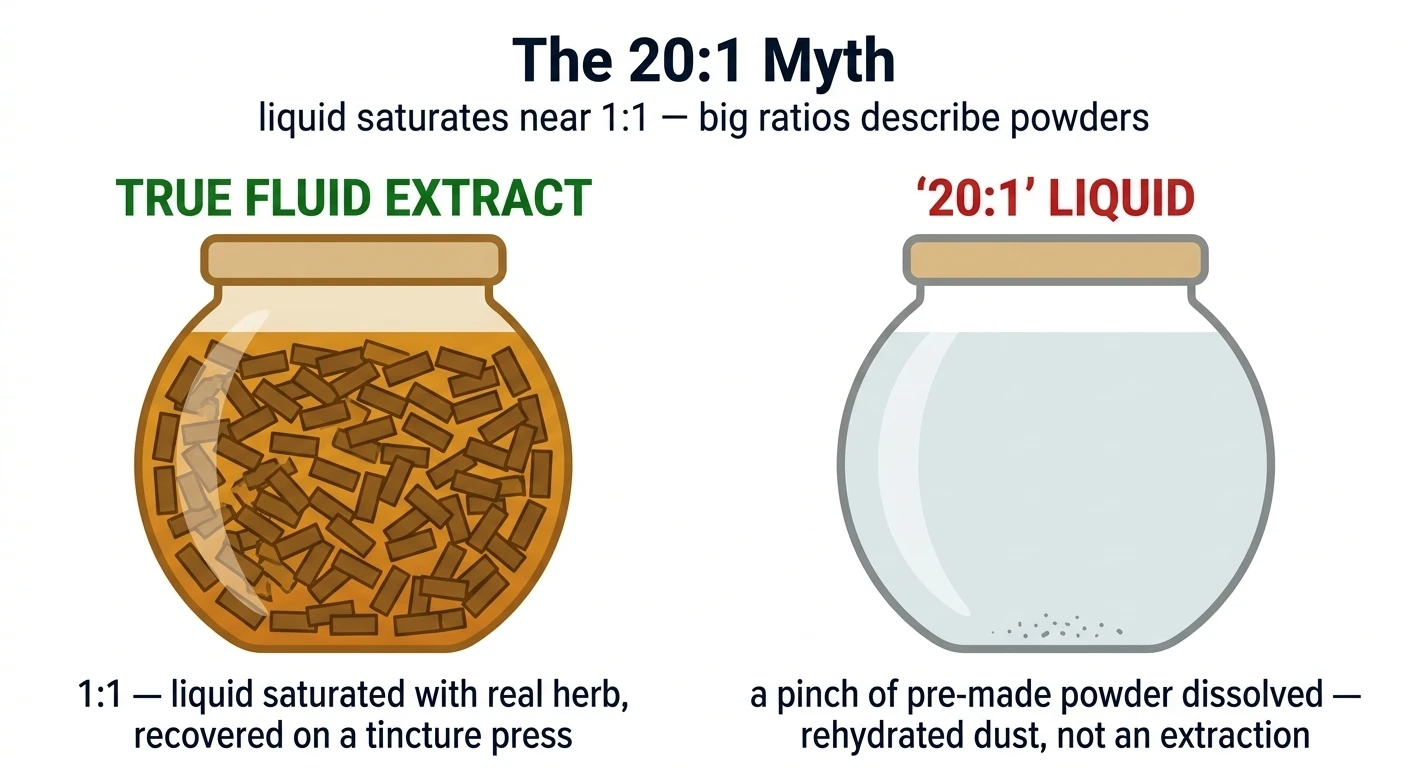
How honest makers state potency: herb equivalency — what one dropper holds in raw-plant terms — and the extraction ratio, stated plainly.
The red flags, decoded:
| Label signal | What it actually means |
|---|---|
| Milligram weight printed inside the liquid's facts box | A dissolved powder — solid mass inside a liquid implies sludge or a reconstituted extract |
| "Proprietary blend," one total weight, no individual amounts | The cheap-to-expensive ratio is hidden; a blend can be ninety-nine percent filler with a sprinkle of the hero herb and still label "truthfully" |
| Spring water listed as the solvent | An inferior menstruum — already mineral-loaded, reduced extraction capacity |
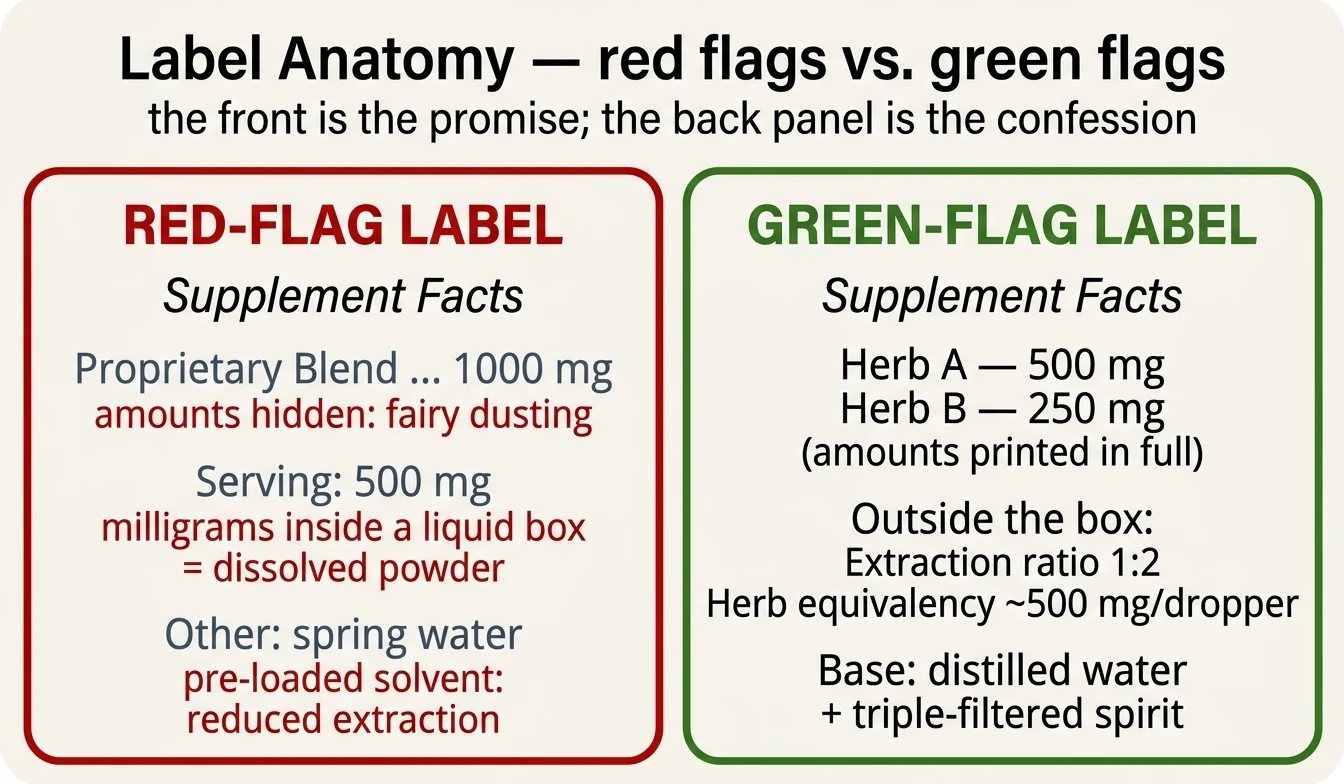
The green flags: distilled water in the base, the extraction ratio stated, herb equivalency printed, the part used named, and amounts in full.
Why the label says "supports" and never "fixes": supplements are a category of food, and food describes how its nutrients work with the normal structure and function of the body. It is the food category's own grammar — and it happens to fit the biology, because a tincture supplies materials the body uses; the body does the work.
Section FAQ
- What does 1:4 on a tincture label mean? One part herb weight extracted into four parts liquid volume — for example, eight ounces of root into one quart of menstruum. The smaller the second number, the more saturated the liquid with actual plant material.
- What does a 20:1 liquid extract claim mean? That the product is a dissolved powder, not an extraction. Liquid saturates at roughly one to one — twenty pounds of herb cannot sit in one part of liquid. The number describes a powder concentrate manufactured elsewhere and rehydrated in the bottle.
- What is a proprietary blend and why is it a red flag? A labeling device that lists ingredients under one total weight with no individual amounts. It legally hides the ratio of cheap filler to expensive active — the practice called fairy dusting.
- Why does the label say "supports" instead of stronger language? Supplements are food, and food describes its nutrients' role in normal structure and function — supports, maintains, promotes. That grammar matches the biology: the tincture supplies raw materials; the body puts them to work.
Part 7 — How Tinctures Are Made
The craft, jar to bottle. Maceration and its equilibrium, the time matrix, the three extraction architectures — single, dual, multi-step — plus percolation, pressing, and reading the sediment. Including the honest history of the spagyric method.
Listen to this section:
Read Audio Transcript
How is a tincture actually made? The whole craft, jar to bottle. This is the longest stop on the tour, so settle in. The process has an arc, the arc has steps, and every step changes what's in the bottle.
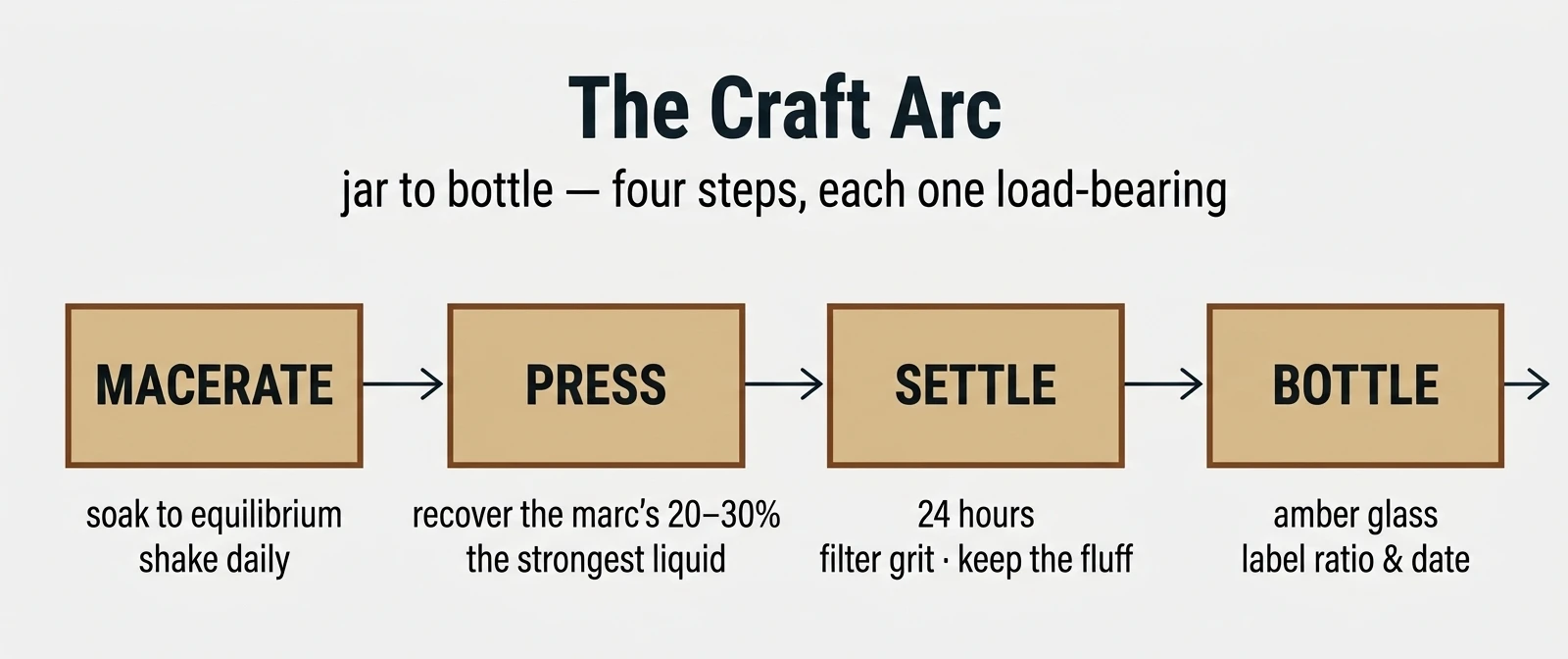
The arc is simple. Macerate. Press. Settle. Bottle. The detail is where the quality lives.
Maceration is the soaking. Herb material, steeped in the liquid until the constituents move into solution. And it runs on a law, not a guess. Solutes move from the plant into the liquid until both sides hold the same concentration. That's equilibrium. Once you reach it, the liquid is full. You can under-extract by soaking too briefly, but you cannot over-extract by soaking too long. The herb simply becomes fully extracted and stays there. What soaking longer buys you is nothing. What shaking daily buys you is speed, because each gentle shake breaks up the saturated layer hugging the herb and lets fresh, hungry liquid take its turn.
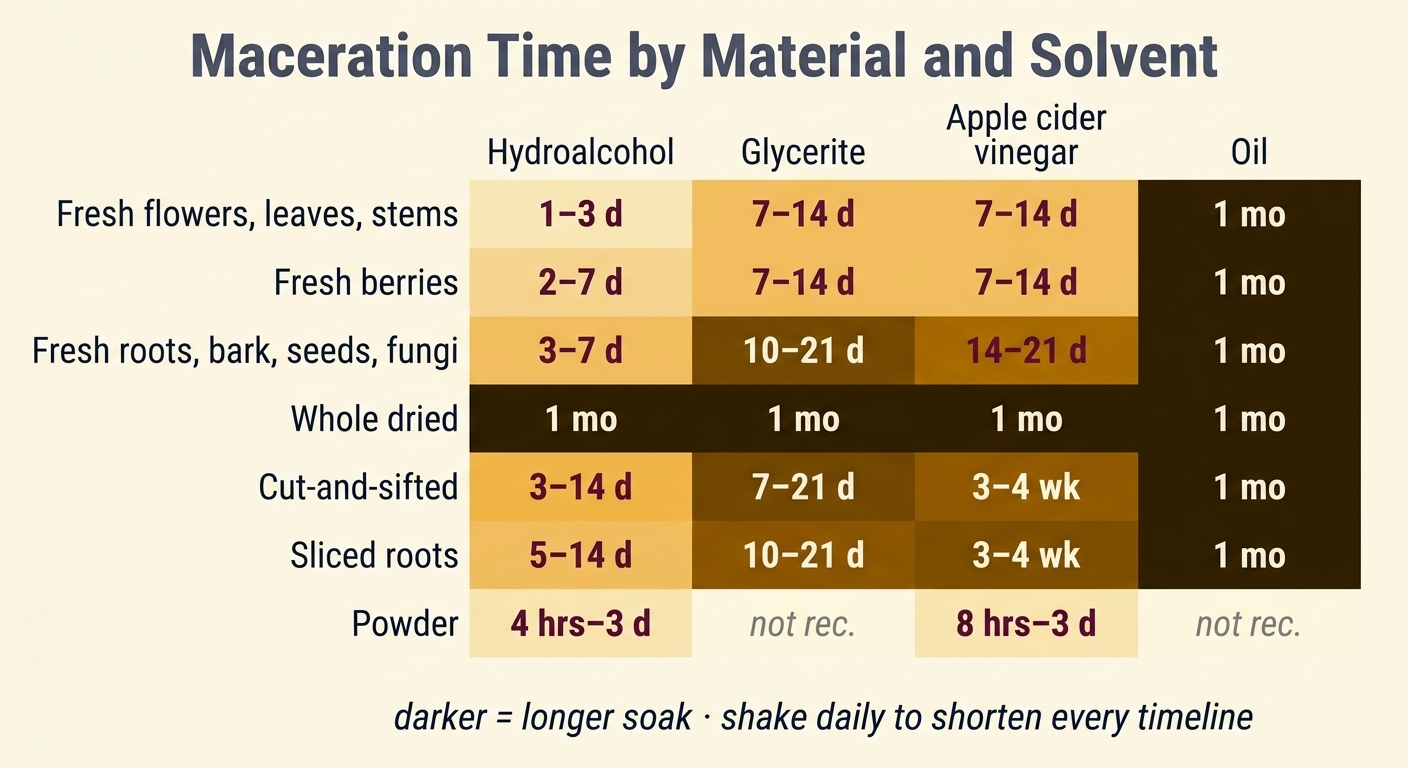
The timelines follow the material. Fresh leaves in alcohol can finish in one to three days. Cut and sifted dried roots take up to two weeks. Whole dried roots, longer. Vinegar and glycerin run slower than alcohol across the board, and oil takes about a month for nearly everything.
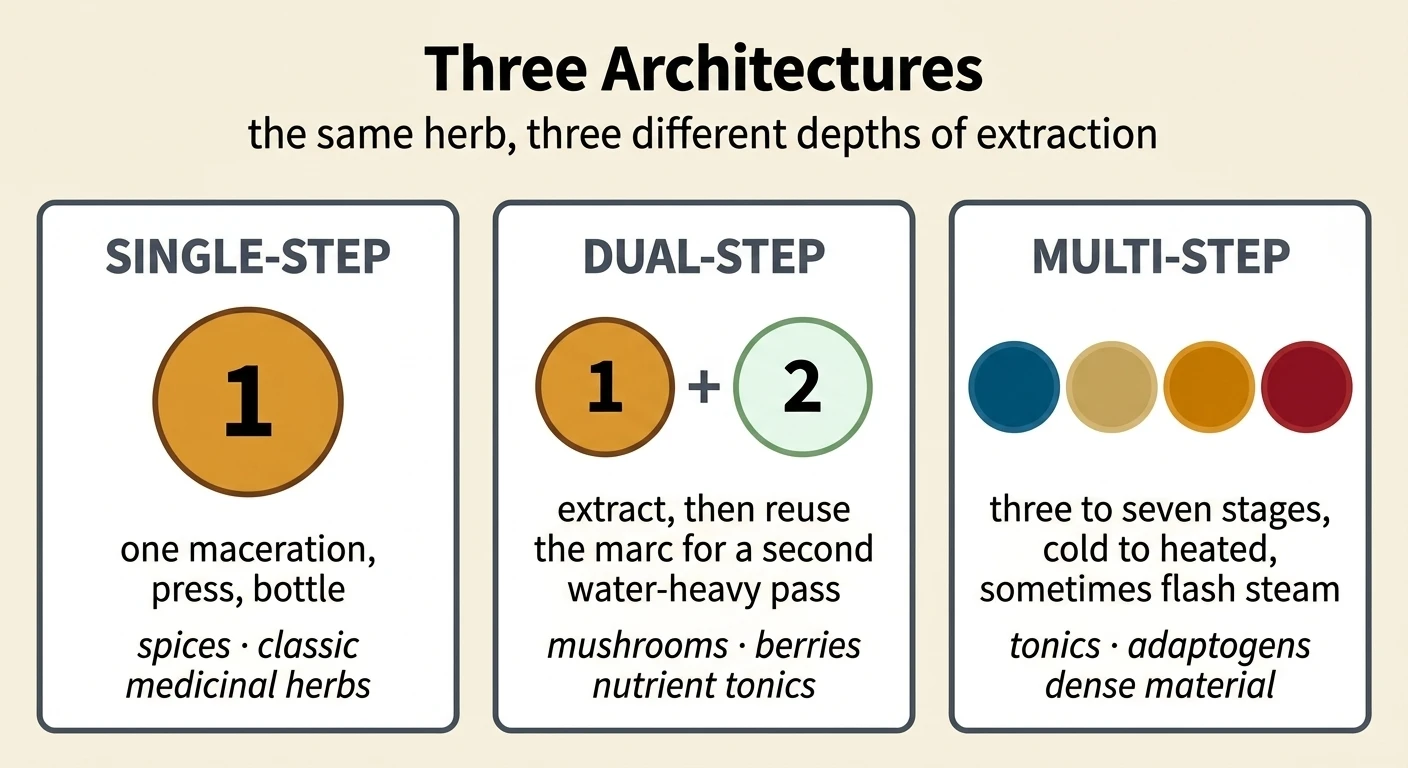
Then the architectures, and this is where products genuinely differ. Single-step is the classic. One maceration, press, bottle. The traditional method, honest and true, and the right form for spices and straightforward medicinal herbs.
Dual-step adds a second pass. You extract once, then instead of discarding the spent herb, you soak it again, usually a water-heavy pass, and combine the two liquids. The first pass took what alcohol takes. The second pulls the nutrients that saturation left behind. Mushrooms, berries, and nutrient-dense tonics earn this treatment.
Multi-step goes further. Three, four, up to seven stages, running progressively from cold to warm to heated, sometimes with flash steam and pressure. The sequence is the intelligence. The cold stages go first, protecting the delicate peptides and oils that heat would ruin. Then heat enters where heat helps. And here's the coolest biology on the page. Mushroom cell walls are chitin, the same tough material as insect shells. Flash steaming cracks those walls so the polysaccharides inside become extractable at all. That's why a serious mushroom extract is never just soaked. It's worked.
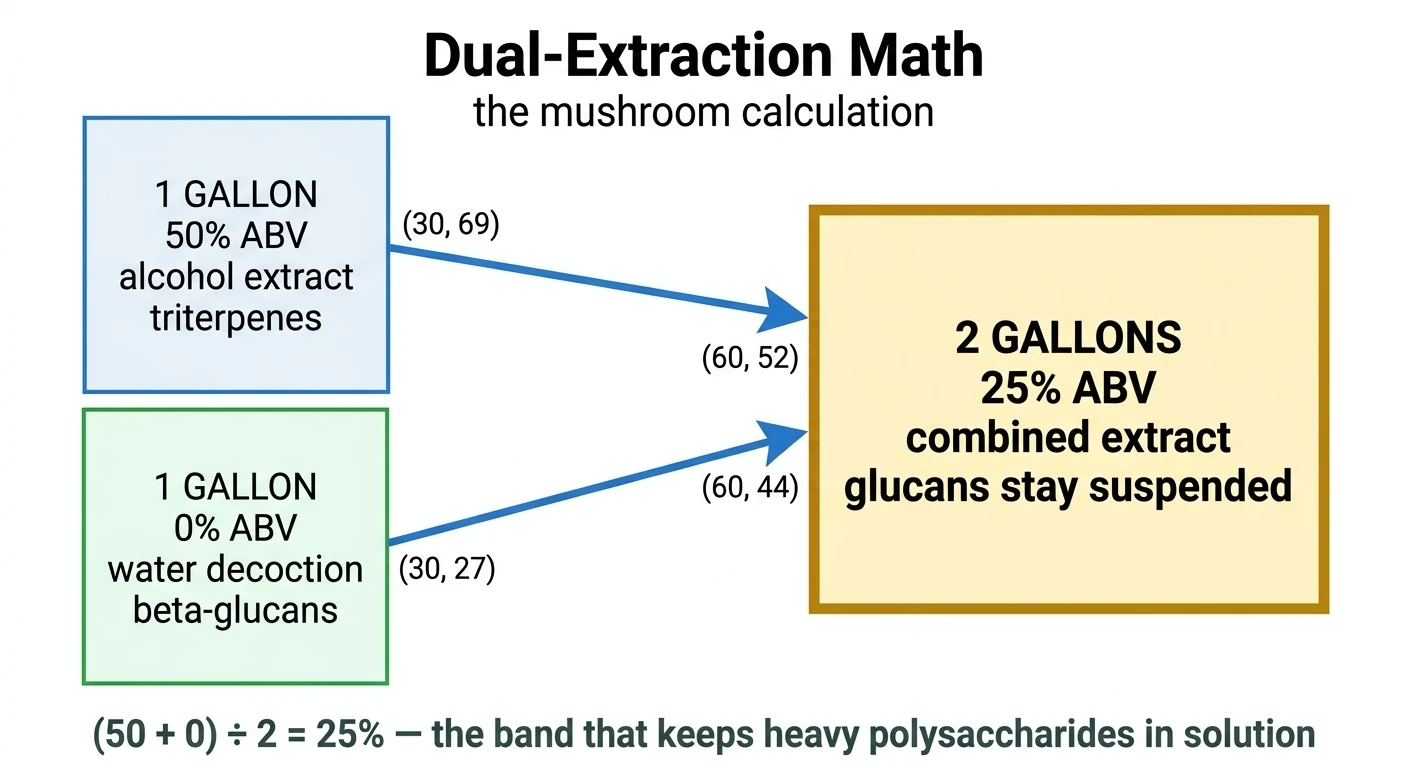
The mushroom math, for the curious. One gallon of fifty percent alcohol extract, combined with one gallon of water extraction, lands you at twenty-five percent. Exactly the band that keeps those heavy beta-glucans suspended instead of shocked out of solution.
Two specialist methods worth knowing. Percolation. Instead of soaking a jar, you pack moistened herb into a vertical column and let liquid drip through under gravity, slow, one drop every two or three seconds. Fresh liquid constantly displaces saturated liquid, so a complete extraction finishes in a day or two instead of weeks. And the pre-soak rule is a safety rule. Dried herbs swell when they wet, and packed dry into glass, that swelling force can shatter the vessel. Always moisten outside the jar first.
And pressing. The spent herb, the marc, holds twenty to thirty percent of your batch, and the liquid it holds is the most saturated in the whole run. A hard twist through cheesecloth recovers most of it by hand. A hydraulic press recovers nearly all, leaving a dry cake. Skipping the press is pouring quality into the compost.
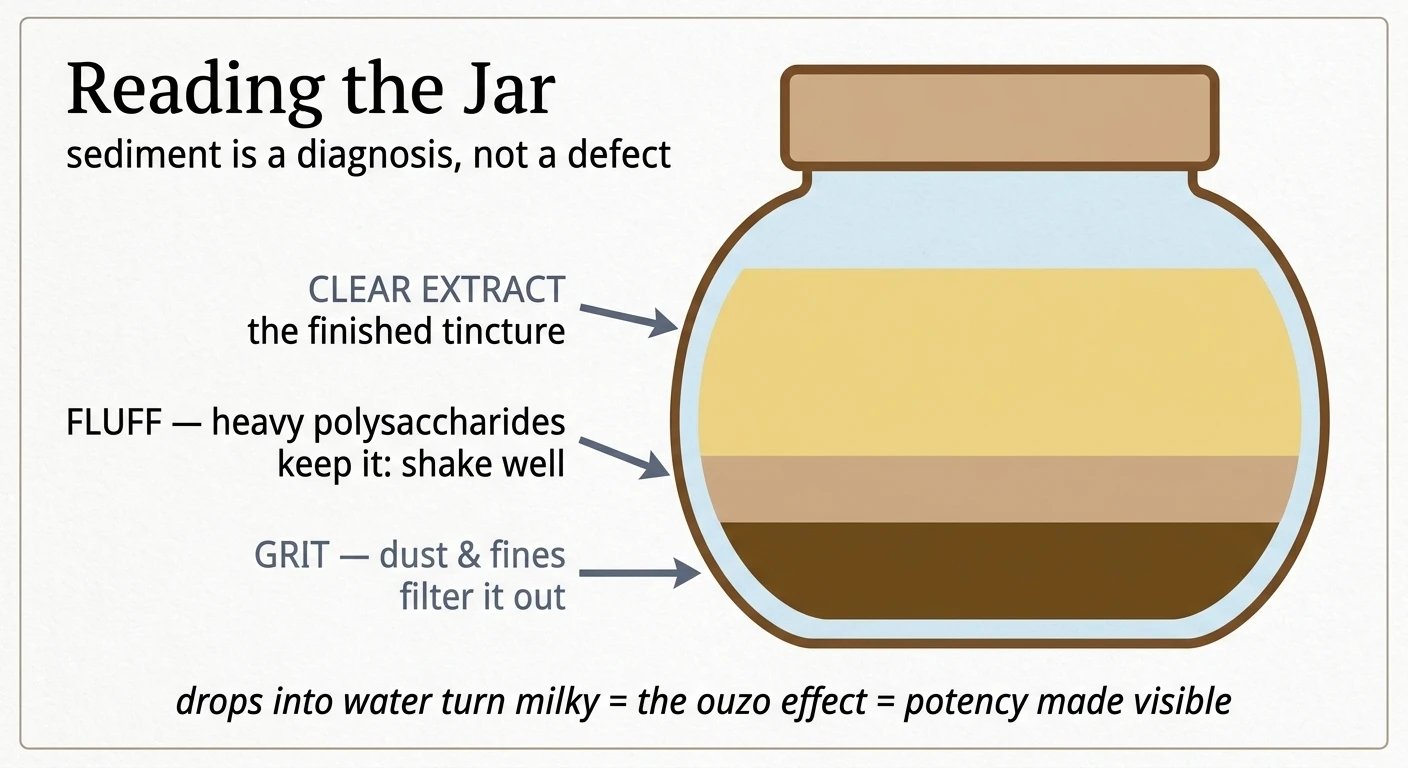
Before bottling, read the jar. Sediment settles, and it means different things. Dark grit that rattles is dust and fines. Filter it. Light, billowy fluff is heavy polysaccharide medicine that fell out of solution. Keep it, and shake well before every dose. And a milky cloud when drops hit water is the ouzo effect, resins emulsifying. Potency, made visible.
Last, the history, told honestly. The old alchemists, the spagyric tradition, extracted the herb, then calcined the spent marc to white ash and dissolved the ash back in, believing they were returning the plant's minerals. The intention was right. The chemistry was not. Mineral ash is largely unabsorbable. Modern multi-step extraction takes the actual minerals and salts directly into the liquid instead. The old aim, done better.
Every step exists to move more of the plant, intact, into the liquid. That's the whole craft.
Taken with meals, over time.
The process arc: macerate — press — settle and filter — bottle.
Maceration kinetics. Solutes move from the plant into the liquid until both hold the same concentration — equilibrium, the plateau. You can under-extract by soaking too briefly; you cannot over-extract by soaking too long — the herb simply becomes fully extracted. Daily gentle shaking disrupts the saturated boundary layer around the herb and introduces fresh hungry solvent, cutting maceration time substantially.
The maceration time matrix:
| Material | Hydroalcohol | Glycerite | Apple cider vinegar | Oil |
|---|---|---|---|---|
| Fresh flowers, leaves, stems | 1–3 days | 7–14 days | 7–14 days | 1 month |
| Fresh berries | 2–7 days | 7–14 days | 7–14 days | 1 month |
| Fresh roots, bark, seeds, fungi | 3–7 days | 10–21 days | 14–21 days | 1 month |
| Whole dried | 5–18 days | 10–21 days | 1 month | 1 month |
| Cut-and-sifted dried | 3–14 days | 7–21 days | 3–4 weeks | 1 month |
| Sliced roots | 5–14 days | 10–21 days | 3–4 weeks | 1 month |
| Powder | 4 hours–3 days | not recommended | 8 hours–3 days | not recommended |
The three architectures:
| Method | How it works | Best for | What it adds |
|---|---|---|---|
| Single-step | One maceration, press, bottle | Spices, straightforward medicinal herbs, the traditional home method | The classic form — clean and true to one solvent's character |
| Dual-step | Extract, then reuse the marc for a second, water-heavy pass; combine | Mushrooms, berries, nutrient-dense tonics | The nutrients the first pass left behind |
| Multi-step | Three to seven stages, cold to warm to heated, sometimes flash-steam and pressure | Tonics, adaptogens, deer antler velvet, master formulations | The complete matrix — the cold stage protects peptides and oils; heat stages activate polysaccharides and crack tough cell walls |
Dual-extraction math, the mushroom calculation: one gallon of fifty percent alcohol extract combined with one gallon of water decoction yields two gallons at twenty-five percent — the band that keeps heavy beta-glucans suspended rather than shocked out of solution.
Why heat for fungi: mushroom cell walls are chitin — the same tough material as insect shells. Flash-steaming cracks it so the polysaccharides become available. Why cold for delicate material: peptides and lipids denature with heat, so antler extractions run cold stages to preserve them.
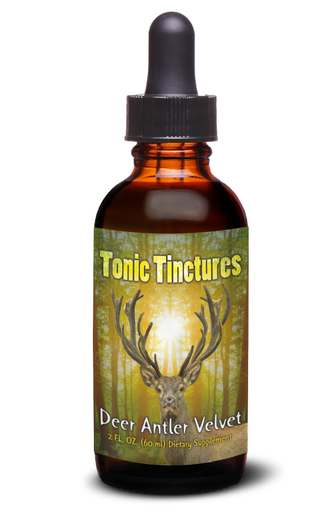
Deer Antler Velvet
Protecting the peptides. Undergoes a strict multi-step cold extraction stage specifically to preserve fragile lipids before any heat is applied.
View Extract →
Reishi Mushroom
Cracking the chitin. Requires a multi-step extraction with flash-steaming stages to break down tough cell walls and capture heavy polysaccharides.
View Extract →Percolation. Instead of soaking a jar, pack moistened herb into a vertical column and let solvent drip through under gravity at a controlled rate — one drop every two or three seconds. Fresh solvent constantly displaces saturated solvent: a complete extraction in twelve to forty-eight hours. The pre-soak rule is safety: dry herbs swell when wetted, and packed dry into glass they can shatter it — always pre-moisten outside the vessel.
Pressing. The spent herb — the marc — holds twenty to thirty percent of the batch, and the liquid it holds is the most saturated in the run. A cheesecloth twist recovers most of it by hand; a hydraulic press recovers nearly all, leaving a dry cake. For expensive herbs, the press pays for itself.
Reading the jar — precipitates:
| Sediment type | Appearance | What it is | What to do |
|---|---|---|---|
| Grit | Dark, sandy, rattles against glass | Dust, soil, cellulose fines — contamination | Filter it out |
| Fluff | Light, billowy layer | Heavy polysaccharides — beta-glucans, inulin — real medicine fallen out of solution | Keep it — shake well before every dose |
| The cloud (louche) | Milky swirl when drops hit water | Resins and oils emulsifying — the ouzo effect | Potency made visible |
The spagyric history, honestly. The old alchemists calcined the spent marc to white ash and dissolved the ash back into the tincture, believing they were returning the plant's minerals. Modern research shows mineral ash is largely unabsorbable — the intention was right, the chemistry was not. Modern multi-step extraction takes the actual minerals and salts directly into the liquid instead: the old aim, done better.
Section FAQ
- What is maceration? The soaking process at the heart of tincture-making — herb material steeped in the liquid until the constituents move into solution. It ends at equilibrium: the liquid holds all it can from the plant, and longer soaking maintains but does not increase potency.
- What is the marc? The spent, used-up herb left after extraction. It holds a fifth to a third of the batch — the most saturated liquid — which is why pressing it matters.
- What's the difference between single, dual, and multi-step extraction? Single is one maceration — the classic. Dual reuses the marc for a second water pass to capture what the first left behind. Multi-step runs three to seven stages from cold to heated, capturing the full matrix for tonics and dense material.
- Why do mushroom tinctures need a heated step? Fungal cell walls are chitin — the same material as insect shells. Heat and flash-steaming crack those walls so the polysaccharides inside become extractable and absorbable.
- What is the cloudy swirl when I add my tincture to water? The ouzo effect: resins and oils dissolved in alcohol emulsify into microscopic droplets when they meet water. In resinous herbs it is a visible certificate of potency.
- What were spagyric tinctures? The old alchemical method: extract, then burn the spent marc to white ash and dissolve the ash into the tincture for its minerals. The mineral ash turns out to be largely unabsorbable — modern multi-step extraction captures the real minerals directly instead.
Part 8 — Make Your Own
The best way to understand a tincture is to build one. The complete home workflow, worked end to end: equipment, the master bitters recipe with parts and weights, the fourteen-day protocol, pressing and labeling — plus two more formulas and the one rule that governs cleansing work.
Listen to this section:
Read Audio Transcript
Can you make a tincture at home? Yes, and building one is the fastest way to understand them all. Here's the complete workflow, worked end to end with our house recipe. Bitters, an apple cider vinegar extraction.
The equipment is short. A quart glass jar. Grade one hundred cheesecloth. A fine mesh strainer. A bowl with a pour spout. Amber dropper bottles, labels, and gloves for handling the herbs. That's the whole shop.
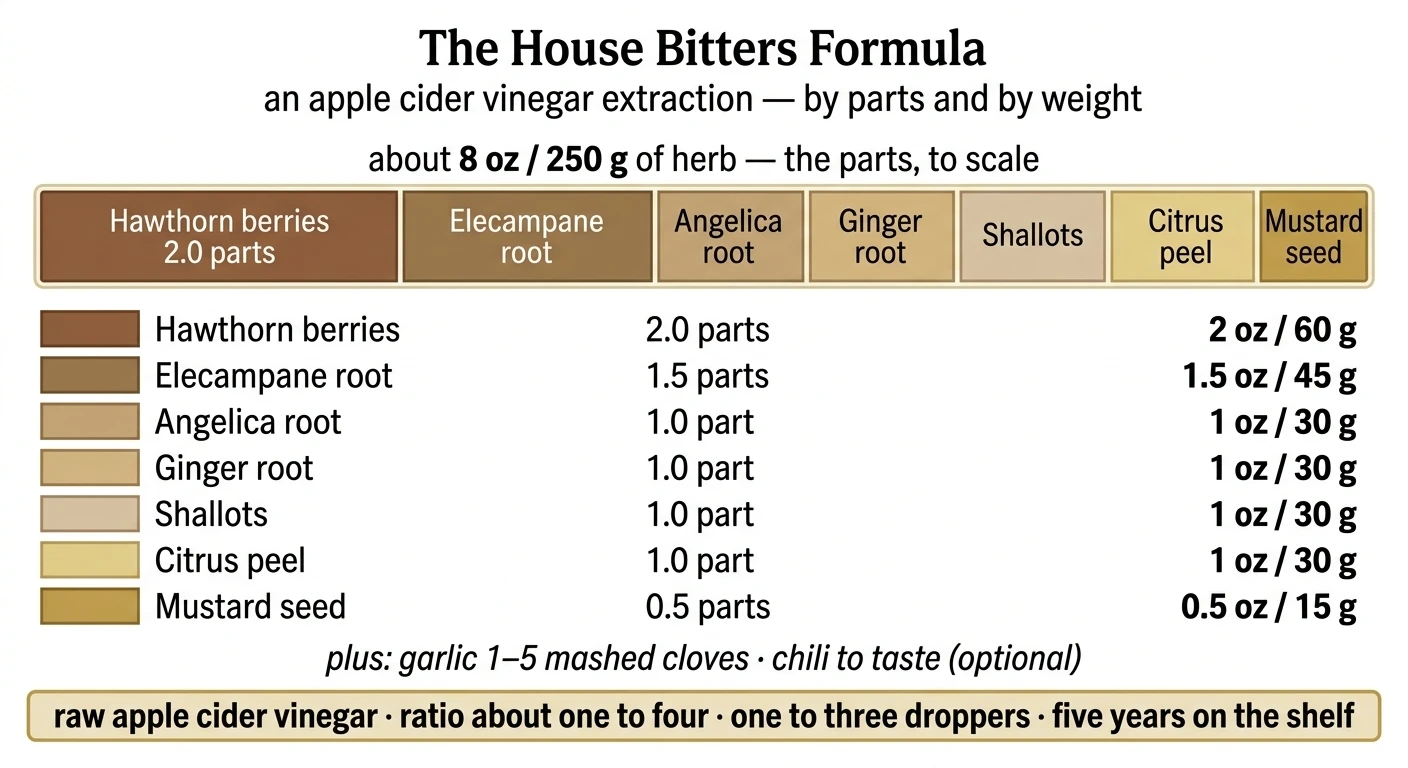
The formula, by weight. Two parts hawthorn berries, the heart of it. One and a half parts elecampane root, or gentian if you want the stronger liver emphasis. One part each of angelica root, ginger root, shallots, and citrus peel. Half a part of freshly cracked brown mustard seed. A few mashed garlic cloves, and chili to taste if you take heat. About eight ounces of herb total, into roughly a quart of raw apple cider vinegar, at about a one to four ratio.
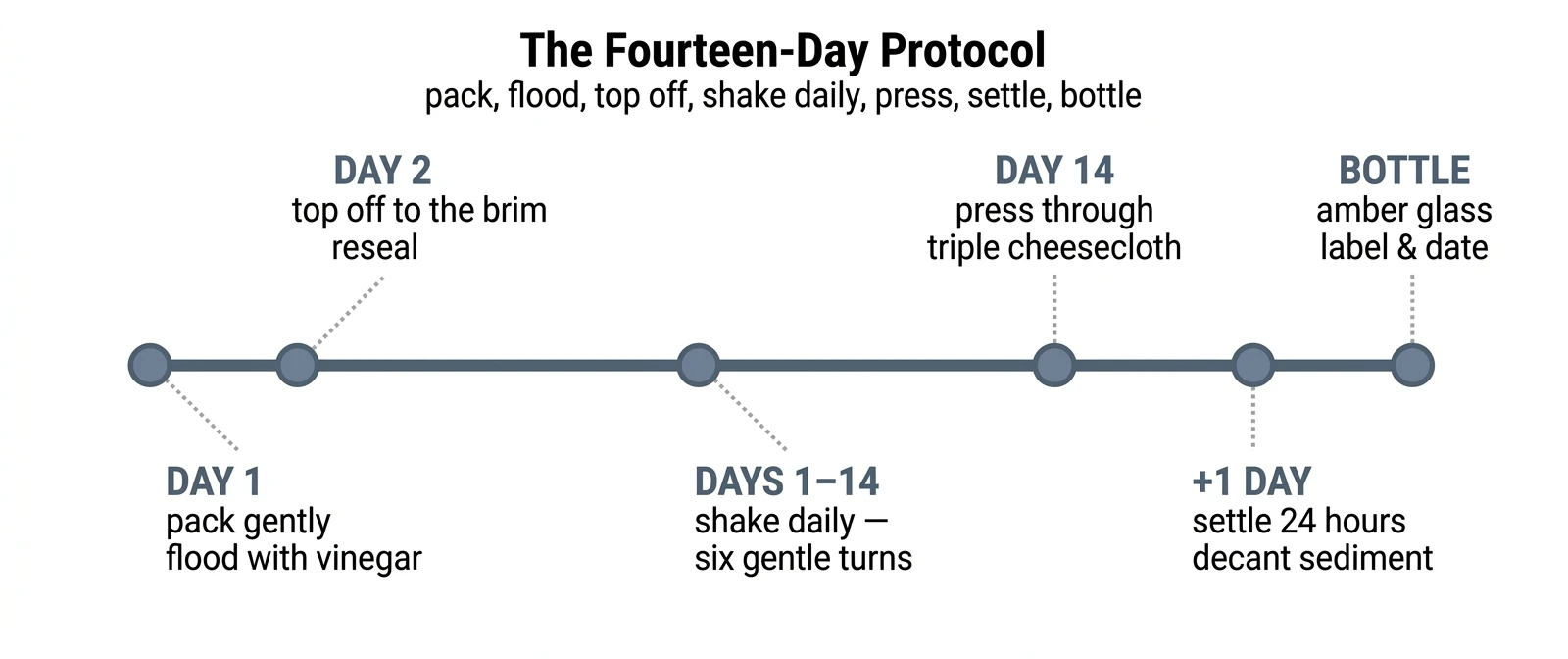
The protocol runs fourteen days. Day one, pack the herbs gently into the jar and flood with vinegar to the top. They'll drink some the first day, so top it off at the twenty-four hour mark. Seal, and shake gently, a dozen slow turn-overs, never violent. Then store it dark, at room temperature, and shake it daily, six gentle turns.
Day fourteen, press. Strain through triple-folded cheesecloth, gather the corners, and twist hard. The fluid trapped in that spent herb is the strongest liquid in the batch. Let it settle a day, decant off the sediment, and bottle in amber glass.
Then label your own bottle. The formula name, the liquid used, the ratio, the date, and keep out of reach of children.
Take one to three droppers around meals, on the tongue if you can take it. The bitter shock is the signal, not a flaw.
And remember the doctrine. Some effects show in the first few days, one to three. The deeper build takes one to two weeks. Benefits accumulate over time.
Taken with meals, over time.
Equipment: a quart glass jar · grade 100 cheesecloth · a fine wire mesh strainer · a large bowl with a pour spout · a spoon · amber dropper bottles · labels · gloves for handling herbs.
The master recipe — Bitters, an acetic tincture. Bitters promote digestion, elimination, and the assimilation of nutrients from food. They are taken around meals, and the bitter taste itself is the signal — hold them on the tongue.
| Ingredient | Parts | Weight |
|---|---|---|
| Hawthorn berries — the heart of the formula | 2.0 | 2 oz / 60 g |
| Elecampane root (or gentian root, for a stronger liver emphasis) | 1.5 | 1.5 oz / 45 g |
| Angelica root | 1.0 | 1 oz / 30 g |
| Ginger root | 1.0 | 1 oz / 30 g |
| Shallots | 1.0 | 1 oz / 30 g |
| Orange or lemon peel | 1.0 | 1 oz / 30 g |
| Fresh-cracked brown mustard seed | 0.5 | 0.5 oz / 15 g |
| Fresh garlic, mashed | minimal | 1–5 cloves |
| Chili peppers, seeds removed (optional) | minimal | 1–5, to taste |
Specifications: menstruum — raw apple cider vinegar, about thirty-two ounces; dried-herb ratio — approximately one to four; dose — one to three droppers; shelf life — five years.
The fourteen-day protocol: Pack the herbs gently into the jar. Flood with vinegar to the top — the herbs will drink some the first day, so top off at twenty-four hours. Seal and shake gently, a dozen slow turn-overs. Store dark and room-temperature. Shake daily, six gentle turn-overs. At day fourteen, strain through triple-folded cheesecloth and twist hard — the fluid trapped in the marc is the strongest in the batch. Let the strained liquid settle twenty-four hours, decant off the sediment, and bottle in amber glass.
Label your own bottle with: the formula name · the menstruum · the herb-to-liquid ratio · single- or multi-step · the date finished · keep out of reach of children.
CALLOUT — Rule of Thumb: "Hawthorn berries may be used as a stand-alone herb — substitute the entire recipe with only hawthorn berries for a delectable, easy-to-take bitter-sweet heart and digestion tonic."

Botanical Profile: Digestapeel (Hawthorn Bitters)
Don't have 14 days to make your own? Digestapeel is built on Hawthorn berries and citrus to stimulate the cephalic phase and promote digestion.
View the Extract →Two more formulas:
The Melissa simplex — one plant, two medicines. Fresh: bruise the leaves to rupture the oil glands, extract two days in eighty-proof — the bright, uplifting aromatics. Dried: extract five days — the deep polyphenols and triterpenes for restorative work. Same plant, different medicine; the choice is the goal.

Lemon Balm Extract
The dried Melissa simplex. Extracted patiently from dried leaves, focusing on the deep restorative polyphenols.
View Extract →
Dandelion Root
The foundation of liver support. An essential dense root extracted at the proper ratio to support natural elimination pathways.
View Extract →The liver-support root blend. Dandelion root two parts, burdock two, yellow dock one and a half, gentian one, oregon grape one, and a half part of cascara sagrada bark to keep the exit open. Four to six weeks maceration in forty percent alcohol. And the one governing rule of cleansing work:
CALLOUT — The Golden Rule of Cleansing: Never scrub faster than you flush. Mobilizing waste without keeping the elimination pathways open just recirculates it. Support the body's own natural pathways — the liver, the bowels, the kidneys — and keep the exit door open.
Section FAQ
- Can I make a tincture at home? Yes — jar, cheesecloth, strainer, and liquid are the whole toolkit. Pack the herb, flood with menstruum, top off after a day, shake daily, macerate per the time matrix, press hard through cheesecloth, settle, decant, and label with the formula, menstruum, ratio, and date.
- Can I use vodka to make tinctures? Yes — eighty-proof vodka is the accessible standard for dried herbs. Its ceiling is its fixed sixty percent water: it cannot reach the higher alcohol some roots and resins need. Diluting ninety-five percent neutral spirit with distilled water covers every target.
- How long do I soak the herbs? It follows the material and the solvent — fresh leaves in alcohol finish in one to three days; cut-and-sifted dried roots take up to two weeks; whole dried roots longer. Shaking daily shortens every timeline.
- Do I have to squeeze the herbs at the end? Yes — the spent marc holds twenty to thirty percent of your batch, and it is the most saturated liquid in the run. Twist the cheesecloth hard.
Part 9 — How to Take a Tincture
Everything practical: the dropper math, finding your own dose, holding under the tongue, the gentle shake, the mealtime doctrine, and what the taste is telling you. The only section of this guide with dosage numbers.
Listen to this section:
Read Audio Transcript
How do you take a tincture? Everything practical, in about ninety seconds.
First, the dropper identity, because every dosing conversation starts here. One dropper is one press of the rubber bulb, which fills the tube to just above half-way. That's thirty drops, and thirty drops is also one milliliter. Own that math, and you can measure anything.
Second, find your dose. Start at a minimum, ten drops to one dropper, and work up over days, watching your own response. The label bounds the dose. Your body defines it.
Third, the mechanics. Shake gently first. Lid on, turn the bottle over back and forth three to five times. Over-shaking whips air into the extract, and air slowly wears it down. Then hold the liquid under the tongue for up to sixty or ninety seconds, and swallow the rest. Or mix it into two to four ounces of lukewarm water. Never hot water. Heat damages the fragile volatile constituents the extraction worked to preserve.
Timing. The best time to take supplements is around mealtime, ideally right after a complete balanced meal, because the meal brings the fats, the bile, and the carriers.
To supplement means 'to add to' a complete meal.
And the taste is telling you something. Bitter is potency announcing itself. The more you taste, the stronger it is.
If a dose didn't sit right, try again at a lower dosage and with a complete meal.
Taken with meals, over time.
The dropper identity. One dropper is one press of the rubber bulb, which fills the tube to just above half-way. That is thirty drops, which is also one milliliter. Own that math and you can measure anything.
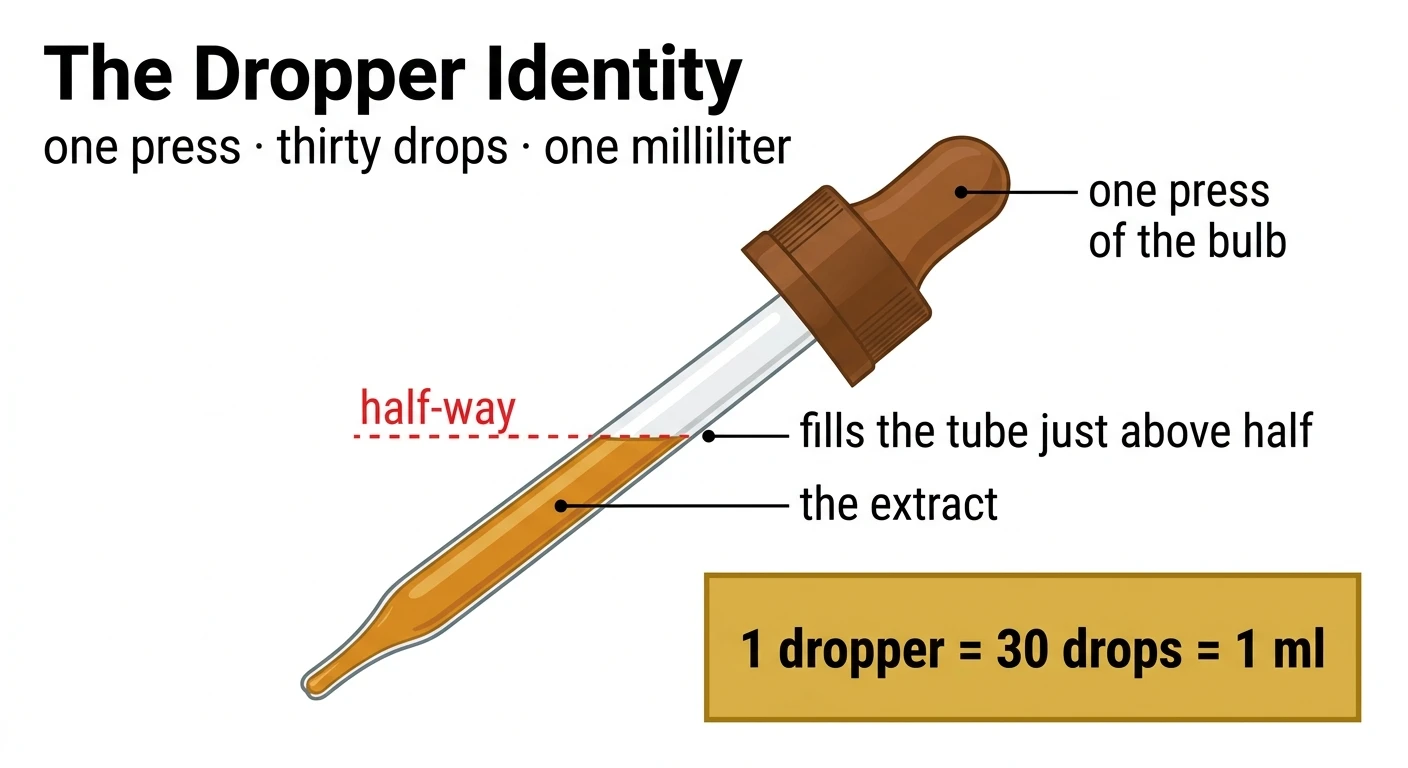
Find your functional dose. Start at a minimum — ten drops to one dropper — and work up over days, watching your own response. The label bounds the dose; your body defines it. You are looking for the amount your body actually responds to, not the maximum on the label.
| Dose tier | Volume | For |
|---|---|---|
| Drop dose | 3–10 drops | Potent botanicals that demand respect |
| Standard dose | 10–30 drops | Most medicinal herbs |
| Tonic dose | 1–3 droppers | Nutritive tonics and adaptogens, taken consistently |
| Short-term elevated frequency | A standard dose every two hours for a day or two | Acute-phase immune and cleansing work, with plenty of water |
By mouth. Hold the liquid under the tongue up to sixty or ninety seconds, then swallow the rest — part absorbs through the capillaries, part goes the digestive route. Or mix into two to four ounces of lukewarm water. Never hot water: heat damages the fragile volatile constituents. Never leave a tincture near heat or in a hot car.
Shake gently. Lid on, turn the bottle over back and forth three to five times. Over-shaking whips air into the extract, and air slowly wears down the delicate constituents. Gentle turnover re-integrates any settled polysaccharides.
The mealtime doctrine. The best time to take supplements is around mealtime — the meal brings the fats, the bile, and the carriers that move constituents across the gut wall, and it buffers the dose. The word itself is the instruction: to supplement means to add to a complete meal.
The flavor decoder. Bitterness is the alkaloid and bitter-constituent family announcing itself. Pungency is volatile oil content. The tingle some herbs leave is data. The more you taste, the stronger it is — a flat, vague extract is flat and vague because little is there to register.
If it didn't sit right: try again at a lower dose and with a complete meal. Almost always the issue was dose or context, not the herb.
Section FAQ
- How many drops are in a dropper? Thirty — one press of the bulb fills the tube just over half-way, which is thirty drops and one milliliter. Every dosing conversation starts from that identity.
- What's the best time to take a tincture? Around mealtime, ideally right after a complete balanced meal. The meal supplies the fats, bile, and carriers that move constituents into the body, and buffers the dose.
- Do I have to hold it under my tongue? It is the better route — the capillary mesh under the tongue takes part of the dose directly into circulation, bypassing digestive transit. Hold up to ninety seconds, then swallow; the rest takes the digestive route.
- Can I mix a tincture into hot tea? No. Heat damages the fragile volatile constituents the extraction worked to preserve. Lukewarm or cool water, juice, or a smoothie — never hot liquid.
- How do I find my dose? Start at the minimum — ten drops to one dropper — and work up over days, watching your response. The label bounds the dose; your body defines it.
- Can I take several tinctures together? Yes, generally — but take liquid tonics separately rather than mixed in the mouth. Each extract holds its own constituent balance and deserves its own clean passage. Space them a minute or two apart.
Part 10 — What to Expect, and How to Store It
Honest timelines and honest storage. You are filling reservoirs, not flipping switches — and the bottle keeps for years if you keep it right: amber glass, cool and dark, no fridge.
Listen to this section:
Read Audio Transcript
How long until you notice something, and how do you keep the bottle right? Honest timelines first, then honest storage.
The timeline has three movements. Some effects show in the first few days, one to three. Deeper effects build and become noticeable within one to two weeks, as the tissues start holding what they were short on. And a full tonic cycle runs forty-five to ninety days. The season your body needs to fill its reservoirs.
Why so long? Because your body keeps a priority list. The survival organs, the heart, the brain, the liver, get fed first. The visible places, the skin, the hair, the nails, are last in line. So the changes you see in the mirror arrive last, on purpose. And skipping days keeps the reservoir forever at the survival tier, never reaching the rest.
That's why consistency beats dosage, every single time. A single dose does very little. The same modest dose, taken daily with meals, compounds the way steady deposits compound. Enough taken regularly outperforms heroic taken occasionally.
Benefits accumulate over time.
Now storage, and it's a short list. Amber glass, because it filters the light that breaks chemical bonds. Cool and dark. A cupboard, not a windowsill. Never refrigerate, because cold gels the lipids and waxy constituents into sludge. Keep it under about one hundred twenty degrees, and never into hot drinks. An opened bottle is best finished within a month or two. Unopened, it keeps for years from the batch date.
And read the bottle as it ages. Fluff settling is heavy polysaccharide medicine, so shake well before every dose. A milky cloud when drops hit water is the ouzo effect, potency made visible. A tincture doesn't spoil. It mellows. An old tincture is a gentle tincture.
Taken with meals, over time.
The timeline doctrine. Some effects show in the first few days — one to three. Deeper effects build and become noticeable within one to two weeks, as the tissues start holding what they were short on. A full tonic cycle runs forty-five to ninety days — the season the body needs to fill its reservoirs.
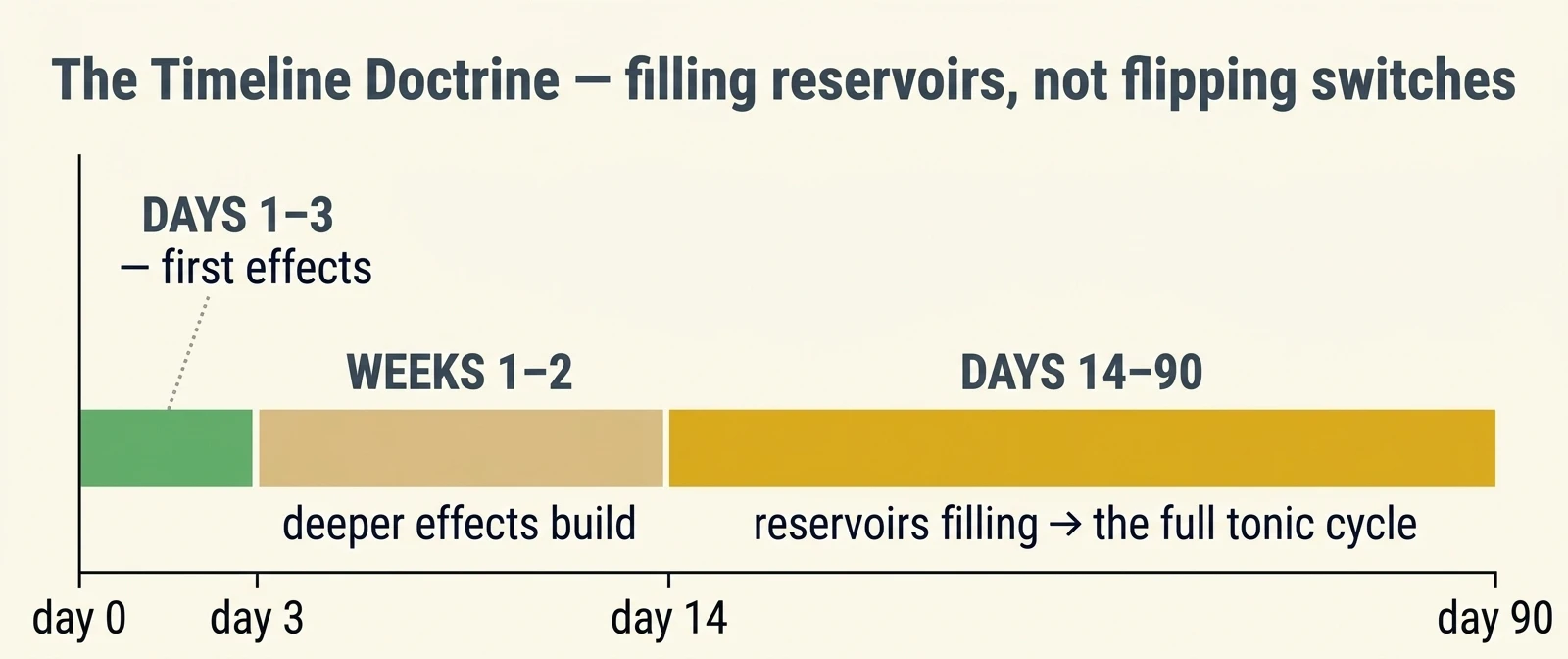
Why it takes time. The body keeps a priority list: the survival organs — heart, brain, liver — get fed first, and the visible places — skin, hair, nails — are last in line. The changes you see in the mirror arrive last, on purpose. Skipping days keeps the reservoir forever at the survival tier.
Consistency beats dosage. A single dose does very little; the same modest dose taken daily with meals compounds, the way steady deposits compound. Enough taken regularly outperforms heroic taken occasionally, every single time. Benefits accumulate over time.
Storage rules: amber glass — it filters the UV light that breaks chemical bonds · cool and dark — a cupboard, not a windowsill · never refrigerate — cold gells the lipids and waxy constituents into sludge · keep under about one hundred twenty degrees · never into hot drinks · opened bottles are best finished within a month or two; unopened, they keep for years from the batch date.
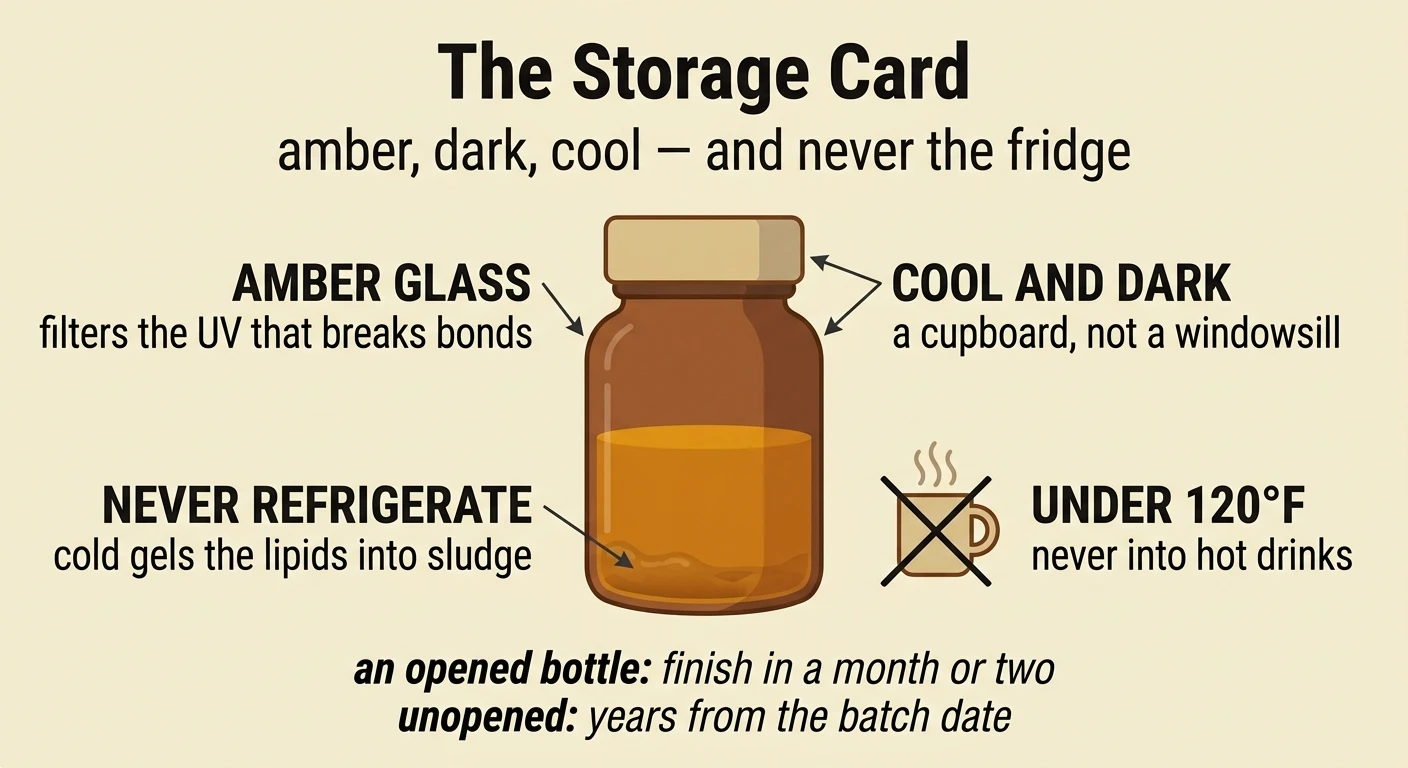
Reading your bottle over time: grit settles — filter it if it bothers you. Fluff collects — that is heavy polysaccharide medicine; shake well before every dose. And a milky cloud when drops hit water is the ouzo effect — potency made visible.
The honesty note: a well-made tincture holds the majority of its potency for years and stays safe far longer than that — the alcohol sees to it. It does not spoil; it mellows. An old tincture is a gentle tincture.
Section FAQ
- How long until I notice something from a tincture? First effects in one to three days; deeper effects build within one to two weeks; a full tonic cycle runs forty-five to ninety days. The reservoirs fill with steady deposits — the visible places get fed last, by design.
- Do tinctures expire? They mature more than they expire. Alcohol keeps the preparation sterile indefinitely; potency declines slowly over years. A tincture a few years old is safe and simply gentler than a fresh one.
- Should I refrigerate my tincture? No. Cold solidifies the lipids and waxy constituents into gel. Room temperature, dark, amber glass — that is the whole storage protocol.
- Why does my tincture say shake well? Because real medicine settles. Heavy polysaccharides and resins fall out of suspension as the bottle sits. Shaking re-integrates them into every dose — it is instruction, not boilerplate.
Part 11 — How to Know a Good Tincture
Quality leaves evidence, and you can read it in about a minute. The checklist, the taste assay, what a serious maker refuses, the plain-language safety vocabulary, and the division of labor between herbs and drugs.
Listen to this section:
Read Audio Transcript
How do you know a tincture is any good? You can't see quality through the glass, but quality leaves evidence, and you can read it in about a minute.
The checklist. Cut and sifted herb material, so the matrix was protected from air before extraction, not pre-oxidized powder. Cold process where the herb demands it, so the fragile fraction survived. Multi-step extraction for tonics and dense material, so you get the full matrix, not just what one pass catches. The ratio stated plainly. The part used named, root for the root plants, not the mowings. Distilled water in the base. And amounts printed in full, with nothing hiding inside a blend.
Then taste, because your tongue and nose are testing equipment you carry everywhere. A real extract of a real herb announces itself. Bitter, pungent, alive. The more you taste, the stronger it is. A flat, sweet, vague liquid is flat and vague because little is in it.
And what a serious maker refuses, said plainly. Dissolved powders sold as extractions. Glycerites for tonics and adaptogens. Proprietary blends. Ratio marketing. Fillers presenting as potency.
Now the safety vocabulary, in plain words, because it's part of quality. When something unpleasant follows a tincture, it's almost always dose or context. An empty stomach, a concentrated dose on a bare gut lining, more of something than the body could process at once. Not the herb. The fix is a smaller amount, a real meal, or a better bottle. And if cleansing work makes you feel worse before better, that's the body mobilizing faster than it's eliminating. Slow down, drink water, keep the exit open. That's information, not alarm.
If you take a medication, that's the one conversation to have with the pharmacist who knows your routine. Logistics, not ownership.
And the division of labor, both directions, because it's the honest frame. Herbs are always more effective and more powerful in the long term, for supporting health and building capacity, day after day. Drugs are always more effective and more powerful in the short term, for emergencies and crisis. Do not use an herb when one should use a drug, and do not use a drug when one should use an herb.
It is important to do your own research. Health is the most valuable asset of one's life and the most valuable investment.
Be the Best and Buy the Best, and know that the best is made the way this guide describes.
Taken with meals, over time.
The quality checklist:
| Marker | What it tells you |
|---|---|
| Cut-and-sifted herb material | The matrix was protected from air before extraction — no pre-oxidized powder |
| Cold process where the herb demands it | The fragile volatile fraction survived |
| Multi-step extraction for tonics and dense material | The full constituent matrix, not just what one pass catches |
| Ratio stated plainly | Saturation transparency — you know what the liquid holds |
| Part used named | The right part of the right plant — root for root herbs, not mowings |
| Distilled water in the base | Maximum extraction capacity, not pre-loaded solvent |
| Amounts printed in full | Nothing hidden in a blend |
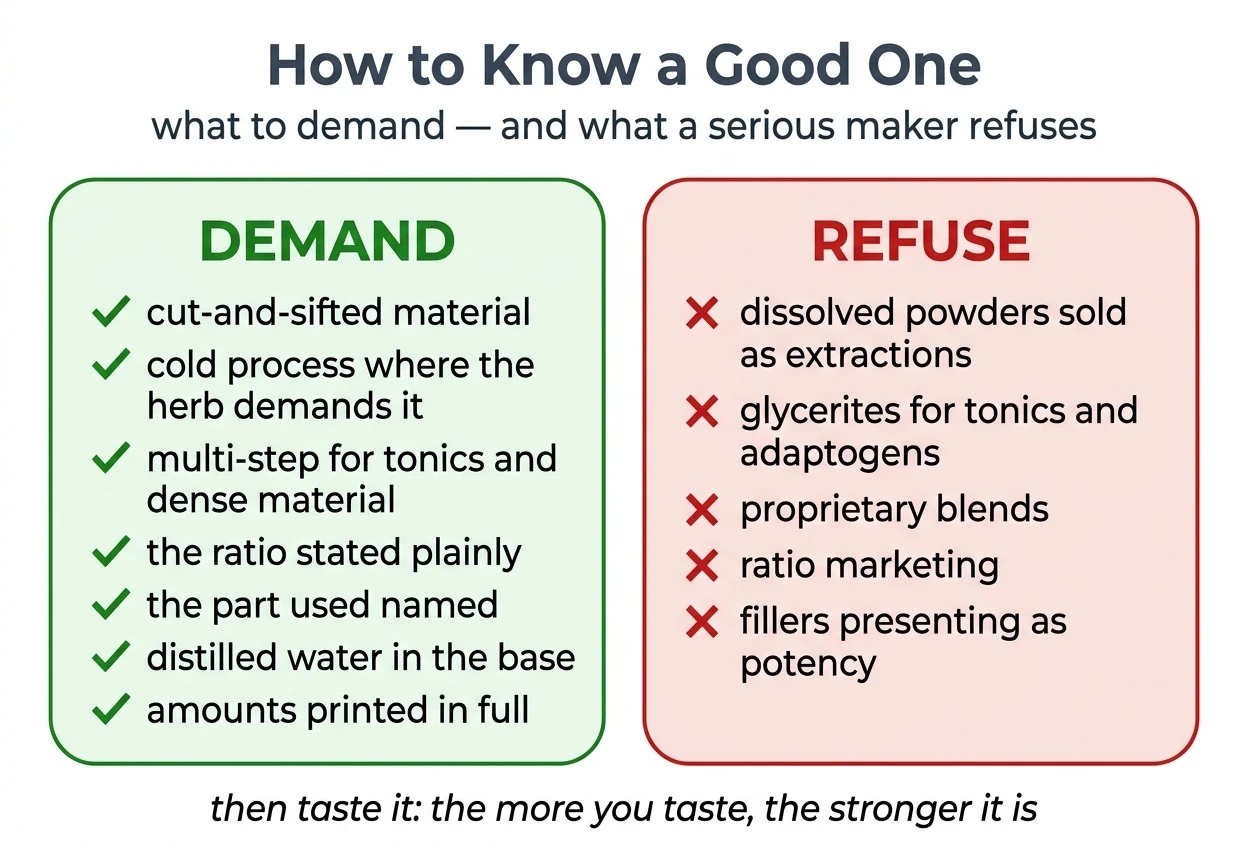
Taste is the built-in assay. Your tongue and nose are testing equipment you carry everywhere. A real extract of a real herb announces itself — bitter, pungent, alive. The more you taste, the stronger it is. A flat, sweet, vague liquid is flat and vague because little is in it.
What a serious maker refuses: dissolved powders sold as extractions · glycerites for tonics, superfoods, and adaptogens · proprietary blends · ratio marketing · fillers presenting as potency.
The safety vocabulary, in plain language. When something unpleasant follows a tincture, it is almost always dose or context — an empty stomach, a concentrated dose on a bare gut lining, more of something than the body could process at once — not the herb. The fix is almost always a smaller amount, a real meal, or a better-made product. And a true reaction to cleansing work — feeling worse before better — means the body mobilized faster than it eliminated; the answer is to slow down, hydrate, and keep the exit open. Each of those is information, and the vocabulary tells you which is which.
Herbs and drugs — a division of labor, stated both ways. Herbs are always more effective and more powerful in the long term, for supporting health and building capacity, day after day. Drugs are always more effective and more powerful in the short term, for emergencies and crisis care. Do not use an herb when one should use a drug, and do not use a drug when one should use an herb. Two tools, two timeframes, two lanes.
The close. It is important to do your own research. Health is the most valuable asset of one's life and the most valuable investment. Be the Best and Buy the Best — and know that the best tincture is the one made the way this guide describes: whole herb, honest liquid, patient extraction, and the part of the plant that earned the reputation.
Section FAQ
- How do I know a tincture is good quality? Read the evidence: cut-and-sifted material, cold processing where the herb demands it, a stated ratio, the right part used, distilled water, full amounts. Then taste it — a real extract announces itself. The more you taste, the stronger it is.
- Do tinctures have side effects? Side effect is a term from the world of forced mechanisms. A tincture supplies materials and the body runs its own processes. When something unpleasant follows, it is nearly always dose, context, or product quality — and the fix is a smaller amount, a real meal, or a better bottle.
- Are tinctures safe with medications? This one is pharmacist territory — bring your full routine, bottles included, and have the conversation. That is not giving up ownership; it is a driver checking with the mechanic before a long trip.
- Are herbs better than drugs? Neither better nor worse — different lanes. Herbs are more effective long-term for supporting health and building capacity; drugs are more effective short-term for emergencies and crisis. The mistake is handing one tool the other's job.
Glossary
Tincture — a concentrated fluid supplement made by extracting herbs into a liquid, taken in small servings and fractional doses.
Tincturing — the overall process of making a tincture.
Herb — any edible, non-intoxicating plant or plant part, including seaweeds, and by tradition even animal materials and minerals.
Extraction — pulling the constituents and nutrients of herbs into the liquid.
Macerate — to soak and soften herbs in the fluid over time.
Menstruum — the extraction liquid: alcohol and water, glycerin, vinegar, or oil.
Marc — the spent herb left after extraction, pressed and discarded.
Precipitates — particles that settle in the finished extract; unwanted ones are dust and fines, semi-soluble ones are constituents worth keeping.
Liquid or fluid extract — the finished tincture.
Hydroalcohol — the alcohol-and-water menstruum; the superior standard.
Glycerite — a glycerin-and-water extract.
Cut-and-sifted — herb cut to small pieces with the powder sifted out; the extraction standard.
Volatile — constituents that evaporate or oxidize on contact with air.
Percolation — extraction by slow drip through a packed column.
Decoction — hot-water extraction, usually of dense roots and fungi.
Spagyric — the old alchemical method of calcining the marc to ash for its minerals; historically important, chemically superseded.
Herb equivalency — the raw-plant weight a serving of extract represents.
Titration — starting at a minimum dose and working up to your functional dose.
Ouzo effect — the milky emulsion when resin-rich drops meet water; potency made visible.