
Discover the honest truth about Astragalus Root—the classical warming adaptogen known for centuries as the "Yellow Leader." Whether you are looking to support sustained daily energy, fortify your adaptive immune response, or build up a run-down constitution, the secret lies in the maturity and synergy of the whole root. This guide strips away the marketing hype to teach you exactly what Astragalus is, what it does, and how to properly use it for deep, systemic vitality.

I recorded these audios to directly answer the questions I've received most over the last 26 years. The text below contains the actual transcripts.
Jason J. DukeOwner / Artisan
Reference Directory

Commit to the Practice
Tonic herbalism rewards consistency. The deep, systemic building work happens quietly over a 45 to 90-day cycle of continuous saturation. Supply the raw materials your body needs with our premium 3-pack.
Shop the 3-Pack Formulation1. What is Astragalus?
So, what is Astragalus, exactly? That is the question worth starting with, because this root carries a standing in Chinese herbalism that few botanicals anywhere can match.
Astragalus is a liquid extract made from one hundred percent astragalus root, the species astragalus membranaceus, organically grown and sustainably sourced. In our classification, it is an adaptogen, and its energetic is invigorating, warming and output. We will come back to what that means, but hold that word, adaptogen, because it tells you what kind of claims are coming.
Now, the Chinese have a name for this root, and the name is the lesson. They call it huang qi. Huang means yellow, for the golden core of the mature root. And qi here means a leader, an elder among men. So the name translates to the yellow leader, and that is not marketing. That is rank. The classical herbalists looked at a thousand roots and named this one the senior of the tonic class, the leader of the herbs that build the body up. When a tradition that old puts a name like that on a plant, you pay attention.
But get this. Astragalus is a legume. It is in the pea family, and the pea family are the soil builders of the plant world. They partner with bacteria in the ground to pull nitrogen out of the air and feed the soil itself, so the ground they grow in becomes richer than the ground they started in. The root that builds the soil, used for two thousand years to build the body. That parallel is not an accident, and it is my favorite thing about this plant.
What is inside the root is a rich profile of constituents. The one I will name now is the astragaloside, a triterpene saponin, which supplies building blocks for cellular function and steady energy metabolism. We will walk that mechanism later. For now, the word is steady.
And that is the honest boundary. Astragalus is not a stimulant. It does not push the body with aggressive stimulation. It supplies raw materials, and your body does the work, steadily, over time.
A good tonic cycle is forty-five to ninety days.
Taken consistently over time.
2. Where Does It Come From?
So where does Astragalus come from, and why has this root stood the test of time? The honest answer is that almost nothing else in the herbal world has stood longer.
Did you know that astragalus carries over two thousand years of recorded use in China? It is honored among the fifty fundamental herbs of classical Chinese herbalism, the short list of the truly great tonics, and it earned a written place in Li Shizhen's great materia medica of the fifteen-nineties, the encyclopedia that organized the whole of Chinese medicine. When a root is still being taken, still being respected, after twenty centuries, that is not a trend. That is a verdict rendered by an unbroken line of practitioners.
And the tradition is a food tradition as much as an apothecary tradition. In Chinese kitchens, huang qi, the yellow leader, is a soup herb. Sliced into chicken broth, simmered into bone stock, ladled out to the tired and the run-down. The grandmother's pot and the physician's shelf carried the same root. That matters for how you use it today, and we will come back to that.
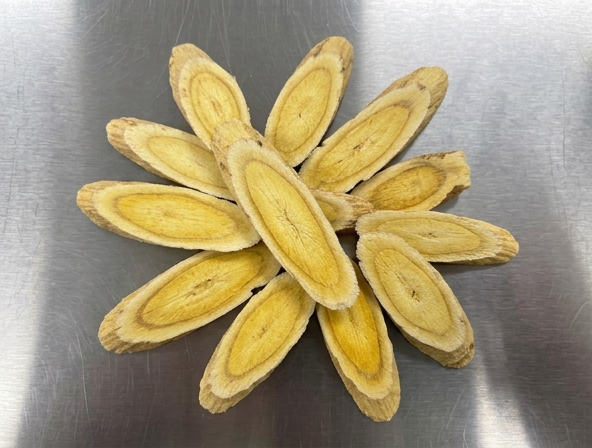
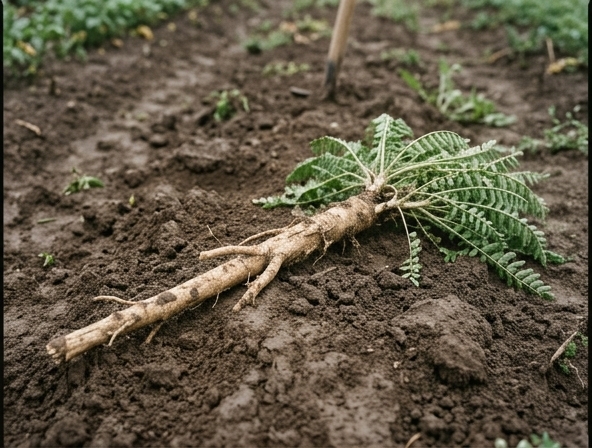
Now, concerning the plant itself. Astragalus is a hardy perennial, and the medicinal grade is the mature root, a long taproot that spends years driving down into the ground, storing its constituents, thickening, building. The traditional slices are cut to show that golden yellow core. The root takes its time, and that patience is the potency.
Our extraction respects that patience. The root we use is organically grown and sustainably sourced, one hundred percent astragalus membranaceus. We extract it in structured distilled water and triple filtered USP grade organic alcohol, twenty-five percent by volume, cold processed, so the fragile constituents hold their structural integrity in fluid suspension for maximum absorption. The water pulls its class of constituents, the alcohol pulls another, and the whole root's synergy comes through into the bottle.
You can view our full extraction and lab standards on our standards page. We keep them published because craft should be visible.
Slow roots, slow extraction, long history. That is where this comes from.
Taken consistently over time.
3. What Does It Actually Do?
What does Astragalus actually do in your body? This is the question the whole page answers, and the answer is a lesson in how tonics work, so let me walk it properly, system by system.
First, the classical frame, because the Chinese saw this first. The old physicians described a defensive energy called wei qi, the protective qi that patrols the surface of the body, just under the skin, standing watch at the walls like a garrison at the outer gate. And huang qi, the yellow leader, was their great herb for nourishing that outer defense. Now hear the modern chemistry say the same thing. The complex polysaccharides in astragalus supply the raw materials your immune function requires. These constituents allow the internal environment to identify foreign material, initiating proper containment and removal, which maintains tissue cleanliness and cultivates a highly adaptive immune response, while fortifying the outer protective wall, the skin. The garrison at the gate, described twice, two thousand years apart. That is my favorite convergence in the whole materia medica.
Second, energy. Specific triterpene saponins, known as astragalosides, supply the building blocks necessary to support cellular function and steady metabolic output during physical activity. Notice the word steady. Your cells get materials, and they make energy with them, at the pace your body sets.
Third, the breath. A rich profile of flavonoids promotes invigorating, warming and output circulation. That healthy blood flow delivers oxygen and nutrients to every cell, maintaining clear and open airways and supporting the lung tissues. Warmth, movement, and breath, all one chain.
And fourth, the foundation underneath all of it. Specific bitter compounds and bioflavonoids maintain the production and activity of your digestive enzymes, allowing the body to extract vital nourishment from the diet. The best food in the world only matters if the body assimilates it, and astragalus works on that assimilation.
Now, a quick note here, because this is a food herb, and it always has been. In the Chinese tradition it was simmered into the soup and taken with the meal. The tradition and our doctrine agree completely. Complete balanced meals first, the herb added to them. Your body does the work. Astragalus supplies the materials.
This constituent synergy fortifies the body against everyday wear and tear, helping you adapt to various challenges and maintain steady physical resilience, across the body, emotions, mind, and spirit.
Benefits accumulate over time.
4. Who Is It For?
Who is Astragalus actually for? Let me paint the pictures, because this root serves more kinds of people than most, and you will likely recognize yourself in one of them.
First, the person around people. Being around crowds, commuting, the office, the school year, the airport, all of it demands an adaptive immune response, and this botanical provides the complex polysaccharides that let the internal environment identify foreign material and maintain tissue cleanliness. If your life puts you in shared air, this is your herb, and it has been for twenty centuries.
Second, the worker. Standing on your feet and working a physical shift requires sustained energy, and specific triterpene saponins supply the raw materials to support steady metabolic output and fortify against everyday wear and tear. And here is where I will add something the tradition teaches. Huang qi was the classical herb of the upright, held-up body. Standing tall through a long shift is structural work, structural work needs materials, and the upright body is a fed body, built on protein and complete meals. The herb supplies materials, the meal supplies the rest.
Third, the one getting strength back. Getting back on your feet after a hard season, feeling like yourself again, demands structural support, and this adaptogen supports the body's natural regenerative processes by replenishing energy stores and supplying building blocks for natural recovery. In China, huang qi was the rebuilding herb. Some uses of a plant never go out of date.
And a fourth beat for the health-conscious. Eating clean and meal prep only work if the body assimilates the nutrients, and the bitter compounds and bioflavonoids here maintain digestive enzyme production so the diet actually delivers its nourishment.
Now, who is this not for? I will tell you plainly. If someone is shopping for aggressive stimulation, an aggressive jolt, a quick fix, this is the wrong shelf. Adaptogens supply raw materials for steady energy. They work with the body, not against it.
So the short version is this. The person who wants their defenses nourished, their energy steady, their recovery supported, and their posture held up on a well-fed frame, that is who astragalus is for.
Long term results bring the most satisfaction.
5. How Do You Take It?
Tonic Synergy & Timing: We remind you that with consistent use, benefits accumulate over time.
Because Astragalus functions to help your body assimilate nutrients and fuel, it is highly recommended to take your doses alongside complete balanced meals (proteins, fats, and carbohydrates) to provide the building blocks your body builds from.
This is Astragalus, the liquid extract of one hundred percent astragalus membranaceus root, the yellow leader of Chinese herbalism. Here is how you take it.
To find a functional dose, start with a minimum dose of ten drops to one dropper and work up. Your unique constitution and needs set the dose, and the label only bounds it.
Our suggested range is ten drops to one to three droppers, taken one to three times daily. One dropper is one press of the rubber bulb, which fills the tube to just above half-way. That is thirty drops, which is also one milliliter.
Shake gently. Secure the lid and turn the bottle over back-and-forth three to five times to evenly distribute the liquid extract. Vigorous shaking oxidizes the volatile constituents, so gentle is the word.
By mouth, hold the liquid under the tongue for sixty to ninety seconds before swallowing, or mix the drops into two to four ounces of drinking water. Never hot water. Hot liquids damage the fragile constituents and lessen potency.
Concerning timing, the best time to take supplements is around mealtime. In China this root was a soup herb, simmered into the broth and taken with food, and the tradition and the doctrine agree. Take it alongside complete balanced meals, with enough protein, because protein is the priority macro, the heavy building block the body builds from. The herb supplies its constituents, the meal supplies the materials, and they meet in the middle.
We advise taking your doses consistently to maintain steady output and systemic balance. Some effects are immediate within the first few days, one to three days. Other effects are building and are noticeable within one to two weeks.
Bingo, that is the whole practice.
Taken consistently over time.
6. How Long Until You Notice Results?
How long until you notice something with Astragalus? Let me give you the honest timeline, because tonics keep a different calendar than stimulants.
Some effects are immediate within the first few days, one to three days. Steadiness tends to arrive first, the sense of a baseline under you.
Other effects are building and are noticeable within one to two weeks. That is the nature of a tonic, and huang qi is a tonic of tonics, the senior of the class. The classical physicians took the decades' view of the body, and this was one of their chief instruments for it.
The key is consistency. Benefits accumulate over time. The more often you take it, along with food and a steady routine, the more the constituents build and the more the root works for you. Skipping meals and eating incomplete meals will lead to ineffective results, because the body builds from the meal first and the herb second.
A good tonic cycle is forty-five to ninety days.
Nothing is a quick fix. That is true of everything worth taking, and the yellow leader is worth taking.
Taken consistently over time.
7. Safety and Quality
Is Astragalus safe, and how do you know you are getting quality? Both questions deserve straight answers.
First, quality. Astragalus is one of the largest plant genera on earth, thousands of species across the temperate world, and only one of them is the classical medicinal, astragalus membranaceus, the yellow leader of the old texts. Our bottle carries one hundred percent astragalus membranaceus root, organically grown and sustainably sourced, and nothing else. Correct species, whole root, no fillers. That is where quality starts.
Then the craft. We extract in structured distilled water and triple filtered USP grade organic alcohol, twenty-five percent by volume, cold processed to maintain the structural integrity of the fragile constituents in fluid suspension for maximum absorption. The dual solvent, water and alcohol, pulls the full spectrum of the root's constituent synergy, polysaccharides, astragalosides, flavonoids, rather than a single isolated fraction. And our full extraction and lab standards are published on our standards page, because a craftsman hides nothing.
Now, the honest register. This is a steady botanical, not an aggressive stimulant. It supplies raw materials, and your body uses them at its own pace. Herbs are more effective and more powerful in the long term for supporting health, whereas drugs are more effective and more powerful in the short term for treating conditions and emergencies. Use each for its own work. Do not use an herb when one should use a drug, and do not use a drug when one should use an herb.
The strong taste of the extract is a marker of potency. The more you taste, the stronger it is. We never apologize for that.
Be the Best and Buy the Best. Selecting the right supplement is a personal responsibility, and it is important to do your own research.
Health is the most valuable asset of one's life and the most valuable investment.
8. Immunity Special
Why do the Chinese revere Astragalus for immunity? That question is really asking why this root, out of thousands of botanicals, earned its name, and the answer runs from the oldest texts to modern kitchens.
The name is huang qi, the yellow leader, and it is rank, not marketing. The classical herbalists named it the senior of the tonic class. And concerning immunity, they described a defensive energy, wei qi, the protective qi that patrols the surface of the body, just under the skin, a garrison standing watch at the outer gate. The yellow leader was their great herb for nourishing that garrison. The modern chemistry tells you why. The complex polysaccharides in astragalus supply the raw materials immune function requires, allowing the internal environment to identify foreign material, initiating proper containment and removal, maintaining tissue cleanliness, and fortifying the outer protective wall, the skin. The old physicians could not name a polysaccharide, but they knew exactly where this root stood, at the wall.
But get this. Astragalus is one of the richest botanical sources of immunologically active polysaccharides anywhere outside the mushroom kingdom. It is the same compound class people seek out in reishi and the medicinal fungi. If you already take the mushroom tonics for defense, you understand this root immediately.
So, the picture. Being around people and crowded spaces demands an adaptive immune response. The commute, the office, the classroom, the gym in January. This is the struggles side of modern life, shared air, every day, and it is precisely what the yellow leader addresses, not by pushing the body, but by supplying the materials the defenses are built from.
And that is the serenity in it. Immunity is built, not switched on, and it is built from complete balanced meals, enough protein, and consistent nourishment over time. The calm-strength register is the honest one here. A wall that stands quiet watch.
A good tonic cycle is forty-five to ninety days.
Benefits accumulate over time.
9. Muscle Building and Frame
How does Astragalus fit into a muscle-building formula? The bodybuilders rarely ask me about this root, and that tells me they are missing something the strength traditions of China understood well.
Huang qi, the yellow leader, holds a place in the tonic formulas of the strength and longevity traditions, and its classical role is the herb of the upright, held-up body. The old physicians reached for it when the constitution sagged and would not hold itself up. Building is not only about size. It is about the frame that holds the frame up.
Here is the mechanism. Specific triterpene saponins, known as astragalosides, supply the building blocks necessary to support cellular function and steady metabolic output during intense physical activity. Your working muscles run on that metabolic output, and the steady part matters in a training block, because output that holds across weeks beats output that spikes and crashes.
Now, the construction-site truth, because I would rather lose the sale than let this slide. The body recovers and rebuilds, and rebuilding is tissue growth, maintenance, and repair, which is construction, and construction runs on materials. Protein is the priority macro, consumed consistently at every meal, the heavy building block. Astragalus supplies its unique constituents, the food supplies the lumber, and you cannot frame a house out of sawdust. A serious stack looks like this, complete balanced meals first, enough protein daily, consistent training, and the tonic added to the meal to support the work. That is how a tonic herbalist pairs it.
And an honest note on what this is not. It is not a stimulant and it is not a pre-workout jolt. Adaptogens supply raw materials for steady energy metabolism naturally, working with the body. If someone is shopping for the buzzy shelf, that is a different product for a different day.
Progressive gains come from materials, meals, and consistency. Long-term building benefits are exactly what this class of herb is for.
Reap the results.
10. Healing and Recovery
What about healing and recovery? If there is one use where the Chinese tradition and the modern customer meet exactly, it is this one.
For twenty centuries, huang qi, the yellow leader, was the rebuilding herb, the root reached for to build a run-down body back up. The classical physicians understood recovery as a season, not a weekend, and they chose their instruments for the long view. This root was among the chief of them, and it still is.
Here is the mechanism in modern dress. This adaptogen supports the body's natural regenerative processes by replenishing energy stores and supplying the building blocks for natural recovery. Notice the division of labor. The body regenerates. The herb supplies the raw materials that regeneration draws on.
Now, the supply-line picture, because recovery is a supply problem before it is anything else. Nutrient reserves get depleted by exertion and replenished by food and tonics. Getting strength back and feeling normal again demands structural support, and the structure is rebuilt from what comes in. That is why the food doctrine lands hardest right here. The body requires macronutrients, protein, complex carbohydrates, and healthy fats, to recover and rebuild. Complete balanced meals first, enough protein at every meal, and the tonic added to the meal, supplying its unique constituents to the same rebuilding project. Skipping meals and eating incomplete meals will lead to ineffective results, and there is no tonic patient enough to build from an empty supply line.
And this is where the systemic reach of the root earns its place, the constituent synergy that fortifies against everyday wear and tear, maintaining tissue cleanliness through the immune channel, supporting steady metabolic output at the cellular level. Recovery, regeneration, and growth are one continuous process, and the yellow leader feeds all three.
Getting strength back takes the long view. A good tonic cycle is forty-five to ninety days, and recovery may ask for patience beyond that. The classical physicians would tell you the patience is the medicine.
Taken consistently over time.
11. Digestion and Assimilation
Can Astragalus really help your digestion? Yes, and the reason goes back to the root of the classical system itself.
In classical Chinese herbalism, the spleen is the organ of digestion, the system that transforms food into usable energy and sends that energy through the whole body. It is the foundation organ of the old medicine, the root of the tree. And huang qi, the yellow leader, is one of the classic spleen tonics, the herb of the digestive fire. When the old physicians wanted a body built up, they started at the spleen, and they started with roots like this one.
Now, the modern chemistry says the same thing in different words. Specific bitter compounds and bioflavonoids maintain the production and activity of your digestive enzymes, allowing the body to extract vital nourishment from the diet. The enzymes are the extraction machinery, and this root maintains the machinery. The tradition called it feeding the digestive fire, and the laboratory calls it enzyme activity, and they are describing the same work.
Here is why this matters so much for the health-conscious. Eating clean and meal prep only work if the body assimilates the nutrients. The best diet in the world is only as good as what the body takes from it, and I have watched people spend real money on beautiful food that their bodies barely absorbed. Nourishment in, energy out. That is the whole engine, and assimilation is the foundation of every other benefit this root carries, the immune materials, the metabolic output, all of it arriving through the digestive tract.
And the practice follows the principle. Food and supplements work together. They meet in the middle. Take your doses around mealtime, with complete balanced meals, and the herb works with the very meal it is helping you use. In China, this root was a soup herb, simmered into the broth. The tradition never separated it from the food, and neither should you.
Superfoods make your food and diet work better. That is the yellow leader's oldest job.
Food heals.
12. Energy, Posture, and Standing Tall
What about energy, posture, and standing tall? Let me tell you about the classical tradition here, because it is one of my favorite pieces of the old medicine.
The classical physicians classified huang qi, the yellow leader, as an herb that lifts. That was the technical term, the uplifting herb, the one reached for when the constitution sags, and slumps, and will not hold itself up. The old texts describe the body that droops, tired and sunken, and they prescribed the yellow leader for exactly that picture. Twenty centuries before anyone said the word posture, this root was the standing-up herb.
Now let me translate that into plain modern terms. Standing tall is structural work, and structural work needs materials. You cannot hold good posture on an empty tank, and you cannot build an upright frame without protein. The upright body is a fed body, period.
Here is the mechanism. Specific triterpene saponins, the astragalosides, supply the raw materials to support steady metabolic output, the energy that holds you up through the day. And a rich profile of flavonoids promotes invigorating, warming and output circulation, healthy blood flow that delivers oxygen and nutrients to the muscles and joints, the steady legs and the warm hands. That is the energetic of this root, invigorating, warming and output, the tonic of the held-up frame.
The pictures are everyday ones. Standing on your feet and working a physical shift requires sustained energy, and this root fortifies against the wear and tear of it. Running errands and skipping the afternoon nap relies on a steady baseline, and this constituent synergy maintains the systemic balance underneath it. These are small things until you cannot do them, and then they are everything.
So the practice is the construction-site practice. Complete balanced meals with enough protein, the heavy building blocks, and astragalus added around mealtime to supply its unique constituents to the same project. The meal builds the frame. The herb feeds the work. Meet life's demands with steady physical endurance, and hold your head up doing it.
Long term results bring the most satisfaction.
Commit to the Practice
Tonic herbalism rewards consistency. The deep, systemic building work happens quietly over a 45 to 90-day cycle of continuous saturation. Supply the raw materials your body needs with our premium 3-pack.
Shop the 3-Pack Formulation