
Discover the honest truth about Dandelion Root—the classical alterative and hepatic tonic prized for over a thousand years. Whether you are looking to support healthy digestion, nourish the liver's natural elimination pathways, or maintain vibrant tissue cleanliness, the secret lies in the deep taproot. This guide strips away the marketing hype to teach you exactly what dandelion root is, what it does, and how to properly use it for deep, systemic balance.

I recorded these audios to directly answer the questions I've received most over the last 26 years. The text below contains the actual transcripts.
Jason J. DukeOwner / Artisan
Reference Directory

Commit to the Practice
Tonic herbalism rewards consistency. The deep, systemic building work happens quietly over a 30 to 90-day cycle of continuous saturation. Supply the raw materials your body needs to maintain healthy digestion and tissue cleanliness.
Shop Dandelion Root Extract1. What is Dandelion Root?
So, what is dandelion root, exactly? Is it just the lawn weed in a bottle? No, and the question deserves a real answer, because this plant is one of the most respected medicines in the Western tradition, hiding in plain sight on every lawn in the neighborhood.
Start with the name, because the names tell the story. Dandelion comes from the French dent de lion, lion's tooth, named for the jagged, saw-toothed leaves. Half of Europe looked at that leaf and reached for the same tooth. And the botanical name, Taraxacum, by one reading descends from the Greek taraxos, disorder, and akos, remedy. The remedy for disorder. A plant whose own name is a job description.
Classification before benefits, always. Dandelion root is an alterative and a hepatic tonic, and both of those old words deserve defining, because together they are the whole job. Alterative comes from the Latin alterare, to alter, to change. It's the name the old materia medica gave to the class of plants traditionally used to gradually restore the body's eliminative function toward proper working order. The old texts called them blood cleansers. The plain-English version is: they work with the body's elimination pathways, the liver, the kidneys, the gut, and the skin, feeding the systems that do the cleaning. And hepatic comes straight from the Greek hepar, liver. A hepatic herb is a liver herb. Put the two words together and you have this root's entire description: the botanical that nourishes the liver's work and the body's cleanup crew.
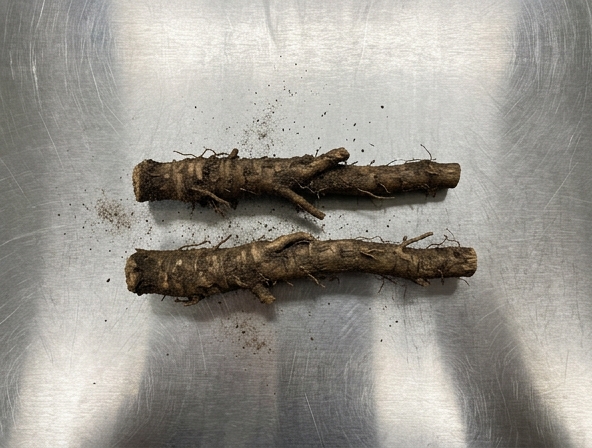
Now here's the piece of biology that explains why the root is the medicine. Dandelion drives a single deep taproot, straight down through soil layers that surface roots never reach, and it pulls minerals up and warehouses them in the root itself. Potassium, calcium, magnesium, iron, zinc. The root is the mine, and that mineral payload is part of what's in the bottle.
Alongside the minerals sit the bitter principles, the taraxacin, the constituents that support healthy digestion by promoting enzyme activity. That's the other half of the root's character, and the full chemistry gets its own piece in this series.
And notice what this plant is not. It's not a rare botanical from a distant rainforest. It's the stubborn yellow flower on the lawn, and every part of it has fed somebody somewhere: the leaves as spring greens, the flowers as wine, the root roasted in wartime coffee pots. The most accessible tonic in the tradition, and one of the most trusted.
This is the root-and-liver bottle. The practice is what makes it work.
Benefits accumulate over time.
2. Where Does It Come From?
Where does dandelion root come from? Short answer: Eastern Europe, grown organic. Real answer: a plant with one of the longest written histories in the Western tradition, and an extraction built to keep the bitter principles intact.
First, the facts, straight. This is one hundred percent dandelion root, Taraxacum officinale, organic, grown in Eastern Europe. Nothing else in the bottle but the liquid. The root is the medicine, stated plainly, because that deep taproot is where the plant warehouses its minerals and its bitter principles.
Now the history, because this plant earned its reputation in writing. Dandelion appears in the Arabic medical texts over a thousand years ago, carried in the materia medica of the great Arabic physicians, and it entered European medicine largely through that transmission. And in the Chinese tradition, the plant has its own name, pu gong ying, and its own place in the system, classed to the liver and the stomach. Two entirely different medical traditions, on opposite sides of the world, arrived at the same plant and kept it in daily use for centuries. That's the kind of trust that doesn't come from marketing.
And here's a piece of the story most Americans never hear. Dandelion isn't native to North America. The colonists packed it on purpose, seed and all, as a valued kitchen and medicine plant, and only later did we recast it as the lawn's public enemy. The weed in the yard is an heirloom that arrived on a boat.
Then the extraction, built to respect the material. Every batch is custom crafted, multi-step, and micro-batched. Structured distilled water and triple filtered USP grade organic alcohol at twenty-five percent by volume. The water pulls one class of constituents, the alcohol pulls the other, and the whole process stays cold, unheated, so the fragile constituents hold their shape in fluid suspension for maximum absorption.
The ratio is right on the label: one part herb to four parts liquid. An honest ratio for a root this dense with material, and nothing dressed up about it.
And the taste tells on it. This extract comes out properly bitter, and that bitter is the fingerprint and the function in one. The more you taste the stronger it is. A sweet, thin tincture tastes like exactly what it is: mostly nothing.
Good root, honestly grown, carefully pulled. That's where it comes from.
Taken consistently over time.
3. What Does It Actually Do?
What does dandelion root actually do in your body? Let me skip the list and give you one picture, because the picture is the mechanism.
A supply run for the cleanup crew. Your body runs a continuous maintenance operation: filtering blood, metabolizing waste, digesting meals, rebuilding tissue. And that operation has working departments, the liver and kidneys, the digestive tract, the skin. Dandelion root is the delivery that keeps the crew fed. And the rule underneath never moves: the root supplies the raw materials. Your body does the work.
Start with digestion, because that's where the bitter principles lead. The taraxacin promotes the production and activity of your digestive enzymes, the workers that break food down into pieces small enough to absorb, and it maintains healthy bile production and flow. And here's why bile deserves its own sentence: bile is the body's dish soap. It emulsifies fat, breaking the globs into droplets small enough for the enzymes to finish, and the page is specific about it, this supports breaking down food, especially the fatty acid lipids. When that machinery runs, the protein and fat on your plate get absorbed instead of parked, and the meal actually replenishes your energy stores.
Next, the elimination pathways, the liver and kidneys, and this is the heart of the alterative job. The naturally occurring polysaccharides and phytosterols support the body's natural processes to filter blood and lymph fluids. They metabolize cellular waste and assist in the elimination of environmental toxins, maintaining tissue cleanliness. And notice the phrase, because it's the honest one: tissue cleanliness. That's the old blood-cleanser idea, stated in plain English. The pathways run their own filtering around the clock, and the root supplies the constituents that nourish that work, without depleting vital energy.
Then the outward read of the same work. Tissue cleanliness translates outwardly to skin vitality, because the skin's natural barrier function is maintained from the same filtered, nourished internal environment. The vanity crowd knows this from the inside out: the cream dresses the wall, but the wall is built from what the blood delivers.
And underneath all of it, the minerals. The essential trace minerals, potassium, calcium, magnesium, iron, and zinc, fill nutritional gaps and fortify cellular health and integrity, buffering against everyday wear and tear. The deep taproot mined those from the soil, and now they're in the bottle.
And one thing this root flat out does not do. It does not create energy out of thin air. It assists your body in efficiently using the food you eat. So the meals aren't optional furniture here. They're the entire point, and the root makes them count.
Supply, and maintain. Feed the crew, and the body holds the clean, steady middle.
Benefits accumulate over time.
4. Who Is It For?
Who is dandelion root actually for? Let me tell you who buys it, because the answer is broader than most people expect. This is the dining-table and kitchen-counter bottle. The root for people whose bodies do real work every day.
The eater, first, because that's the flagship. Real meals, big meals, and the sluggish, uncomfortable hour that used to follow them. The bitter principles promote the production and activity of digestive enzymes and maintain healthy bile production and flow, so the meal gets broken down and metabolized instead of sitting there. The bottle sits on the dining table, right where the work happens, and the meal stops being a debt you pay all afternoon.
The beauty buyer, next. The skin is the outer wall, and the wall is built from what the blood delivers. By nourishing the natural elimination pathways, the liver and kidneys, this root supports the body's capacity to filter blood and lymph fluids, maintaining the tissue cleanliness that shows up as vibrant skin vitality and a rested appearance. The bottle sits on the bathroom vanity, right next to everything that only works from the outside.
The juicer. Shakes and juices carrying the day's nutrition in liquid form, and all of it depending on enzymatic activity to actually assimilate. The taraxacin and natural polysaccharides work with the digestive tract to promote nutrient absorption and the efficient use of energy from every smoothie. The bottle stands right next to the blender, making the liquid food count.
The vitality buyer. Errands, chores, skipped naps, and a schedule that asks for steady output anyway. This formulation helps metabolize cellular waste and replenish energy stores, cultivating the core vitality needed to run the day without emptying the reserves. The bottle lives front and center on the kitchen counter, next to the coffee and the keys, and it goes out the door with them.
And the tonic herbalist, stated briefly, because this buyer knows the routine. A daily practice of botanicals, complete balanced meals underneath, the quiet work of maintaining systemic balance. As a classical alterative, this root supplies the essential trace minerals to fortify cellular health and integrity, and it earns its spot front row of the apothecary shelf.
Notice what all five have in common, because it's the whole thesis. Every one of them is buying clean, steady function: the meal that digests, the skin that's built from clean blood, the smoothie that assimilates, the day that doesn't drain the tank, the regimen that holds the line. Same root, five uniforms.
This is the root for the everyday-working body.
Taken consistently over time.
5. How Do You Take It?
Tonic Synergy & Timing: We remind you that with consistent use, benefits accumulate over time.
We suggest taking this formulation on an empty stomach (up to 30 mins before eating) for rapid mucosal assimilation, followed by a complete balanced meal to provide the building blocks (proteins, complex carbohydrates, and healthy fats). The bitter primes the system, the enzymes gear up, and the meal walks into a kitchen that's already warm.
This is dandelion root liquid extract, the general-use tonic in a one-ounce bottle with sixty dropper servings.
One dropper is one press of the rubber bulb, which fills the dropper tube to just above half-way. That's thirty drops, which is also one milliliter.
To find a functional dose, start with a minimum dose of ten drops and work up. We suggest ten to ninety drops, taken one to three times per day.
Now, the bottle has two jobs, and it's worth knowing both. For immediate impact, hold one to two droppers under the tongue, sublingually, for fifteen to thirty seconds. Longer isn't necessary. For tonic building, to continually saturate your system and build deep, long-term health, take one to two droppers with meals, or up to two to three droppers with your largest meal.
Shake gently. Secure the lid and turn the bottle over back-and-forth three to five times to evenly distribute the liquid extract. Vigorous shaking oxidizes the volatile constituents, so don't do that.
By mouth: hold the liquid under the tongue for sixty to ninety seconds before swallowing, or mix the drops into two to four ounces of lukewarm drinking water. Never boiling water. Boiling water alters the delicate volatile compounds.
One practical note, because it matters with this root. If you take too much, you'll know it: the bowels start moving more than you want, and you're making extra trips to the bathroom. That's not a problem, that's just information. Skip a dose, then start again at a lower dose, and take less from there. Consistency is what matters, not volume, and enough is the target.
Storage is easy: an opened bottle holds about thirty to forty-five days. Unopened, about two years from the batch date. Keep it dark and cool.
If it didn't sit right, try again at a lower dosage and with a complete meal.
Some effects are immediate within the first few days. Consistency at a functional dose is what builds the rest.
6. How Long Until You Notice Results?
How long until you notice something from dandelion root? Most-asked question about any tonic, so here's the straight answer, in three windows.
Some effects are immediate within the first few days, one to three days. That's the felt layer. The meal that goes down easier. The afternoon that doesn't feel like the food is still sitting there. Digestion gives fast feedback, because you run the experiment three times a day.
Other effects and benefits are building, and become noticeable within one to two weeks. The steadier energy after eating. The skin that starts looking like it's built from cleaner material. The deeper work doesn't announce itself. It stacks up underneath, quietly, while you go about your life.
Then the long game. The systemic shifts arrive as you continuously saturate your body over a thirty to ninety day cycle. That's how every tonic works. You're feeding a system that puts materials to use on its own schedule. The body doesn't take orders. It takes deliveries.
A good tonic cycle is thirty to ninety days. That's not a sales line; that's just how tonics work. A tonic is a practice, not an event.
And you gotta take enough to make it work. Not enough doesn't work. Someone can only take so much of anything at any one time, so enough is the target, and consistency is the vehicle that gets you there.
Nothing is a quick fix. Tonics reward time, not dosage.
And keep the foundation under all of it: complete balanced meals, every time, with your protein and your fat. Skipping meals and eating incomplete meals will lead to ineffective results. The root rides on food; it doesn't replace it.
Benefits accumulate over time.
7. Safety and Quality
Is dandelion root safe, and how do you know you're getting a quality bottle? With this root, those are the same question, and the answer isn't a promise printed on a label. It's the honesty of the formulation, the sourcing, and the craft.
Start with honest use, stated plainly. This root is not for use during pregnancy or nursing. And here's the practical note worth keeping: if you've taken too much and the bowels are moving more than you want, you haven't broken anything. Skip a dose, start again at a lower dose, and take less from there. That's the whole correction. Beyond that, these botanicals are food added to the diet, suitable for daily use, and generally this formulation may be taken with other dietary supplements, working synergistically with your complete balanced meals underneath.
Now the markers that matter. Species named: one hundred percent dandelion root, Taraxacum officinale, nothing else in the bottle but the liquid. Source named: organic, grown in Eastern Europe. Craft named: custom crafted, multi-step, and micro-batched, extracted with structured distilled water and triple filtered USP grade organic alcohol at twenty-five percent by volume, cold processed so the fragile constituents hold their integrity in fluid suspension for maximum absorption. The ratio is one part herb to four parts liquid. Rapid, high bioavailability, and the full extraction and lab methods are published on our standards page, if you want to see exactly how the work gets done.
And that species name carries its own credential. Officinale is the apothecary's word, from the officina, the workshop where the classical herbalists kept their working materials. A plant wearing that name earned a permanent shelf in the medicine room. This one has held its shelf for over a thousand years, in writing, across two medical traditions.
And your own tongue is the lab. A real dandelion root extract comes out properly bitter, and that bitter is the fingerprint of the taraxacin and the minerals in suspension. The more you taste the stronger it is. A clear, thin tincture is mostly what it tastes like: mostly nothing.
One piece of doctrine to keep the whole thing straight. Herbs are always more effective and more powerful in the long-term for supporting health, whereas drugs are always more effective and more powerful in the short-term for treating diseases, conditions, and any emergencies. Do not use an herb when one should use a drug, and do not use a drug when one should use an herb. Each has its own job, and this bottle's job is the long term.
And the price. You shouldn't pay mystique prices for dandelion, because this is a classic botanical with a real market behind it, not some rare treasure. Pay for the root and the craft, not for the story.
Be the Best and Buy the Best.
It is important to do your own research. Health is the most valuable asset of one's life and the most valuable investment.

8. Dandelion and the Liver
What does dandelion root have to do with the liver? Fair question, and it deserves the full answer, because the liver is the organ your body trusts with its heaviest work, and this root is one of the classical botanicals for nourishing that work.
Start with a piece of old knowledge that still surprises people. The liver is the only internal organ that regenerates itself. A healthy liver can rebuild lost tissue from a fraction of itself, and no other organ in the body does that. The Greeks knew it three thousand years ago, and they put it in their myths on purpose: Prometheus, chained to the rock, his liver consumed each day and regrown each night. The punishment was designed to be endless precisely because the regrowth is real. The old storytellers and the modern biologists agree on this one.
So the liver rebuilds, and it also works. The liver carries hundreds of distinct jobs: filtering, converting, storing, producing. It processes effectively over a liter of blood every minute, around the clock, which is more continuous traffic than any other organ in the body handles. That is the worksite we're talking about, and it never closes.
Now the classical word for this root's relationship to that worksite. Hepatic comes from the Greek hepar, liver. A hepatic herb is a liver herb, and dandelion root has carried that classing for centuries, in the Western tradition and in the Chinese tradition alike, where pu gong ying is classed to the liver as well. Two medical systems, opposite sides of the world, same assignment.
Here's what the root actually supplies to that worksite, stated plainly. The taraxacin, the bitter principles, maintain healthy bile production and flow, and bile is one of the liver's own products, the fluid that carries fats toward digestion. The naturally occurring polysaccharides and phytosterols support the body's natural processes to filter blood and lymph fluids, metabolizing cellular waste and assisting in the elimination of environmental toxins. And the essential trace minerals, potassium, calcium, magnesium, iron, and zinc, fill nutritional gaps, fortifying cellular health and integrity.
The root supplies. The liver works and rebuilds. That division of labor never moves, and it's the honest way to talk about liver support: the body does the regenerating, and the botanical nourishes the conditions that regenerating runs on.
And the meals matter here more than most, because the liver's rebuilding runs on raw materials. The heavy building blocks, the proteins and fats, come from complete balanced meals. Keep the yolks soft, so as not to denature the cholesterol, and salt your eggs for stomach acid to absorb the protein, vitamins, fat, and cholesterol. The liver builds from deliveries, and the plate is the loading dock.
A good tonic cycle is thirty to ninety days, continuous saturation, meals underneath. The liver works on its own schedule, and it takes deliveries, not orders.
Taken consistently over time.
9. Dandelion and Detox
Can dandelion root help with detoxification? Yes, and here's the straight answer on how, because this is a word that gets tossed around a lot, and the actual biology is more interesting than the slogans.
The plain fact first: your body detoxifies itself, continuously, every minute of the day. The liver and kidneys are the body's natural elimination pathways, and they filter blood, metabolize cellular waste, and process environmental burden around the clock, whether you're awake, asleep, or taking anything at all. That's not a claim from a bottle. That's just what those organs do. They're on shift right now, as you listen to this.
So what does a botanical actually contribute? Here's the honest framing, and it's the classical one. The old herbal tradition had a category called alteratives, from the Latin alterare, to alter, to change: plants traditionally used to gradually restore the body's eliminative function toward proper working order. The old texts called them blood cleansers. Dandelion root is one of the classical members of that class, and its job is to nourish the pathways that do the cleaning.
The mechanisms, stated straight. The naturally occurring polysaccharides and phytosterols in the root support the body's natural processes to filter blood and lymph fluids. They metabolize cellular waste and assist in the elimination of environmental toxins, maintaining tissue cleanliness. The taraxacin promotes the production and activity of digestive enzymes and maintains healthy bile production and flow, which keeps the digestive side of the elimination picture moving. And the essential trace minerals fill nutritional gaps, fortifying cellular health and integrity. The pathways run their own work; the root supplies the constituents that nourish it.
Now here's a piece of plumbing most people never hear, and it ties the whole story to the plate. The body recycles its bile, several times a day, in a loop the physiologists call enterohepatic circulation. And what finally carries spent bile out of the body is fiber, from real food. The plumbing is a circle, and the exit is on your plate. That's the deepest reason the detox story runs through complete balanced meals: the pathways need the fiber to carry things out, and the protein and fat to rebuild with.
And the routes out are three: the liver and bowel, the kidneys and bladder, and the sweat through the skin. Dandelion root's classical work touches the first two directly, and you can read the results of all three in the same place. Tissue cleanliness translates outwardly to skin vitality, because the skin's natural barrier function is maintained from the filtered, nourished internal environment. The outward wall shows the state of the inner terrain.
The systemic shifts arrive as you continuously saturate your body over a thirty to ninety day cycle, with the meals underneath every step of the way. The pathways take deliveries, not orders, and they reward consistency.
Taken consistently over time.
10. Dandelion and Digestion
What does dandelion root actually do for digestion? Let me walk it from the first taste to the finished meal, because this root's digestive work starts earlier than most people think, and the story begins on the tongue.
Here's the piece of biology that explains the whole bitter class. Your digestive tract is lined with taste receptors, the same kind your tongue carries, running all the way down. The whole gut tastes. And when the first bitter arrives, the system gears up: saliva, stomach acid, enzymes, bile, all of it, before the food ever lands. That's not a quirk, that's a signal. The bitter taste is the starter bell, and the kitchen starts warming before the meal walks in. Which is exactly why the European traditions served bitter botanicals before dinner for centuries, and why the spring greens tradition ate bitter leaves as the first fresh food after a long winter of stored rations. The customs arrived at the physiology on their own, long before anyone could name a receptor.
Dandelion root is one of the classical bitter roots, and its bitter principles have a name: taraxacin. Here's the mechanism, stated straight. The taraxacin promotes the production and activity of your digestive enzymes, the workers that break food down into pieces small enough to absorb. And it maintains healthy bile production and flow, and bile deserves its own beat: bile is the body's dish soap for fat. It emulsifies, breaking the fat globs into droplets small enough for the enzymes to finish. That's why this root's classical strength is the heavy meal, the one with real protein and real fat on the plate. The page is specific here, and so is the tradition: this supports breaking down food, especially the fatty acid lipids.
When that machinery runs, the meal gets absorbed instead of parked. Nutrients are assimilated, energy stores are replenished, and the afternoon stops paying for lunch. A meal that's actually broken down doesn't sit there hogging the afternoon.
And the timing follows the mechanism, which is why the label says what it says. Take it on an empty stomach, up to thirty minutes before eating, for rapid mucosal assimilation, followed by a complete balanced meal. The bitter primes the pump, the enzymes gear up, and the meal walks into a kitchen that's already warm. Prime, then eat. The order is the whole trick.
For the juicing crowd, same mechanism, different vehicle. Shakes and juices carry the day's nutrition in liquid form, and all of it still depends on enzymatic activity to assimilate. The taraxacin and natural polysaccharides work with the digestive tract to promote nutrient absorption and the efficient use of energy from every smoothie. The blender doesn't skip the crew; it just changes the delivery truck.
And one honest limit to keep the picture true. The root does not create energy out of thin air. It assists your body in efficiently using the food you eat. The meals are the fuel; the root is the hand on the machinery. Skipping meals and eating incomplete meals will lead to ineffective results.
Prime the pump, eat the meal, stay consistent.
Benefits accumulate over time.
Commit to the Practice
Tonic herbalism rewards consistency. The deep, systemic building work happens quietly over a 30 to 90-day cycle of continuous saturation. Supply the raw materials your body needs to maintain healthy digestion and tissue cleanliness.
Shop Dandelion Root Extract