
Discover the honest truth about Immuno-Bomb—the classical fortification formula designed to support your body's natural defenses. Whether you are navigating crowded spaces, enduring long transit, or adjusting to high altitude, this specific architecture of eleven wildcrafted botanicals acts as the ultimate medicine-cabinet formula. This guide strips away the seasonal marketing hype to teach you exactly what Immuno-Bomb is, how the four-tier extraction works, and how to properly use it for acute, robust resilience.

I recorded these audios to directly answer the questions I've received most over the last 26 years. The text below contains the actual transcripts.
Jason J. DukeOwner / Artisan
Reference Directory
Commit to the Practice
Tonic herbalism rewards consistency. Ensure you are ready for when the seasons turn or the world gets demanding. Supply the raw materials your body needs with our premium 3-pack.
Shop the 3-Pack Formulation1. What is Immuno-Bomb?
So, what is Immuno-Bomb, exactly? The name sounds like something loud in a small bottle, and there's some truth in that, but the deeper truth is quieter and much older. This is a classical formula: eleven botanicals arranged in four tiers, built around one job, fortifying the body's natural defenses. The loud part is the work. The sophisticated part is the architecture.
And architecture is the honest word for it. Half of this bottle is the chief tier, the main medicinal herbs that carry the formula: Echinacea root, both species, Goldenseal root, and Osha root. A third is assistant tonics that broaden the effort. A tenth is directing herbs, the classical envoys whose whole job is guiding a formula where it's meant to go. And the last piece is supporting herbs that finish the work. Chief, deputy, assistant, envoy: that four-part hierarchy has governed serious formulary for centuries, and here it's printed right on the label in percentages. That's not marketing structure. That's classical herbalism, stated plainly.
Classification before benefits, always. The page classifies these as adaptogenic herbs, and the deeper classification is the older one: this is the acute class, the as-needed botanicals. The old materia medica kept two great classes. The constitutional tonics, taken daily to build deep reserves over months. And the specifics, kept in the cabinet and reached for when the season turns or the world gets demanding. Immuno-Bomb is the second kind. The medicine-cabinet bottle. On hand, not on schedule.
Now, a taste note, because with this blend the taste is the fingerprint. A real Echinacea extract does something on the tongue that nothing else in the herbal does: it tingles, and then it numbs, faintly, like a mild, natural botanical buzz. That buzz is the alkamides, the same constituent class that works with your white blood cells. Your tongue can verify what the label claims. The more you taste, the stronger it is, and with this bottle the taste announces the chemistry.
And the name Echinacea itself earns a beat. It descends from the Greek echinos, hedgehog, because the flower is a spiky bronze cone riding above the purple petals. A hedgehog on a stem. And Osha, beside it in the chief tier, is the mountain root the bears dig first thing out of hibernation, a plant named for the animal that taught its use. That story, and the deep inheritance behind all three chiefs, gets its own piece in this series.
One more piece, and it's the hint that pays off later. The great majority of your immune tissue is not stationed where most people picture it. It lives in and around the gut. Which is why a serious fortification formula touches digestion too, and this one does. That mechanism gets its own piece in this series, and it's the heart of the whole blend.
This is the fortification blend, built like the old formularies and kept like them. In the cabinet, ready.
On hand, not on schedule.
2. Where Does It Come From?
Where does Immuno-Bomb come from? Short answer: North American wild country, arranged on a classical skeleton. Real answer: three roots out of Native American plant medicine, a European lung root standing beside them, and a cold extraction built to keep the bite intact.
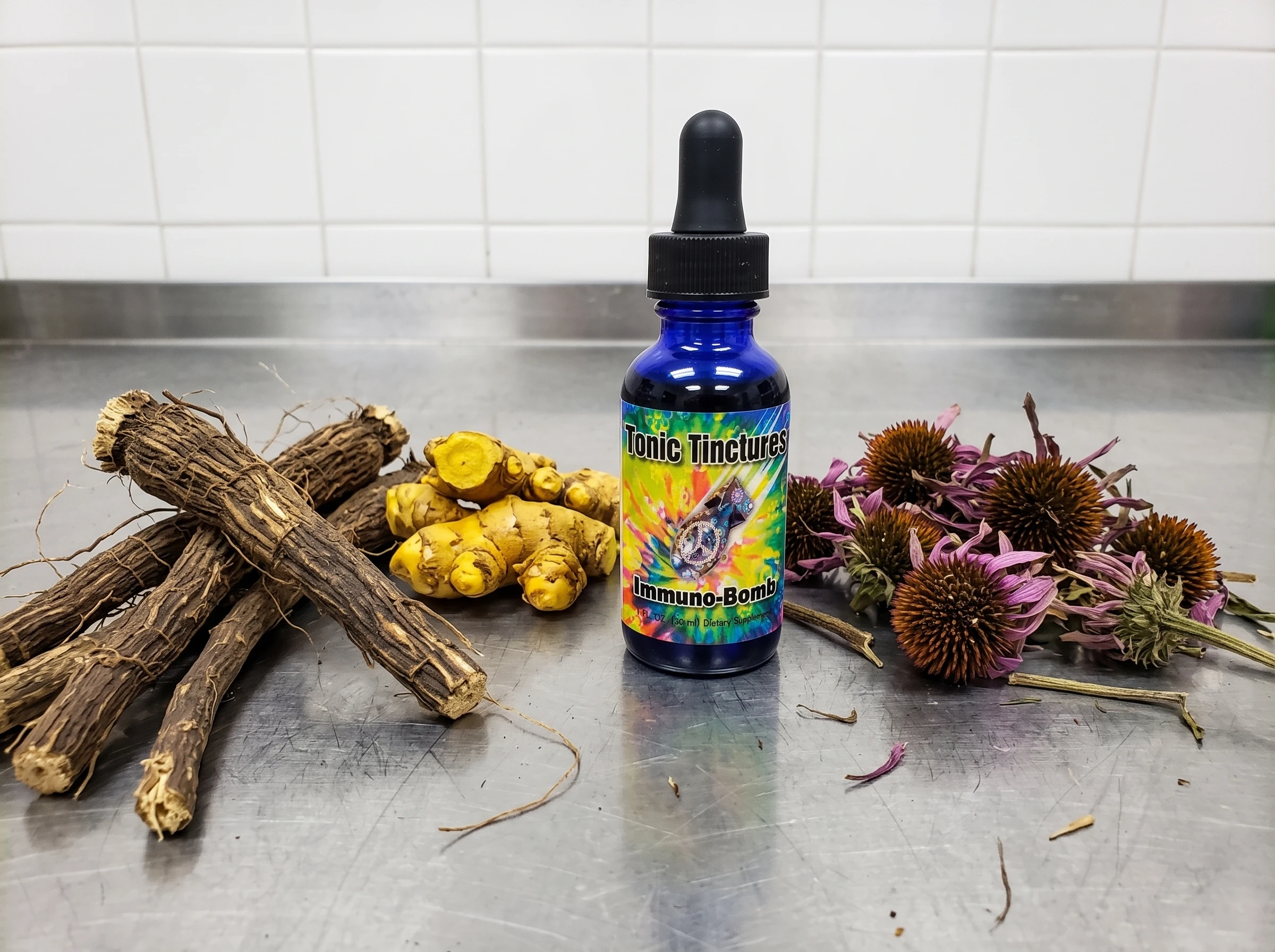
The facts first, straight. This is Echinacea root, angustifolia and purpurea, Goldenseal root, Osha root, Eleuthero, Solomon's Seal, Elecampane root, Kudzu root, Angelica root, Turmeric root, and Ginger root. Eleven botanicals, nothing else in the bottle but the liquid. And most of the roots are wild sourced, Echinacea and Goldenseal among them, gathered from the country where they actually grow. That matters with a fortification formula, and here's the reason: a wild root has to build its own defenses against a whole season of real challenges, and that's exactly the character of material you want feeding yours.
Now the inheritance, because this blend stands on one of the deepest stories in American herbalism. The purple coneflower is a child of the Great Plains, and the Plains nations worked it deeply: the Lakota, the Cheyenne, the Pawnee, the Omaha, the Comanche, each carrying their own body of use for root and leaf and blossom. It entered settler medicine by way of the Omaha and the Ponca, and but get this, within a generation it was one of the most dispensed botanicals in the country. The Eclectic physicians, the American school that married Native plant knowledge to clinical observation, carried it into their dispensatories, and a prairie root became a commercial apothecary staple before the era of modern synthetics nearly buried the whole tradition. Generations later, European researchers dug the trail back up, and the coneflower returned as one of the most studied plants in the Western tradition.
Goldenseal walked the same road from the other direction. It's one of the great botanicals of the Cherokee tradition, worked deeply in the Southeastern woodlands, and the Eclectics took it up right alongside the coneflower. The yellow root and the purple root, the Eastern woodlands and the Western plains, arriving at the same dispensatory shelf within the same few decades.
And Osha belongs to the mountain country, the high Rockies and the Southwest, where the same root goes by chuchupate in the Hispanic healing traditions and where the bears dig it first thing out of hibernation, chew it, and roll in it. The mountain peoples watched the bears and took the lesson. A plant named for the animal that taught its use.
Then the old-world half of the chest. Elecampane is the classical European lung root, and its Latin name, Inula helenium, carries the legend that it sprang from the tears of Helen of Troy. Pairing it with Osha is the formulator's eye at work: the old-world lung root and the new-world mountain root standing in the same tier, doing the same job. Two continents arrived at the same answer centuries apart, and this formula simply puts them side by side.
Then the extraction, built to respect the material. Custom crafted, multi-step, micro-batched, with structured distilled water and triple filtered USP grade organic alcohol at forty percent by volume. The water pulls one class of constituents, the alcohol pulls the other, and the whole process stays cold, unheated, so the volatile oils and the delicate compounds hold their shape in fluid suspension for maximum absorption.
Now, a quick note here on that forty percent, because it's doing real work. Most blends carry twenty-five or thirty percent alcohol. This one runs forty, and the reason is sitting in the chief and assistant tiers: a blend carrying volatile essential oils wants the solvent strength to hold them in solution, unheated, intact. The percentage isn't potency theater. It's the craft answering the material.
The ratio is right on the label: one pound of botanicals to one quart of liquid, about fifteen thousand milligrams extracted into every one-ounce bottle. Nothing hidden, nothing dressed up.
And the taste tells on it. This extract comes out strong and properly bitter, with a golden stain on the glass and a tingle on the tongue. The gold is the berberine, the tingle is the alkamides, and the more you taste the stronger it is. A thin, ghostly tincture tastes like exactly what it is: mostly nothing.
Good roots, honestly wild, carefully pulled. That's where it comes from.
Enough, taken consistently, through the days you need it.
3. What Does It Actually Do?
What does Immuno-Bomb actually do in your body? Let me skip the list and give you one picture, because the picture is the mechanism.
A border, held. Your body maintains a boundary against the outside world: the skin, the airways, the lining of the gut. And behind that boundary stands a guard force, the white blood cells and the whole defensive apparatus, identifying what doesn't belong, containing it, removing it, keeping the tissue clean. Fortify is the label's own word, and it's the right one. This formula feeds the guards and keeps the gates clear. And the rule underneath never moves: the botanicals supply the raw materials. Your body does the defending.
Start with the thesis beat, the piece of physiology that ties the whole formula together. The great majority of your immune tissue lives in and around the digestive tract. The biggest garrison isn't stationed on the skin or in the throat. It's in the gut, right where the outside world comes in with every meal. Which is why the old traditions never separated immune herbs from digestive herbs the way the modern shelf does. Feeding digestion and fortifying defenses were understood as one job, one territory. This blend is built on that old intuition, and the label proves it: the immune chiefs and the digestive machinery share one bottle.
First mechanism, the guards themselves. The alkamides and polysaccharides from Echinacea support white blood cell activity and the adaptive immune response, giving your body the nutritive support it uses to identify foreign material, facilitate containment and removal, and maintain tissue cleanliness. What that looks like in real life: the crowded room, the long flight, the season turning, the guards staying fed while the room keeps coming.
Second, the gates and the waste route, and this is where Goldenseal earns its tier. Berberine, the golden alkaloid, supports the natural elimination pathways, specifically healthy bile production and flow, so waste moves out of the body efficiently. Bile breaks the fats on your plate into droplets small enough for the enzymes to finish, and it's one of the routes the body uses to carry spent material out. The digestion half of the story, fed directly. Immunity and elimination, one territory, as the old intuition said.
Third, the air side of the border. The volatile essential oils from Osha and Elecampane maintain clear and open airways, nourishing the lung tissues and promoting efficient gas exchange. Thin air at elevation, dry air in transit, the long stretch indoors. The gates stay open and the exchange keeps running.
Then the supporting tier does quiet work underneath. Eleuthero works with the neuroendocrine system to maintain systemic balance and support energy metabolism, helping the body adapt to various challenges while the campaign runs. And the Turmeric and Ginger constituents neutralize free radicals and promote a healthy inflammatory response, managing the everyday wear and tear that comes with demanding stretches. The steady layer under the defense layer.
And one thing this formula flat out does not do. It does not build the wall for you. It supplies the raw materials, and the body fortifies on its own schedule. Which is why the meals aren't optional furniture here. The page is explicit: these constituents must be assimilated alongside a broad spectrum of phytonutrients from complete balanced meals, the building blocks for cellular repair and regeneration. The guards eat from the same plate you do.
Supply, and fortify. Feed the garrison, and the body holds the line.
Enough, taken consistently, through the days you need it.
4. Who Is It For?
Who is Immuno-Bomb actually for? Let me tell you who buys it, because the cabinet bottle has a specific customer, and it's not who the seasonal aisle points at. This is the medicine-cabinet-and-carry-on bottle. The blend for people whose boundaries get tested.
The crowd-navigator, first, because that's the flagship. Offices, airports, gatherings, classrooms, rooms full of people day after day, the body's border running its filter continuously. The alkamides and polysaccharides fortify the natural defense mechanisms, giving the white blood cells the nutritive support they use to identify foreign material and maintain tissue cleanliness. The bottle sits in the medicine cabinet, and the crowded stretch stops feeling like a gauntlet.
The traveler. Long transit, jet lag, unfamiliar beds, hours of recycled air, everything about the journey disrupting the body's steady state. Berberine supports the natural elimination pathways to maintain the internal environment in unfamiliar surroundings, and the volatile oils keep the airways clear through the dry cabin hours. This one rides zipped in the carry-on, or in the toiletry bag, exactly where the page puts it.
The worker on their feet. A full shift, physical jobs, metabolic output draining hour by hour. The adaptogenic Eleuthero works with the neuroendocrine system to replenish vital energy stores and adapt to everyday stress, so the body keeps its reserves while the shift keeps coming. The bottle lands in the lunch pack.
The mountain crowd. Adjusting to elevation, breathing thin air, catching your breath on the climb. The mountain peoples have known this territory for centuries, and their root is in this blend for exactly this job: the volatile essential oils from Osha nourish the lung tissues and maintain efficient gas exchange when the air runs thin. The bottle rides in the top pocket of the pack.
And the person bouncing back, and this one deserves its say. Getting out of bed, getting your strength back, wanting to feel like yourself again. The comeback runs on nourishment, and it takes what it takes. These botanicals support white blood cell activity to facilitate the containment and removal of cellular waste, helping the body naturally recover and rebuild. The bottle sits right on the nightstand, next to the water glass.
Now the honest redirect, because it matters more with this bottle than any other on the shelf. This is not the daily constitutional. If you want the deep, months-long saturation work, the thirty to ninety day cycles that rebuild core vitality, that job belongs to the long-cycle tonics, and they do it beautifully. This is the other half of the shelf: the short campaign, opened when the world demands and capped when it doesn't. Both halves have jobs. Knowing which half you're reaching for is the whole art.
And one more piece of honesty, because the enough doctrine applies double here. One heroic dose on day one and nothing after is the amateur move, and it doesn't work. A functional dose, held consistently, through every day of the stretch. That's what carries the work.
Right blend, right moment. The cabinet bottle, opened when you need it.
5. How Do You Take It?
Tonic Synergy & Timing: We remind you that with consistent use, benefits accumulate over time.
For rapid mucosal assimilation, we recommend taking it on an empty stomach (up to 30 mins before eating). This should be followed by a complete balanced meal (proteins, fats, and carbohydrates) to provide the fuel and building blocks your body requires for natural regenerative processes.
This is Immuno-Bomb liquid extract, the fortification blend in a one-ounce, thirty-milliliter bottle with thirty dropper servings.
One dropper is one press of the rubber bulb, which fills the dropper tube to just above half-way. That's thirty drops, which is also one milliliter.
To find a functional dose, start with a minimum dose of ten drops to one dropper and work up. We suggest ten drops to one to three droppers, taken one to three times per day, which is one hundred sixty to three thousand milligrams daily.
Now, the bottle has two jobs, and it's worth knowing both. For immediate impact, hold one to two droppers under the tongue, sublingually, for fifteen to thirty seconds. Longer isn't necessary. For the building stretch, to continually saturate your system while you're using it, take one to two droppers with meals, or up to two to three droppers with your largest meal.
Shake gently. Secure the lid and turn the bottle over back-and-forth three to five times to evenly distribute the unique constituents. Vigorous shaking oxidizes the volatile constituents, so don't do that.
By mouth: hold the liquid under the tongue for sixty to ninety seconds before swallowing, or mix the drops into two to four ounces of lukewarm drinking water. Never boiling water. Boiling water alters the delicate volatile compounds, and this blend carries a full tier of them.
Timing, plain and simple. Take it on an empty stomach, up to thirty minutes before eating, for rapid mucosal assimilation, followed by a complete balanced meal to provide the building blocks, the proteins and fats.
One cadence note, because it's this bottle's character. This is a campaign bottle, not a calendar bottle. Taken for a stretch of days when you need it, then capped until the next time. During the stretch, consistency is what carries it: a functional dose, every day of the campaign, and the bottle goes back in the cabinet when the stretch ends.
Storage is easy: an opened bottle holds about thirty to forty-five days. Unopened, about two years from the batch date. Keep it dark and cool. The cabinet, naturally.
If it didn't sit right, try again at a lower dosage and with a complete meal.
Some effects are immediate within the first few days. Consistency at a functional dose is what builds the rest.
6. How Long Until You Notice Results?
How long until you notice something from Immuno-Bomb? Most-asked question about any botanical, so here's the straight answer. And with this bottle the honest answer is its own doctrine, because this is the acute bottle, and acute has its own clock.
The cycle here is short: one to fourteen days, taken when you need it, capped when you don't. And notice how cleanly the label's own figures fit that window. Some effects are immediate within the first few days, one to three days. Other effects and benefits are building and noticeable within one to two weeks. The immediate window and the building window, back to back: that is the acute cycle. The formula was built to be felt inside the stretch, not months down the line.
And during the stretch, you gotta take enough to make it work. Not enough doesn't work. Someone can only take so much of anything at any one time, so a functional dose held consistently through the days you're taking it, that's the target and the vehicle in one.
Now the honest contrast, because the shelf has two halves and they get confused constantly. The deep systemic work, the hormonal rebuild, the core-vitality cultivation, belongs to the constitutional tonics and their thirty to ninety day saturation cycles. That's their job, and they're superb at it. This bottle's job is the short campaign: the season turning, the crowded stretch, the long transit, the comeback. Different clock, different bottle, same body.
Nothing is a quick fix. Anyone selling overnight magic is selling snake oil. The body fortifies on its own schedule. The botanicals supply the materials, and the materials have to arrive consistently while the work runs.
And keep the foundation under all of it: complete balanced meals, every time, with your protein and your fat. The guards eat from the same plate you do. Skipping meals and eating incomplete meals will lead to ineffective results.
Enough, held consistently, through the days you need it.
7. Safety and Quality
Is Immuno-Bomb safe, and how do you know you're getting a quality bottle? With this blend, those are the same question, and the answer isn't a promise printed on a label. It's the architecture, the honesty of the sourcing, and the craft.
Start with the markers that matter, stated straight. Formula named: eleven botanicals in four stated tiers, fifty percent main medicinal herbs, thirty-five percent assistant and supporting tonics, ten percent directing herbs, five percent supporting herbs, every species right on the label and nothing else in the bottle but the liquid. Sourcing named: most of the roots are wild sourced, Echinacea and Goldenseal among them. Craft named: custom crafted, multi-step, micro-batched, extracted with structured distilled water and triple filtered USP grade organic alcohol at forty percent by volume, cold processed so the volatile oils and delicate constituents hold their integrity in fluid suspension for maximum absorption. The ratio is one pound of botanicals to one quart of liquid, about fifteen thousand milligrams in every one-ounce bottle. Rapid, high bioavailability, and the full extraction and lab methods are published on our standards page, if you want to see exactly how the work gets done.
And with wild Goldenseal there's a piece of context every buyer in this category should know. Wild Goldenseal became so sought-after over the generations that the species now sits on the international conservation lists, which makes honest wild sourcing one of the distinguishing marks of a serious bottle in this class. Where the root comes from matters, with this herb more than most, and the people who dodge that question are telling you something.
And your own tongue is the lab. A real extract of these botanicals comes out strong and properly bitter, with a golden stain on the glass and a tingle on the tongue. The gold is the berberine, the tingle is the alkamides, and the more you taste the stronger it is. A clear, thin tincture is mostly what it tastes like: mostly nothing.
Now, honest use, plain and simple. These botanicals are food added to the diet, suitable for use as needed, and generally this formulation may be taken with other dietary supplements. It works synergistically with other formulations and with your complete balanced meals underneath, and the page is explicit about why: these raw materials must be assimilated alongside a broad spectrum of phytonutrients to supply the building blocks for cellular repair and regeneration.
One piece of doctrine to keep the whole thing straight. Herbs are always more effective and more powerful in the long-term for supporting health, whereas drugs are always more effective and more powerful in the short-term for treating diseases, conditions, and any emergencies. Do not use an herb when one should use a drug, and do not use a drug when one should use an herb. Each has its own job, and this bottle's job is fortification.
And the price. You shouldn't pay mystique prices for a fortification blend, because these are real roots with real markets behind them, not rare treasures. Pay for the botanicals and the craft, not for the story.
Be the Best and Buy the Best.
It is important to do your own research. Health is the most valuable asset of one's life and the most valuable investment.
8. The Indigenous Roots
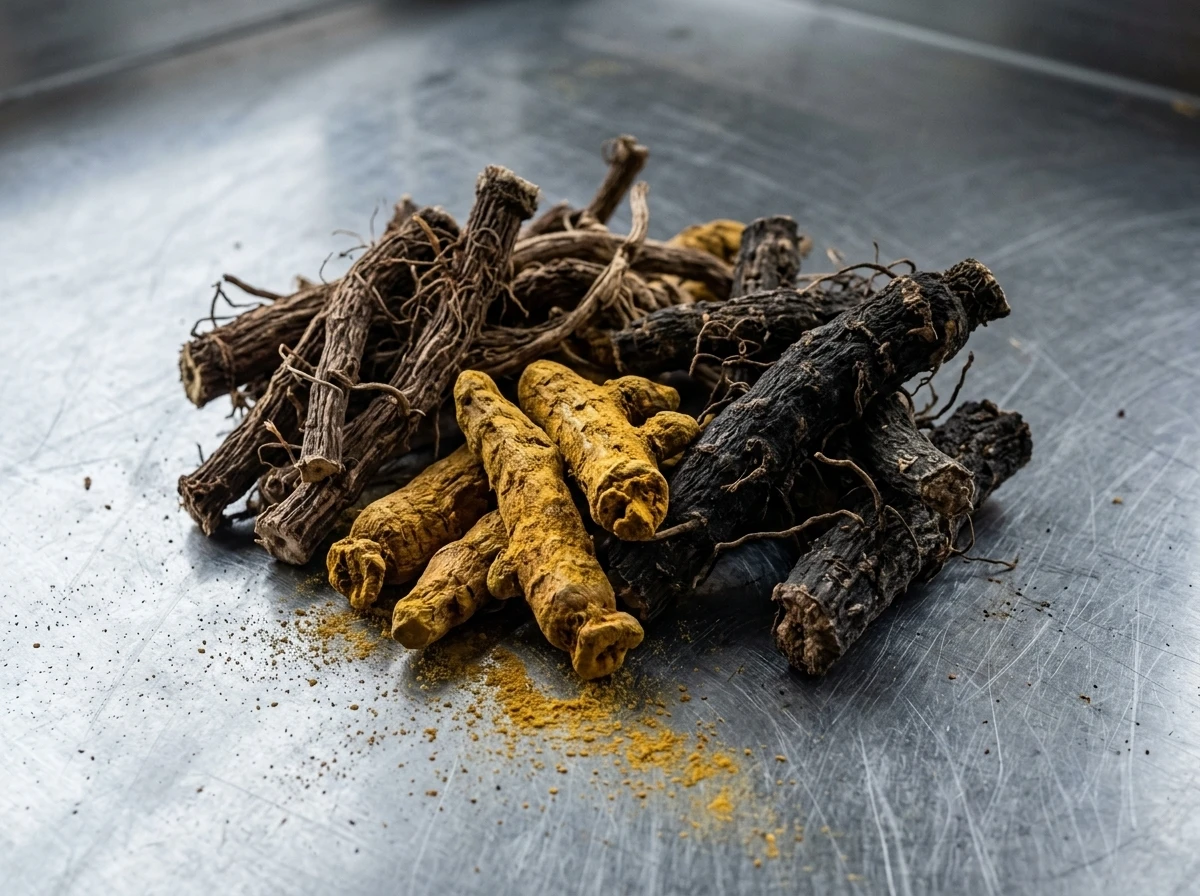
Why does this blend carry so much North American history? Because the chief tier itself came out of Native American plant medicine, and the road those roots traveled into the modern tradition is one of the great untold stories in American herbalism. Let me walk it, because once you know it, the label reads differently.
The coneflower first. The purple coneflower is a child of the Great Plains, and the Plains peoples worked it deeply: the Lakota, the Cheyenne, the Pawnee, the Omaha, the Comanche, each nation carrying its own body of use for the root, the leaf, and the blossom. The plant entered settler medicine by way of the Omaha and the Ponca, and within a generation it was one of the most dispensed botanicals in American practice. The Eclectic physicians, the American school that married Native plant knowledge to clinical observation, carried it into their dispensatories and their specific-medicine lines, and a root that grew on the prairie became a commercial apothecary staple.
Goldenseal walked the same road from the other direction. It's one of the great botanicals of the Cherokee tradition, worked deeply in the Southeastern woodlands, and the Eclectics took it up right alongside the coneflower. The two herbs entered American pharmacy together, out of Native medicine, within the same few decades. The yellow root and the purple root, the Eastern woodlands and the Western plains, arriving at the same dispensatory shelf.
Osha never took the commercial road, and that's part of its character. It belongs to the mountain country, the high Rockies and the Southwest, where the same root goes by chuchupate in the Hispanic healing traditions of New Mexico and the Pueblo country, and where the tribes of those mountains hold it among their most important plants. The bears dig it first thing out of hibernation, chew it, and roll in it, and the mountain peoples watched and learned. Bear root, bear medicine. Some plants stay regional because their home is the point.
Then the near-death and the resurrection. The era of modern synthetics nearly buried the American botanical tradition whole, and the coneflower especially, and for a generation it survived mostly as a memory and a garden flower. Then European researchers, working decades later, picked the trail back up and studied the root seriously, and the plant returned as one of the most studied botanicals in the Western tradition. And here's the irony worth sitting with: the herb the Plains nations shared had to be re-discovered by modern science before the modern shelf would take it seriously again.
The blend honors all of it the quiet way. No ceremonies borrowed, no rituals performed, just the roots themselves, arranged on classical formulary architecture and extracted cold. The inheritance is in the bottle, not on the label.
A deep tradition, honestly wild, carefully kept. That's the roots of this formula.
Enough, taken consistently, through the days you need it.
9. The Cabinet Bottle
Why isn't Immuno-Bomb a daily tonic? Fair question, and it deserves the doctrine answer, because the distinction is one of the oldest ideas in herbalism, and the modern shelf has almost entirely lost it.
The old materia medica sorted the cabinet into two great classes. The constitutional tonics: the roots you take daily, meal after meal, cycle after cycle, building deep reserves over months. They earn their thirty to ninety day saturation cycles, and they're the long game. And then the specifics: the botanicals you keep in the cabinet, ready, reached for when the moment demands, taken at a functional dose for a short stretch, and capped when the moment passes. Two classes, two clocks, two completely different jobs. The serious tradition kept both halves of the shelf and knew which half it was reaching into.
Immuno-Bomb is the second class, and it's built like it: heavy in the main medicinal tier, organized for intensity over a short campaign. The cycle is one to fourteen days, taken when you need it. The season turns, the rooms get crowded, the transit runs long, the comeback starts. You open the bottle, you take a functional dose consistently through the stretch, and when the stretch ends, the bottle goes back in the cabinet. That's not inconsistency. That's the design.
And here's the practical wisdom that makes the design work. Consistency still governs, inside the stretch. A functional dose, held steady, through every day of the campaign: that's what carries the work. One heroic dose on day one and nothing after is the amateur move, and it doesn't work. Enough, held consistently, through the days you're taking it.
The cabinet itself is part of the practice. A bottle you own before you need it is worth two bottles you order after. The people who get the most from this class are the people who stocked it in the quiet season: the medicine cabinet, the toiletry bag, the top pocket of the pack, staged where the demanding moments actually find them.
And the honest redirect, one more time, because it's the heart of the piece. If you're looking for the daily constitutional, the deep rebuild, the months-long saturation work, that's the other half of the shelf, and it's a beautiful half. Keep both. The cabinet bottle and the constitutional bottle are complements, not competitors: one for the moment, one for the years. The household that knows which bottle answers which day is the household herbalism was built for.
On hand, not on schedule. Opened when you need it.
10. The Formula Architecture
How do eleven botanicals become one formula? Not by pile, by architecture. Let me walk the label tier by tier, because the structure is the sophistication, and once you can read it, every serious formula on every shelf becomes legible.
The architecture is classical, and it goes by a four-part name: chief, deputy, assistant, and envoy. The chief herbs carry the formula's main job and command the majority of the material. The deputies strengthen and extend the chiefs' move. The assistants broaden the work into related territory and smooth the rough edges. And the envoys, the smallest tier, direct the whole caravan where it's meant to go. That hierarchy has governed serious formulary for centuries, and it works whether the materia medica is Chinese, European, or North American. The skeleton is universal. The roots are local.
Now the label. Fifty percent, the chief tier: Echinacea root in both species, angustifolia and purpurea, Goldenseal root, and Osha root. The fortification core, three traditions of defense botany commanding half the bottle. And note the two coneflowers: the narrow-leaved prairie species the Plains peoples knew, and the broad eastern species the European researchers took up, both carrying the alkamides and polysaccharides, two lineages of the same chief doing the same job.
Thirty-five percent, the deputy and assistant tier: Eleuthero, the adaptogen that helped mint the very word, bringing the neuroendocrine steadiness. Solomon's Seal, the classical moistening root of the old tradition. And Elecampane, the European lung root, standing beside Osha. The old world and the new world in the same tier, two herbal continents arriving at the same answer centuries apart, now sharing a bench.
Ten percent, the envoys: Kudzu root and Angelica root, the directing pair whose classical job is guiding a formula where the formulator wants it to go. And Angelica carries the most romantic name in the herbal, archangelica, because the old legend says the archangel revealed the plant to mankind. An envoy with an archangel's name, doing traffic duty.
Five percent, the supporting tier: Turmeric root and Ginger root, the warming finishers, neutralizing free radicals and promoting a healthy inflammatory response while the chiefs do the heavy work.
Now, a quick aside, because the label hides a quiet joke for the herbalists: two seals in one bottle. Goldenseal, named for the round wax-seal scars on its golden rhizome, and Solomon's Seal, named for the same kind of circular mark on its own root. Two different plants, two different families, and the old herbalists reached for the same image twice. Some naming instincts are universal.
And the extraction honors the architecture: custom crafted, multi-step, micro-batched, one pound of botanicals to one quart of liquid, cold processed so every tier arrives intact. The chiefs, the deputies, the envoys, and all. Architecture in, architecture out.
Eleven roots, four tiers, one voice. That's a formula.
Enough, taken consistently, through the days you need it.
Commit to the Practice
Tonic herbalism rewards consistency. Ensure you are ready for when the seasons turn or the world gets demanding. Supply the raw materials your body needs with our premium 3-pack.
Shop the 3-Pack Formulation