
Discover the honest truth about Winter's Paradise—the classical Chinese tonic blend built around one idea: keeping the body's internal environment moist, calm, and steady while the world outside runs dry and loud. Whether you are looking to support respiratory well-being, maintain deep skin hydration, or anchor your nervous system against daily chaos, the secret lies in these moisture-rich winter roots. This guide strips away the marketing hype to teach you exactly what this blend is, what it does, and how to properly use it for deep, systemic vitality.

I recorded these audios to directly answer the questions I've received most over the last 26 years. The text below contains the actual transcripts.
Jason J. DukeOwner / Artisan
Reference Directory

Commit to the Practice
Tonic herbalism rewards consistency. The deep, systemic building work happens quietly over a 30 to 90-day cycle of continuous saturation. Supply the raw materials your body needs with our premium 3-pack.
Shop the 3-Pack Formulation1. What is Winter's Paradise?
So, what is Winter's Paradise, exactly? Is it a holiday mood in a bottle? No, though the name has a real story, and it's better than a mood. This is a classical Chinese tonic blend, four botanicals, built around one idea: keeping the body's internal environment moist, calm, and steady while the world outside runs dry and loud.
Classification before benefits, always. The category is superior tonic and adaptogenic herb blend, and the energetic is grounding, cooling and calming. Plain English: this is the moistening, steadying side of the tonic shelf. The bottle that feeds and settles, not the one that fires and drives.
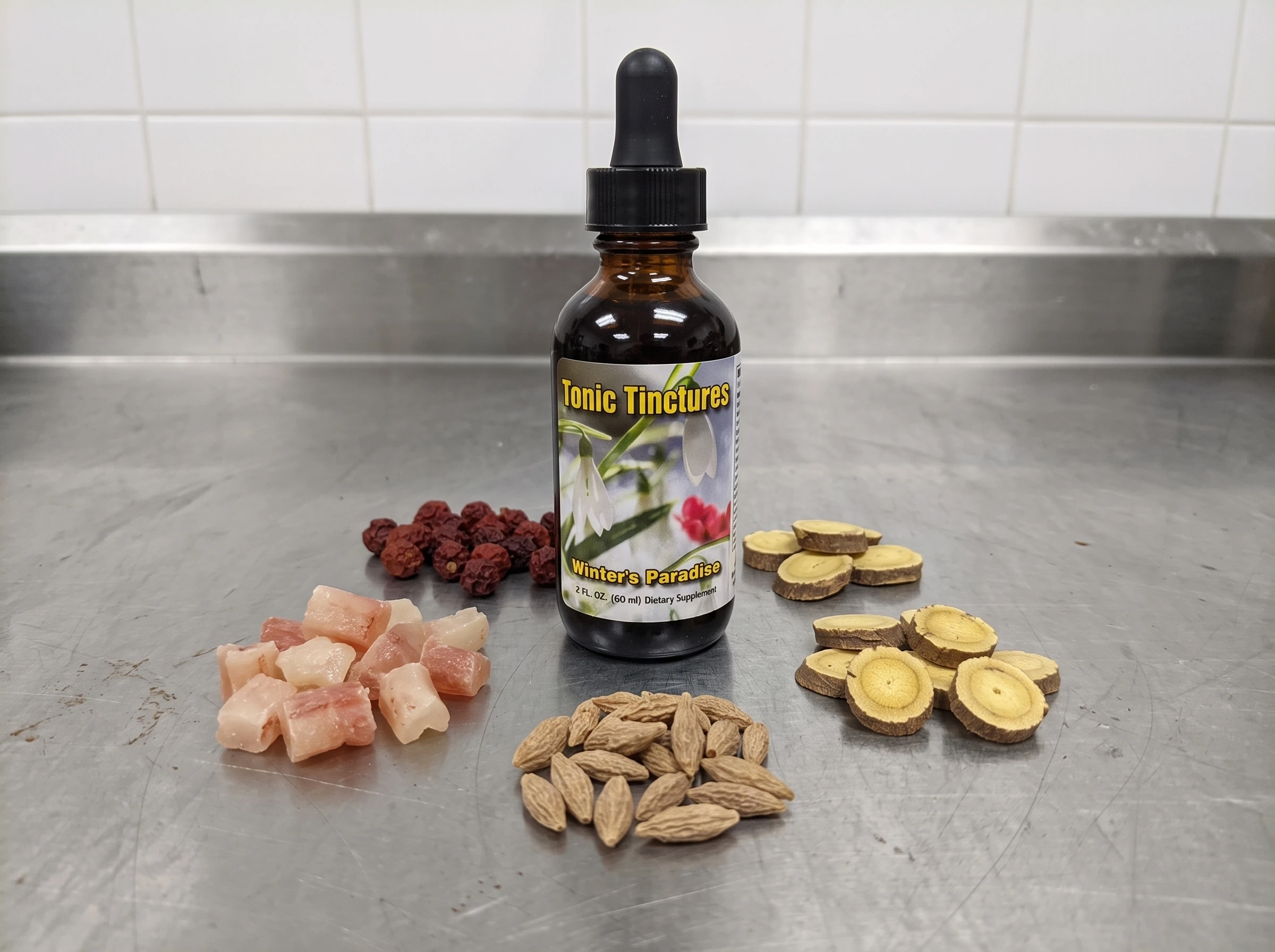
Here's the blend, stated plain. Eighty-five percent of it is two roots, Chinese asparagus root and ophiopogon root tuber. Those two roots are the formula. Then ten percent schisandra berry, and five percent Chinese licorice root to harmonize the whole thing. All four are classical Chinese tonic herbs, grown in China, inside the tradition that has used them continuously, in daily practice, for a very long time.
Now let me clear up the word everybody trips on, same as with any cooling formula. Cooling does not mean cold. It does not literally lower your body temperature, and it does not sedate you. In this tradition, cooling refers to grounding actions, constituents that work with the nervous system to anchor a calm, relaxed alertness. Settled, not sleepy. Steady, not chilled.
The signature constituents are the moisture-rich ones: the polysaccharides and saponins from those two main roots, the class of compounds that nourish your internal environment and help your tissues hold their hydration. That's the heart of what this bottle is, and the full chemistry gets its own piece in this series.
And the name. Here's the teaser: both of those main roots carry the word winter right inside their Chinese names. Two winter roots, eighty-five percent of the bottle. That's not a coincidence, and the full story gets its own piece in this series. It's worth the listen.
This is the moist, steady blend. The practice is what makes it work.
Benefits accumulate over time.
2. Where Does It Come From?
Where does Winter's Paradise come from? Short answer: China. Real answer: a tradition that has run on these exact herbs for centuries, plus a cold extraction process built to respect them.
The facts first, straight. Every herb in this bottle is a Chinese botanical, grown in China: Chinese asparagus root, ophiopogon root tuber, schisandra berry, and Chinese licorice root. And that origin is a quality statement, not a trivia note. China is the home ground of this tradition. Over in the East, these herbs are not niche wellness products; they are working material in everyday medical practice, stocked and dispensed the way this country stocks pharmaceuticals. The people who grew up inside the tradition are the people still using it daily. That's the level of continuous use behind every root in this bottle.
The blend itself is stated plainly on the label: eighty-five percent asparagus root and ophiopogon root tuber, ten percent schisandra berry, five percent Chinese licorice root. No filler herbs, no decorative dust. Two main roots carry the formula, and two supporting herbs finish it.
Then the extraction, built to respect the material. Custom crafted, multi-step, micro-batched, with structured distilled water and triple filtered USP grade organic alcohol at thirty percent by volume. The water pulls one class of constituents, the alcohol pulls the other, and the whole process stays cold, unheated, so the fragile moisture-rich compounds hold their shape in fluid suspension for maximum absorption.
The ratio is honest and heavy: one pound of herb to one quart of liquid, which works out to about twenty-eight thousand five hundred milligrams extracted into every two-ounce bottle. Nothing hidden, nothing dressed up.
And the taste tells on it. This extract comes out thick and dense, and that density is the fingerprint of the polysaccharides and saponins from those two main roots, held in suspension. The more you taste, the stronger it is. A clear, thin tincture tastes like exactly what it is: mostly nothing.
One history note, because people ask about the two main roots. Those two have been paired together in the classical tradition for a very long time, and the pairing has a name of its own. That story gets its own piece in this series, and it explains the name on this bottle.
Good roots, honestly sourced, carefully pulled. That's where it comes from.
Taken consistently over time.
3. What Does It Actually Do?
What does Winter's Paradise actually do in your body? Let me skip the list and give you one picture, because the picture is the mechanism.
A reservoir. It doesn't flood the system, doesn't drain it. It holds the level: a moist, calm, steady internal environment, kept that way while the world outside runs dry. And the rule underneath never moves: the botanicals supply the raw materials. Your body maintains the terrain.
Start with the respiratory system, because that's where the formula leads. The polysaccharides from asparagus root and ophiopogon are moisture-rich compounds, and they directly nourish the lung tissues, facilitating efficient gas exchange and maintaining clear and open airways. What that looks like in real life: breathing that stays easy and quiet, morning to night, even when the indoor air has gone bone dry.
Next, the skin, and here's a piece of old doctrine that explains why one formula serves both. In the classical Chinese tradition, the lung governs the skin. The old doctors classed the airways and the skin as one territory, the body's outer barrier against a dry world. The saponins in this blend supply the raw materials to maintain hydration and elasticity throughout the skin's natural barrier function, supporting skin vitality and a vibrant appearance. Airway moisture and skin moisture, one department, sorted centuries before chemistry confirmed both are barrier tissues.
Then the immune system. The schisandrins from schisandra berry nourish your white blood cells, giving them the nutritive support your body uses to identify foreign material, contain it, remove it, and keep tissue clean. A balanced, adaptive immune response, fed from the inside.
Then the steady-output layer. A synergistic blend of flavonoids promotes efficient energy metabolism, helping maintain physical endurance during exertion, while the trace minerals supply the cardiovascular system with the nourishment it uses to maintain the integrity and flexibility of your blood vessels. And at the cellular level, proteolytic enzymes facilitate the body's natural regenerative processes, working with your complete balanced meals to fortify your capacity for renewal and repair.
And the anchor through all of it: calm. The naturally occurring substances in Chinese licorice root work with the nervous system, grounding and cooling, cultivating relaxed alertness while everything else gets fed. The engine idles quiet while the reservoir holds.
Now the honest limit, because it comes up with every moisture formula. Drinking water provides the fluid, but your cells need structural integrity to hold it. Wet ground with no organic matter drains overnight; ground rich in material stays soft for days. The botanicals supply the materials the body uses to assimilate moisture and maintain cellular homeostasis. The water isn't optional. Neither is the material.
Supply, and maintain. Feed the terrain, and the body holds it.
Benefits accumulate over time.
4. Who Is It For?
Who is Winter's Paradise actually for? Let me tell you who buys it, because it's not who the marketing usually points at. This is the humidifier-and-carry-on bottle. The blend for people who run hot and live dry.
The high-stress buyer, first, because that's the flagship. Chaotic days, dealing with people constantly, mental and emotional balance draining hour by hour. This blend supplies grounding, cooling and calming constituents that work with the nervous system to maintain relaxed awareness while the day keeps coming. The bottle ends up in the bottom desk drawer, right next to the keyboard, and the four o'clock wired feeling stops being a scheduled event.
The beauty buyer, next. Skin upkeep is difficult when the internal environment is depleted, and no cream repaints a wall built from thin material. The saponins provide the raw materials to nourish from within, maintaining the hydration and elasticity of the skin's natural barrier function. The bottle sits on the bathroom vanity, next to everything that only works from the outside.
The traveler and the mountain crowd. Airline cabin air runs drier than most deserts, and thin air at elevation makes the lungs work double. The moisture-rich polysaccharides nourish the lung tissues, facilitating efficient gas exchange and maintaining clear and open airways. This one rides in the top pocket of the pack.
The immunity buyer. Crowded offices, planes, gatherings, the body constantly filtering whatever the room is carrying. The schisandrins nourish the natural defense mechanisms, enabling the white blood cells to identify foreign material, ensure containment and removal, and maintain tissue cleanliness. The bottle lands in the medicine cabinet, and it earns the spot.
Then the quiet-practice crowd, and this one deserves its say. The yoga practitioner, stretching stiff muscles and holding poses, needing steady physical mechanics and steady breathing: the botanicals work synergistically to ground the internal environment, easing tension and promoting the structural integrity that mindful movement runs on. And the meditation crowd, sitting still, quieting the brain, tuning out noise: these adaptogenic herbs anchor the body, cultivating a quiet sense of calm and a vivid, focused experience of life. The blend for people whose practice is stillness.
Two more, stated briefly. The convalescent, getting strength back after a stretch of hard exertion: the formulation supplies essential vitamins, minerals, and proteolytic enzymes to promote natural regenerative processes and fortify the capacity for renewal and repair. And the sage, aging well and staying sharp: vital nourishment and essential trace minerals to maintain cellular health and longevity, supporting the brain's natural resilience.
Now the honest redirect, because it matters with cooling blends. If you run cold, if you want fire and drive and ignition, this is not your bottle; the warming roots are the honest answer, and plenty of people keep both and take them at different times of day. Right blend, right constitution. And the seasonal honesty: grounding and cooling works year round, but the dry, heated months of winter are where it shows up most obvious.
Taken consistently over time.
5. How Do You Take It?
Tonic Synergy & Timing: We remind you that with consistent use, benefits accumulate over time.
For rapid mucosal assimilation, take it on an empty stomach (up to 30 mins before eating), followed by a complete balanced meal to provide the heavy building blocks (proteins/fats) required for sustained physical form and long-term building benefits.
This is Winter's Paradise liquid extract, the general-use tonic blend in a two-ounce bottle with sixty dropper servings.
One dropper is one press of the rubber bulb, which fills the dropper tube to just above half-way. That's thirty drops, which is also one milliliter.
To find a functional dose, start with a minimum dose of ten drops to one dropper and work up. We suggest ten drops to one to three droppers, taken one to three times per day, which is one hundred sixty to four thousand five hundred milligrams daily.
Now, the bottle has two jobs, and it's worth knowing both. For immediate impact, hold one to two droppers under the tongue, sublingually, for fifteen to thirty seconds. Longer isn't necessary. For tonic building, to continually saturate your system and build deep, long-term health, take one to two droppers with meals, or up to two to three droppers with your largest meal.
Shake gently. Secure the lid and turn the bottle over back-and-forth three to five times to evenly distribute the liquid extract. Vigorous shaking oxidizes the volatile constituents, so don't do that.
By mouth: hold the liquid under the tongue for sixty to ninety seconds before swallowing, or mix the drops into two to four ounces of lukewarm drinking water. Never boiling water. Boiling water alters the delicate volatile compounds.
Timing, plain and simple. For rapid mucosal assimilation, take it on an empty stomach, up to thirty minutes before eating, followed by a complete balanced meal to provide the heavy building blocks, the proteins and fats.
One practical note, because it catches people off guard. This extract comes out thick and dense, and that density is the fingerprint of the polysaccharides and saponins in suspension. That's normal, not a defect.
If it didn't sit right, try again at a lower dosage and with a complete meal.
Some effects are immediate within the first few days. Consistency at a functional dose is what builds the rest.
6. How Long Until You Notice Results?
How long until you notice something from Winter's Paradise? Most-asked question about any tonic, so here's the straight answer, in three windows.
Some effects are immediate within the first few days, one to three days. That's the felt layer. The subtle settling, the sense of staying level when the day gets loud, breathing that stays quiet. Subtle is the honest word for a grounding blend, and subtle is not the same as nothing.
Other effects and benefits are building, and become noticeable within one to two weeks. The skin that stops feeling tight. The steadier afternoon. The mood that stays level. The deeper work doesn't announce itself. It stacks up underneath, quietly, while you go about your life.
Then the long game. The systemic shifts and the deep benefits arrive as you continuously saturate your body over a thirty to ninety day cycle. That's how every tonic works. You're feeding a system that puts materials to use on its own schedule. The body doesn't take orders. It takes deliveries.
A good tonic cycle is thirty to ninety days. That's not a sales line; that's just how tonics work. A tonic is a practice, not an event.
And you gotta take enough to make it work. The more you take, the better it works, up to what your body can put to use at any one time. Enough is the target, and consistency is the vehicle that gets you there.
Nothing is a quick fix. Anyone selling a quick fix in a bottle is selling snake oil. Tonics reward time, not dosage.
And keep the foundation under all of it: complete balanced meals, every time. Skipping meals and eating incomplete meals will lead to ineffective results. The tonic rides on food; it doesn't replace it.
Benefits accumulate over time.
7. Safety and Quality
Is Winter's Paradise safe, and how do you know you're getting a quality bottle? With this blend, those are the same question, and the answer isn't a promise printed on a label. It's the honesty of the formulation, the sourcing, and the craft.
Start with the markers that matter, stated straight. Formula named: eighty-five percent Chinese asparagus root and ophiopogon root tuber, ten percent schisandra berry, five percent Chinese licorice root. Nothing else in the bottle. Source named: China, the home ground of the tradition, where these exact herbs are working material in everyday medical practice. The tradition that grew these herbs is the tradition that still uses them daily. That's quality control measured in centuries of continuous use.
Then the craft. Custom crafted, multi-step, micro-batched. Structured distilled water and triple filtered USP grade organic alcohol at thirty percent by volume, cold processed so the fragile moisture-rich constituents hold their integrity in fluid suspension for maximum absorption. The ratio is honest and heavy: one pound of herb to one quart of liquid, about twenty-eight thousand five hundred milligrams in every two-ounce bottle. Rapid, high bioavailability, and the full extraction and lab methods are published on our standards page, if you want to see exactly how the work gets done.
And your own tongue is the lab. A real extract of these roots comes out thick and dense, and density is the fingerprint of the polysaccharides and saponins in suspension. The more you taste, the stronger it is. A clear, thin tincture is mostly what it tastes like: mostly nothing.
Now, honest use, plain and simple. These botanicals are food added to the diet, suitable for daily use, and generally this formulation may be taken with other dietary supplements. As food added to the diet, it works synergistically with other formulations and with your complete balanced meals underneath.
One piece of doctrine to keep the whole thing straight. Herbs are always more effective and more powerful in the long-term for supporting health, whereas drugs are always more effective and more powerful in the short-term for treating diseases, conditions, and any emergencies. Do not use an herb when one should use a drug, and do not use a drug when one should use an herb. Each has its own job, and this bottle's job is the long term.
And the price. You shouldn't pay mystique prices for classical tonic herbs, because this is a real herbal tradition with a real market behind it, not some rare treasure. Pay for the roots and the craft, not for the story.
Be the Best and Buy the Best.
It is important to do your own research. Health is the most valuable asset of one's life and the most valuable investment.
8. The Name
Where does the name Winter's Paradise come from? That question has the best answer in the whole catalog, and it's hiding in plain sight on the label. Let me walk it, because once you see it, you can't unsee it.
Start with the two main roots, the eighty-five percent. Chinese asparagus root goes by the name tian men dong in Chinese. The characters read, piece by piece, as heavenly gate winter sprout. Conventionally: heavenly winter. Then ophiopogon root tuber, mai men dong, which reads as wheat gate winter sprout. Two different plants, two different root shapes, and the same word sitting in both names: winter.
Sit with that one a second. Eighty-five percent of this bottle is two roots that are both literally named winter in the language of the tradition that uses them. The name on the bottle isn't a mood, isn't a marketing snowfall. It's the contents, stated in Chinese. Two winter roots.
And the tradition got there first, centuries ago. There's a classical formulation called er dong gao, which translates as Two Winters Paste: asparagus root and ophiopogon root, the two winters, simmered together into a dense nourishing paste. It's one of the old standard moistening formulas of the tradition, and the core of Winter's Paradise is exactly that classical pairing, extracted cold instead of simmered. The blend isn't a novelty. It's a classical pairing in modern craft.
Now, why winter? In the classical tradition, winter is the storage season, the yin season, the time when living things draw inward, conserve, and build their reserves against the spring to come. And these two roots class as moistening, nourishing tonics, the class the tradition reaches for to replenish the deep, quiet, moist reserves. Paradise in the name is the promise: the well-watered internal environment in the season when everything outside is frozen and parched.
The supporting herbs finish the story. Schisandra berry is wu wei zi, five flavor seed, the one material in the classical materia medica said to carry all five flavors at once: sour, bitter, sweet, acrid, and salty. One berry, the whole language. And Chinese licorice is gan cao, sweet grass, the great harmonizer, appearing in more classical formulas than any other herb in the tradition, the guide that blends a formula's parts into one voice. Five percent of it here, doing its ancient job.
Last piece of doctrine, and it ties the whole formula together. The classical texts call the lung the tender organ, the first touched by dryness, the one that loves moisture and hates drought. And the lung governs the skin: the airways and the skin are one territory, the body's outer barrier against the dry world. That's why this one blend serves breathing, skin, calm, and immunity together. The old doctors drew the map that way centuries ago, and this modern label still follows it.
The name is the formula. Two winter roots, and the moist season they build inside you.
Taken consistently over time.
9. Real World Use
What does using Winter's Paradise actually look like? Let me walk you through the calendar and the carry-on, because this blend earns its keep at very specific moments, and once you know them, the bottle stops being a mystery.
The January apartment, first, because it's the signature scene. Radiator hissing all night, humidifier bone dry by morning, and you wake with a scratchy throat and tight skin. Heated indoor air in deep winter runs as dry as desert air. That's the physics, not a feeling. The moisture-rich polysaccharides from those two winter roots nourish the lung tissues and maintain clear and open airways, and the saponins supply the raw materials your skin's barrier uses to hold its hydration. This blend in January is the counter-season. That's the paradise in the name: the moist internal environment while the world outside is frozen and parched.
The flight. Recycled cabin air at altitude runs drier than most deserts, and plenty of travelers land with a tight chest and a scratchy voice. The bottle rides zipped in the carry-on, and the polysaccharides keep the respiratory side nourished through hours of desert-dry air.
The trailhead. Thin air at elevation makes the lungs work double for every step, and the body notices. Same mechanism, mountain edition: nourished lung tissues, efficient gas exchange, breathing that holds its rhythm on the climb.
The four o'clock desk. Back-to-back meetings, people all day, the wired, drained feeling that shows up when the calendar finally empties and the nervous system doesn't. The grounding, cooling and calming constituents work with the nervous system to hold relaxed awareness instead of riding every wave. The bottle sits in the desk drawer, and the evening stops paying for the afternoon.
The quiet practice. The yoga mat and the meditation cushion, same territory: held poses, long slow breaths, a brain that won't settle down. These adaptogenic herbs anchor the body, easing tension and cultivating a calm, vivid focus. The practice and the blend want the same thing: a settled floor to work from.
And the comeback. Getting strength back after a long season of hard exertion, life emptying the tank. The formulation supplies essential vitamins, minerals, and proteolytic enzymes to promote natural regenerative processes and fortify the capacity for renewal and repair. The rebuild runs on deliveries, and this is one of them.
Underneath every scene, the same rules. Complete balanced meals, every time, because the materials only build on fuel. Enough at a functional dose, held consistently, over a thirty to ninety day cycle. The scenes are where the bottle comes out. The cycle is where the benefits live.
Real life runs dry and loud. The blend holds the moist, steady middle.
Taken consistently over time.
Commit to the Practice
Tonic herbalism rewards consistency. The deep, systemic building work happens quietly over a 30 to 90-day cycle of continuous saturation. Supply the raw materials your body needs with our premium 3-pack.
Shop the 3-Pack Formulation